
 Base
Base Unichain
 Robinhood
Blockchain transparency has long been its greatest asset and its biggest barrier to institutional adoption. Existing privacy solutions, such as Zero-Knowledge Proofs (ZKPs), work well for isolated transactions but fail when applied to shared state systems (like DeFi liquidity pools). Fully Homomorphic Encryption (FHE) addresses this fundamental limitation by allowing mathematical computations directly on encrypted data without ever decrypting it.
This article explores the mechanics of FHE, compares it to alternative cryptographic methods, addresses performance bottlenecks, and explains why FHE is poised to become the ultimate standard for privacy in Web3.
The Transparency Dilemma of Public Ledgers
The core premise of public blockchains is absolute data transparency. Every participant can inspect any wallet balance, transaction history, and smart contract state. While this transparency fosters trust, it makes public networks unusable for commercial applications where confidentiality is a critical business requirement. Pseudonymity no longer provides protection.

Modern blockchain analytics platforms easily link on-chain addresses to real-world identities using data clustering and exchange tracking. Proprietary trading strategies, corporate cash flows, and treasury balances are exposed to competitors in real time. To attract traditional financial institutions and institutional capital to decentralized ecosystems, robust privacy is indispensable.
The industry must find a technological solution that conceals transaction details while maintaining decentralized consensus and operational auditability.
Understanding the Mechanics of FHE
Traditional encryption algorithms (like AES or RSA) secure data only in transit or at rest. To compute, the server must decrypt the data, exposing it to potential memory exploits or malicious hosts. Fully Homomorphic Encryption (FHE) changes this paradigm by allowing mathematical computations directly on ciphertexts.

The output remains encrypted and can only be decoded by the private key holder. The server processes the inputs without ever learning what values they represent. This is best explained by the analogy of a transparent, locked glove box. You place gold inside the box and hand it to a jeweler.
Using built-in rubber gloves, the jeweler shapes the gold into a ring but cannot open the box or retrieve the metal. The locked box is returned to you, and you open it with your private key. The jeweler completed the work without ever having direct physical access to the gold.
This is precisely how an FHE node processes encrypted user data.
The Evolutionary Path: From Theory to Practice
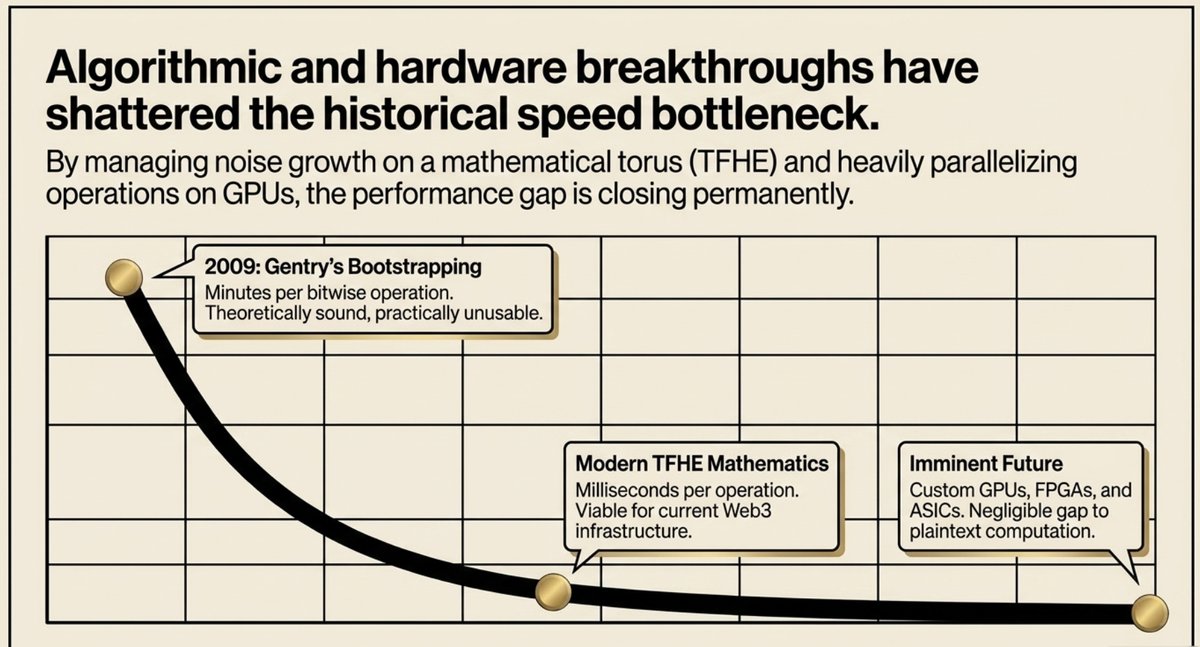
Proposed in 1978 by the inventors of RSA, homomorphic encryption remained a theoretical challenge for decades. Early designs were only Partially Homomorphic (PHE), supporting either only addition or only multiplication, but not both. Without both operations, running arbitrary algorithms on ciphertexts is impossible. A major breakthrough occurred in 2009 when IBM researcher Craig Gentry proposed the first Fully Homomorphic Encryption (FHE) scheme.
Gentry introduced a method called bootstrapping to manage mathematical noise that accumulates during homomorphic operations. Bootstrapping resets the noise level, enabling infinite computations. However, Gentry's initial scheme was extremely slow, taking minutes for a single bitwise operation. For years, FHE remained computationally impractical, prompting research to focus on reducing bootstrapping overhead.
Why ZKPs Struggle with Shared State
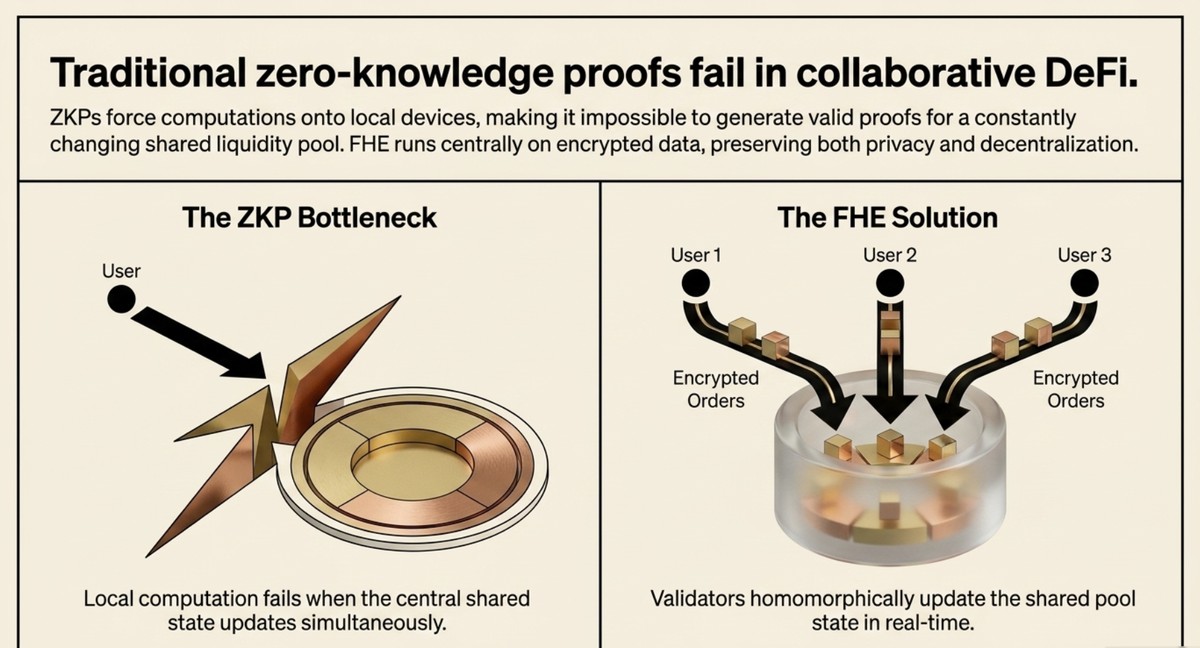
Zero-Knowledge Proofs (ZKPs) have dominated blockchain privacy, allowing users to prove statements without revealing data. While ZKPs are powerful, they struggle with shared state systems. In ZK-based networks, computations occur on the user's local device. The user calculates their new private balance, generates a proof of correctness, and submits it.
Validators verify this proof. This works well for isolated transactions, but fails in collaborative DeFi. In an automated market maker (AMM) like Uniswap, the liquidity pool is a shared resource. Asset prices depend on the pool's ratio, which changes with every user's trade. Under ZK privacy, a user cannot know the current state of the pool beforehand to generate a valid proof locally.
This forces a trade-off between privacy and decentralization. FHE solves this. Since computations run on encrypted data on the validator side, users simply submit encrypted orders. Validators homomorphically update the pool's shared state and user balances in encrypted form. Privacy is maintained without sacrificing decentralization.
Architectural Trade-offs: FHE vs. MPC vs. TEEs
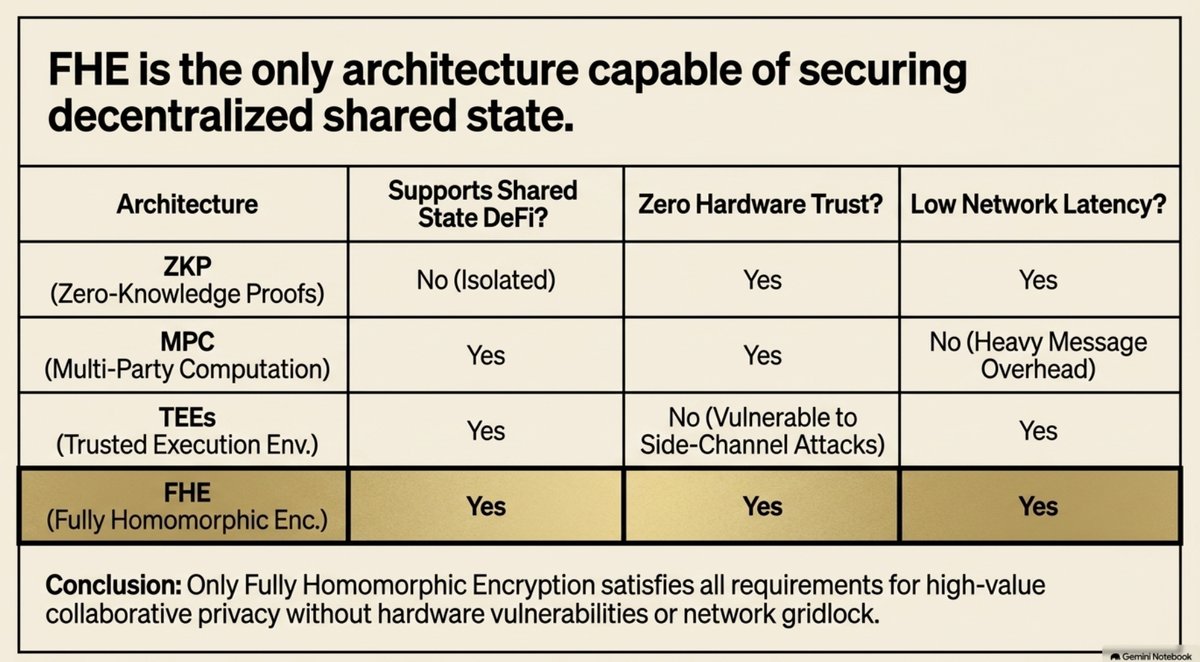
Aside from FHE and ZKPs, developers have explored Trusted Execution Environments (TEEs) and Multi-Party Computation (MPC), but both have major drawbacks. TEEs, like Intel SGX, rely on hardware-level isolation to process data in secure CPU enclaves. TEEs are fast and cheap, but hardware is vulnerable to side-channel attacks.
Exploits like Foreshadow and SGXpectre have shown that attackers can extract private keys from enclaves. Relying on manufacturer hardware security for high-value blockchains is a substantial risk. MPC distributes computations across independent servers. No single server sees all the data, but they compute the result collectively.

However, MPC requires heavy network communication. Nodes must constantly exchange messages during execution, causing latency bottlenecks as the network grows. FHE, by contrast, runs locally on a single server without network roundtrips, offering superior scalability.
Real-world FHE Use Cases in Web3
Integrating FHE into blockchain architecture enables a new class of confidential decentralized applications. Confidential smart contracts hide user balances and contract execution logic. In DeFi, this allows credit protocols to assess creditworthiness automatically using encrypted collateral, without exposing a user's financial history to third parties.
MEV (Maximal Extractable Value) protection is another critical application. In public mempools, front-running bots exploit pending transactions. An FHE-encrypted mempool hides transaction details until they are executed on-chain, eliminating front-running and ensuring fairer execution for retail traders. Private DAO voting also benefits. Participants vote using encrypted balances, and the smart contract aggregates the votes homomorphically.
Only the final result is revealed, preventing collusion and voter manipulation.
Overcoming the Performance Bottleneck
The historical objection to FHE was its speed. Early schemes were billions of times slower than standard operations. Modern optimizations are rapidly closing this gap. Specialized schemes like TFHE (Torus FHE) have reduced bootstrapping times to milliseconds. TFHE manages noise growth by representing data on a mathematical torus, which simplifies the underlying arithmetic.
Hardware acceleration is key to industrial scaling. Developers are building custom accelerators using GPUs, FPGAs, and ASICs. High-performance GPUs parallelize thousands of homomorphic operations, improving speed by orders of magnitude. Upcoming FHE ASICs will soon reduce the performance gap to a negligible margin.
Compliance and Regulation in an Encrypted World
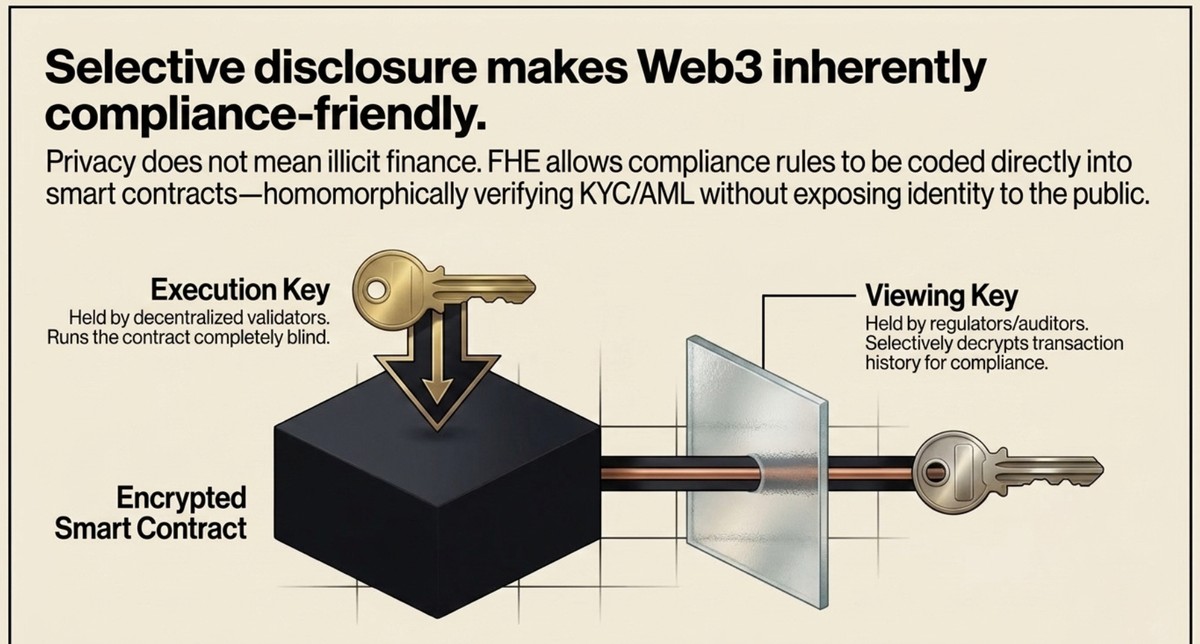
Regulators are traditionally skeptical of crypto privacy tools, often associating them with illicit finance. FHE, however, offers a compliance-friendly alternative. Its mathematical properties support selective disclosure. Users can provide auditors with a viewing key that decrypts transaction histories without giving up control of their funds.
Additionally, compliance rules can be coded directly into encrypted smart contracts. For instance, a contract can homomorphically verify that a sender is not on a sanctions list before executing the transaction, without revealing the user's identity to validators.
This allows protocols to maintain KYC/AML compliance while preserving public privacy. Real-world applications are emerging. Integrations like the Zama FHE token demonstrate how Zama's cryptographic solutions are entering regulated fintech ecosystems. This shows that cryptographic privacy can coexist with strict regulatory standards in mainstream finance.

The FHE Venture Capital Landscape
Venture capital interest in FHE is growing rapidly, with investors identifying homomorphic encryption as the foundation of Confidential Web3. French startup Zama is a central player, offering open-source libraries like fhEVM, which enables encrypted smart contracts in EVM networks. Zama's major funding rounds reflect strong industry confidence in FHE infrastructure.
Other projects, such as Fhenix and Inco Network, are building Layer 1 and Layer 2 blockchains with native FHE support. They offer developers standard environments to build confidential applications. Rising valuations indicate that the FHE infrastructure layer is nearing production readiness.
Conclusion: The Future of Decentralized Privacy
Fully Homomorphic Encryption represents a paradigm shift in blockchain privacy, moving data protection from hardware assumptions to mathematical proofs. FHE resolves the tension between public transparency and corporate privacy. It allows the ledger to remain decentralized and auditable while keeping transactions confidential. As hardware accelerators and algorithms advance, FHE will become a standard component of Web3. It will not only secure DeFi but also pave the way for institutional capital to enter the decentralized economy, establishing privacy as the default state for digital finance.