 Base
Base Unichain
 Robinhood
Flash loans have redefined capital efficiency in DeFi by allowing collateral-free, single-transaction borrowing. However, they have also become the primary tool for executing complex attacks on price oracles. Traditional defenses like Time-Weighted Average Price (TWAP) struggle with price latency, creating profitable arbitrage windows during volatile market conditions.
This article analyzes the anatomy of oracle exploits, details why legacy oracle architectures fail, and examines how next-generation first-party oracle designs secure liquidity pools on emerging Layer-2 platforms.
The Anatomy of Flash Loans: Infinite Capital in a Single Block
The introduction of flash loans by protocols like Aave marked a paradigm shift in leverage. In traditional finance, obtaining credit is a slow process requiring borrowers to present collateral and wait for approval. In DeFi, any user with basic smart contract skills can borrow millions of dollars without collateral, provided the assets are returned within the same transaction execution.
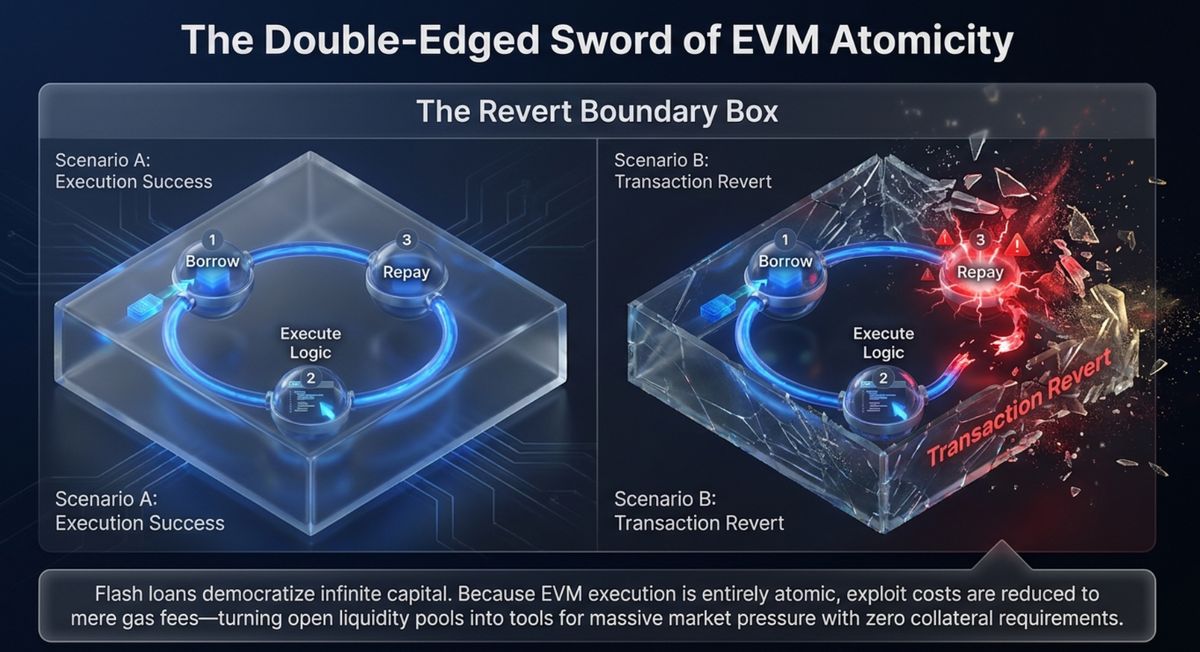
This unique mechanism relies on the atomicity of transactions in the Ethereum Virtual Machine (EVM) and other compatible execution environments. A blockchain transaction is a series of state changes that either succeeds entirely, moving the state from one stable point to another, or reverts completely if any condition fails at any point during execution.
A borrower pulls assets from a liquidity pool, channels them through multiple smart contracts to execute arbitrage trades or liquidate debt, and returns the principal plus a small fee to the lender in the final step of the same transaction. If the borrower cannot return the funds by the end of the transaction execution, the entire sequence is rolled back, leaving the blockchain as if the transaction never existed.
Technically, a flash loan executes via a callback to the borrower's contract, allowing complex routing and arbitrage in one atomic transaction. While this maximizes capital efficiency, it also democratizes market manipulation. Attackers do not need their own capital; flash loans reduce exploit costs to simple gas fees, turning massive pools into tools for market pressure.
The Core Dependency: Why DeFi Smart Contracts Live and Die by Oracles
Smart contracts are deterministic state machines that cannot independently query external data. Blockchains cannot query web APIs directly due to the consensus model, where every node must reach the exact same state independently during block validation. To bridge this gap, DeFi applications rely on price oracles - specialized middleware that retrieves market data from off-chain sources and writes it to the blockchain.
In DeFi, oracles act as critical infrastructure. Lending platforms rely on them to calculate collateral ratios and trigger liquidations, synthetic protocols use them to price derivatives, and AMMs leverage them to prevent frontrunning and balance liquidity. Inaccurate or delayed oracle data exposes protocols to immediate risk.
If a feed reports an inflated collateral price, a user can borrow excessive stablecoins and default, leaving the system undercollateralized. Consequently, DeFi security depends entirely on oracle freshness and integrity.
The Mechanics of Manipulation: Deconstructing Spot Price Attacks
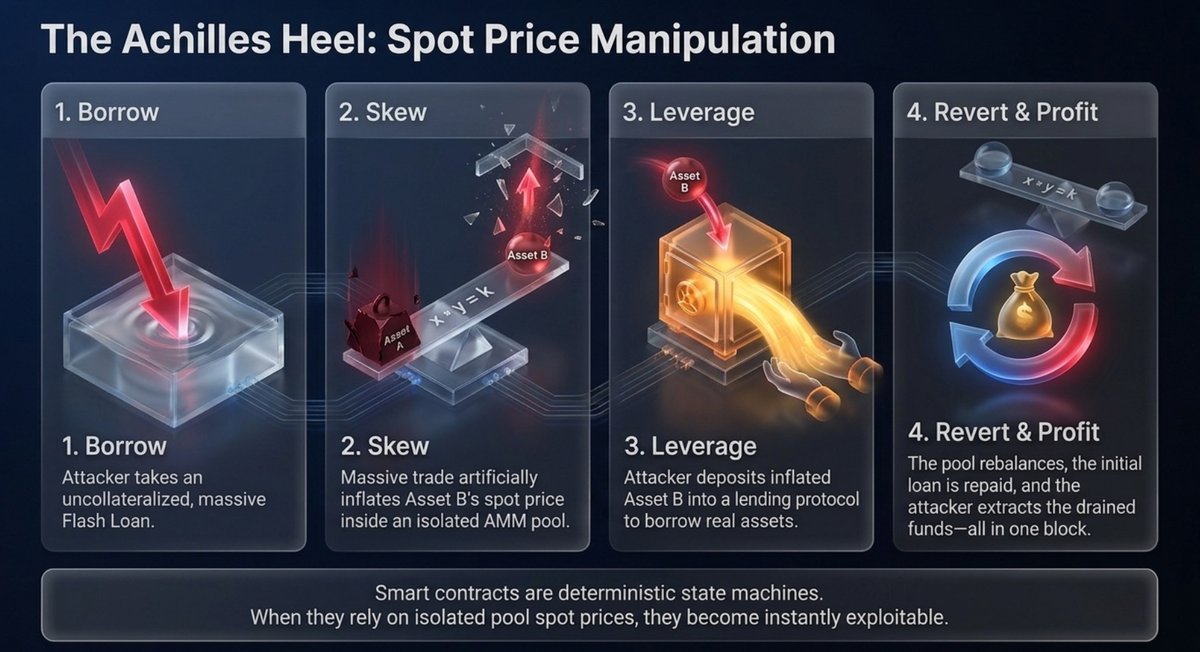
A majority of flash loan exploits target spot price calculations on decentralized exchanges (DEXs). Many early DeFi protocols queried the spot price directly from a single automated market maker (AMM) pool, which relies on formulas like the constant product market maker (x \* y = k).
In a typical exploit, an attacker borrows a large amount of Asset A via a flash loan and swaps it for Asset B in a specific pool. This massive trade skews the pool's asset ratio, causing severe slippage and inflating the price of Asset B inside that pool, while its price elsewhere remains unchanged.
The attacker then deposits a small amount of Asset B into a lending protocol that relies on that pool's spot price, borrowing a larger amount of another asset against the inflated collateral. Finally, they reverse the swap to restore the pool's balance, repay the loan, and keep the profit, all within a single block.
The Failure Modes of Traditional Oracles: Latency, TWAP, and Node Collusion
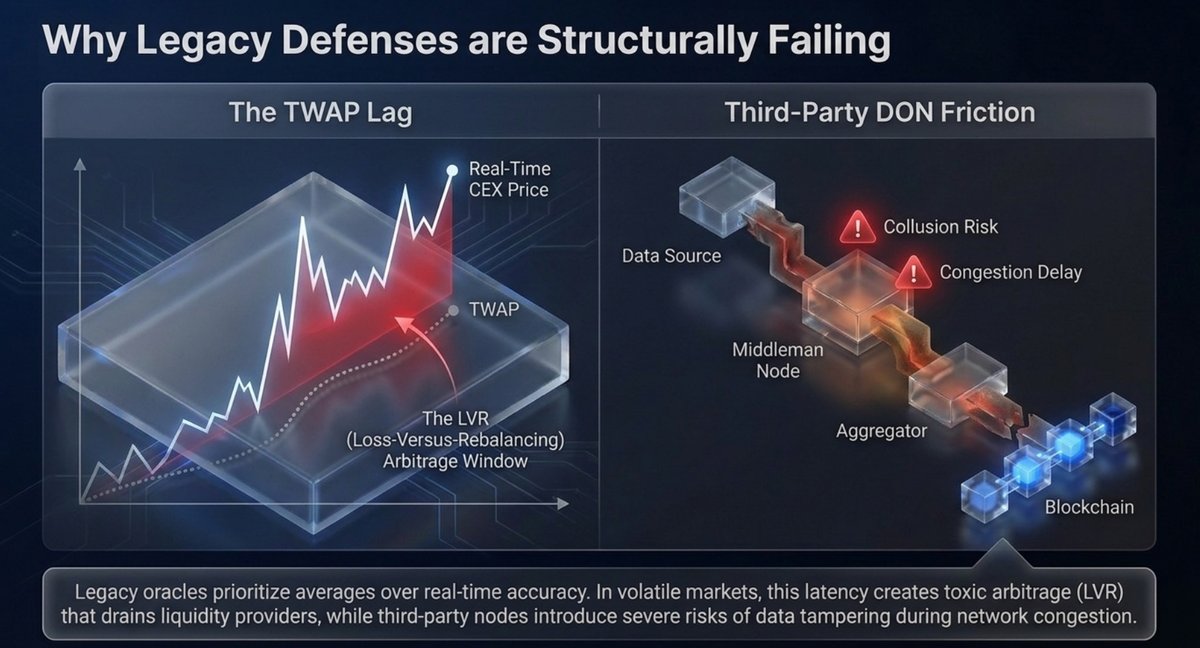
To prevent spot price manipulation, developers adopted Time-Weighted Average Price (TWAP) feeds. TWAP calculates the average price of an asset over a set period, such as 30 minutes. This mitigates single-transaction manipulation, as an attacker would have to maintain the price skew over multiple blocks, incurring unsustainable arbitrage costs from external arbitrageurs.
However, TWAP introduces price latency. During high-volatility events, the on-chain TWAP lags behind real-time prices on CEXs. This lag creates room for toxic arbitrage, known as loss-versus-rebalancing (LVR), which drains value from liquidity providers. Essentially, liquidity providers bear the cost of slow oracle adaptation to global market movements, as arbitrageurs exploit the price difference before the pool updates.
Another vulnerability lies in the node operator model. Traditional decentralized oracle networks (DONs) rely on third-party node operators. These operators scrape data from APIs, aggregate it, and push it to the blockchain. This multi-layered structure increases transaction delays and gas costs. It also introduces security risks, such as node operator collusion or data tampering during transmission.
In extreme cases, third-party operators can censor transactions or delay updates during network congestion, leaving protocols exposed to severe exploits.
Next-Generation Architecture: First-Party Oracles and dAPIs
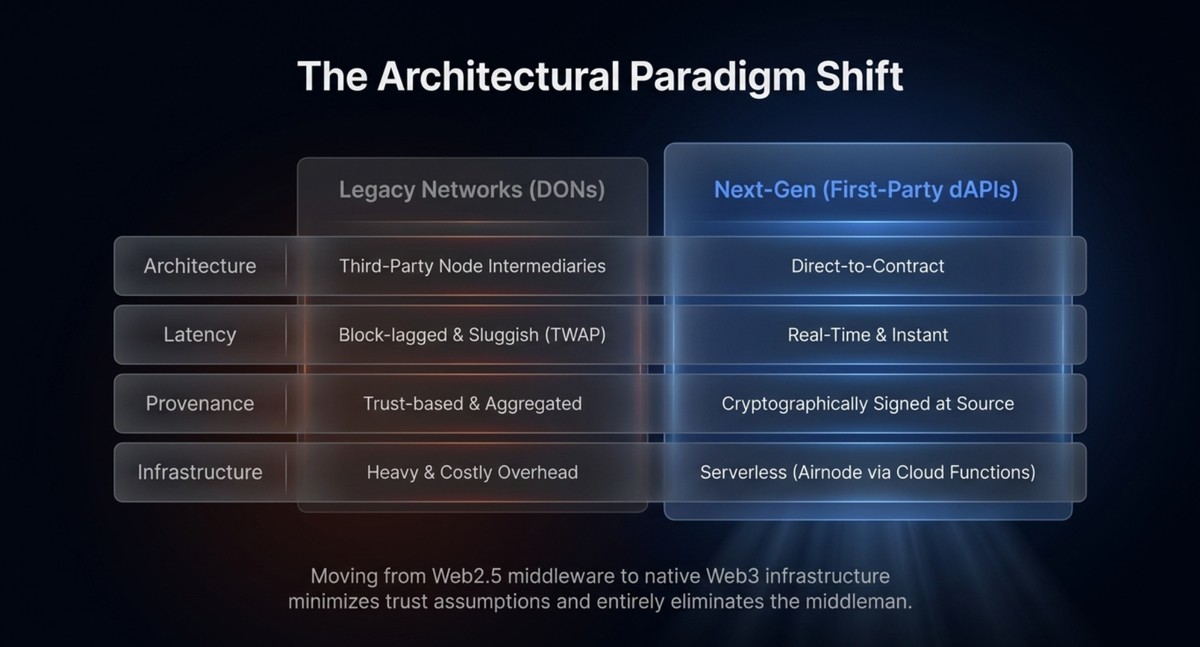
Modern DeFi protocols require oracle architectures that minimize latency and overhead. A prominence solution is the first-party oracle model, pioneered by API3. Instead of relying on third-party intermediaries, first-party oracles connect API providers directly to the blockchain. Data providers - including institutional crypto exchanges, market makers, and financial aggregators - run their own Airnode oracle nodes.
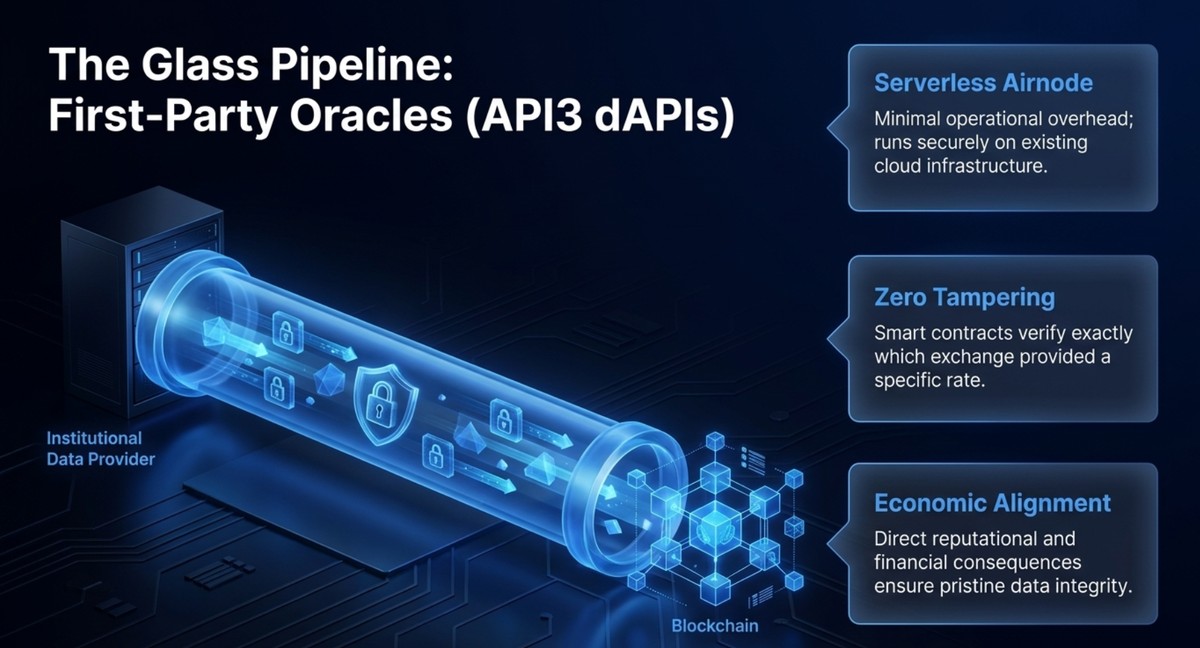
This removes the middleman layer, reducing data transmission latency and gas consumption. These direct, on-chain price feeds are known as dAPIs. Airnode is designed as a serverless node running on cloud infrastructure (like AWS Lambda or Google Cloud Functions), ensuring high reliability and minimal operational overhead for the data providers.
By having the data source cryptographically sign every data point, first-party oracles provide verifiable provenance. Smart contracts can verify exactly which exchange provided a specific rate. This eliminates the risk of intermediary data manipulation and enhances protocol resistance to flash-loan-assisted attacks. First-party providers also face direct reputational and financial consequences, creating a strong economic alignment to publish accurate data.
Neutralizing Oracle Extractable Value (OEV) to Protect Liquidity
With the rise of Maximal Extractable Value (MEV) on Layer-2 networks, a new subcategory of value leakage has emerged: Oracle Extractable Value (OEV). When an oracle updates an on-chain price, the update often creates arbitrage opportunities or enables liquidations. MEV searcher bots compete to execute transactions immediately after the price update, paying high gas fees to validators.
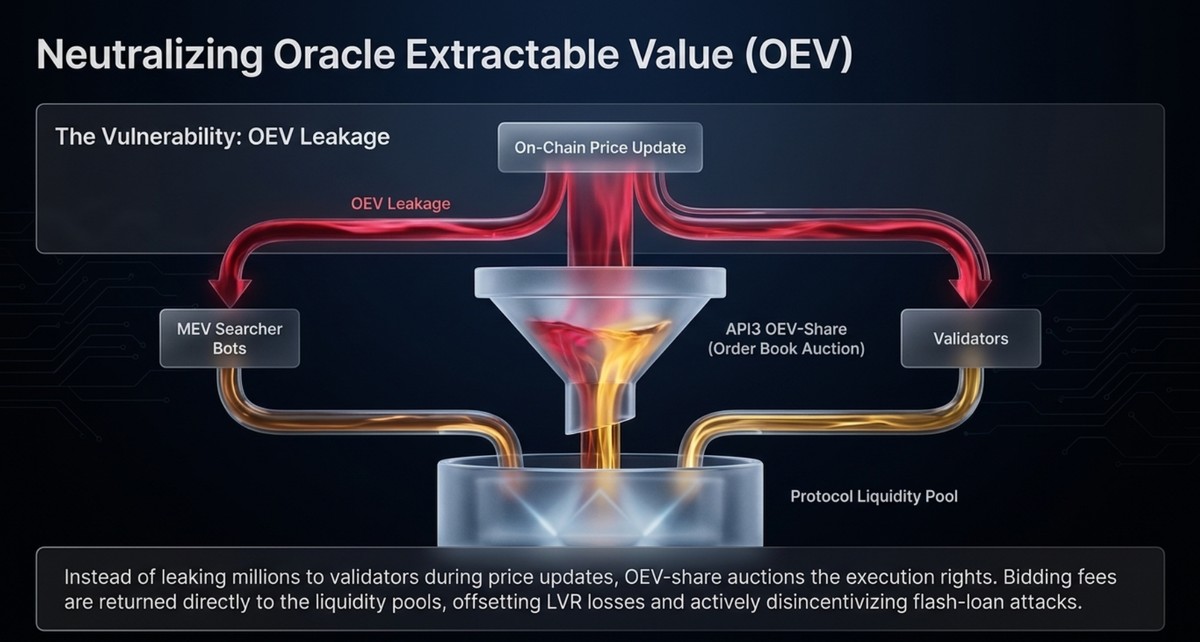
This competition leaks millions of dollars from DeFi protocols to validators, harming long-term liquidity providers. To reclaim this capital, API3 introduced the OEV-share mechanism. OEV-share enables protocols to auction the execution rights of oracle updates. Instead of allowing validators to capture this value, searchers bid for the right to update the oracle through a dedicated order book.
The bidding fees are returned directly to the liquidity pools of the affected protocol. This offsets LVR losses, reduces the profitability of arbitrage exploitation, and disincentivizes flash-loan attacks.
Practical Application: Securing the Next Wave of L2 Networks
As Layer-2 ecosystems like Unichain gain traction, oracle security requirements become even more stringent. Unichain is optimized for high transaction throughput and low fees, making it a hub for DeFi activity. However, sub-second block times also mean that malicious actors can execute rapid, complex transactions with minimal cost.
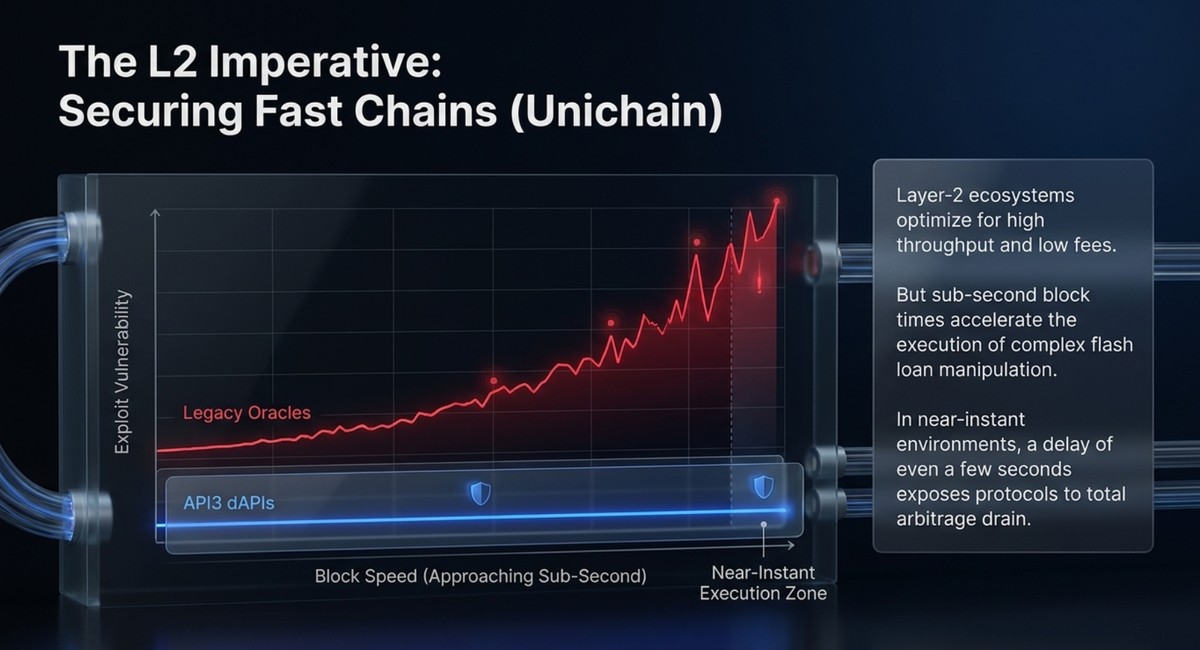
In this environment, relying on legacy oracles with high latency is a significant risk. Fast block execution accelerates the potential for flash loan manipulation. Comprehensive Unichain oracle security depends on integrating oracle systems that offer real-time updates while capturing and returning OEV to the underlying protocols.
In L2 environments with near-instant blocks, a delay of even a few seconds can expose a protocol to significant arbitrage drain. Integrating API3 dAPIs on Unichain gives developers access to direct, low-latency price feeds from first-party sources. This setup prevents spot price manipulation in AMM pools and ensures that price updates do not leak value to external validators.
The result is a robust, self-securing liquidity environment that reduces the feasibility of flash loan exploits.
Conclusion: The Path to Institutional-Grade DeFi Security
The DeFi sector is moving away from basic security models that rely on simple averages or assumptions about market participants. Developers now recognize that any open liquidity pool is a potential target for flash loan manipulation, requiring active, systemic risk management at the infrastructure level.
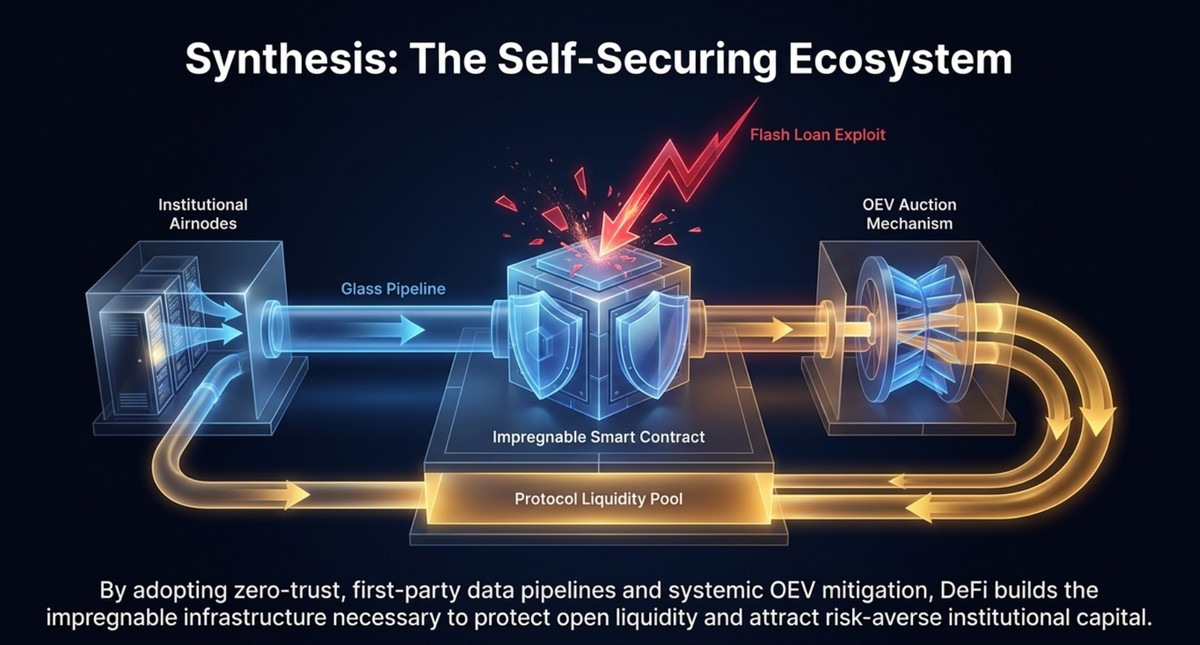
Transitioning to first-party oracle networks and implementing OEV-share mitigation represent crucial steps forward. By securing liquidity pools against atomic price manipulation and toxic arbitrage, DeFi can build the trust necessary to attract risk-averse institutional capital. The future of decentralized finance relies on infrastructure maturity, where every layer is optimized to minimize trust assumptions and maximize capital protection.