
 Base
Base Unichain
 Robinhood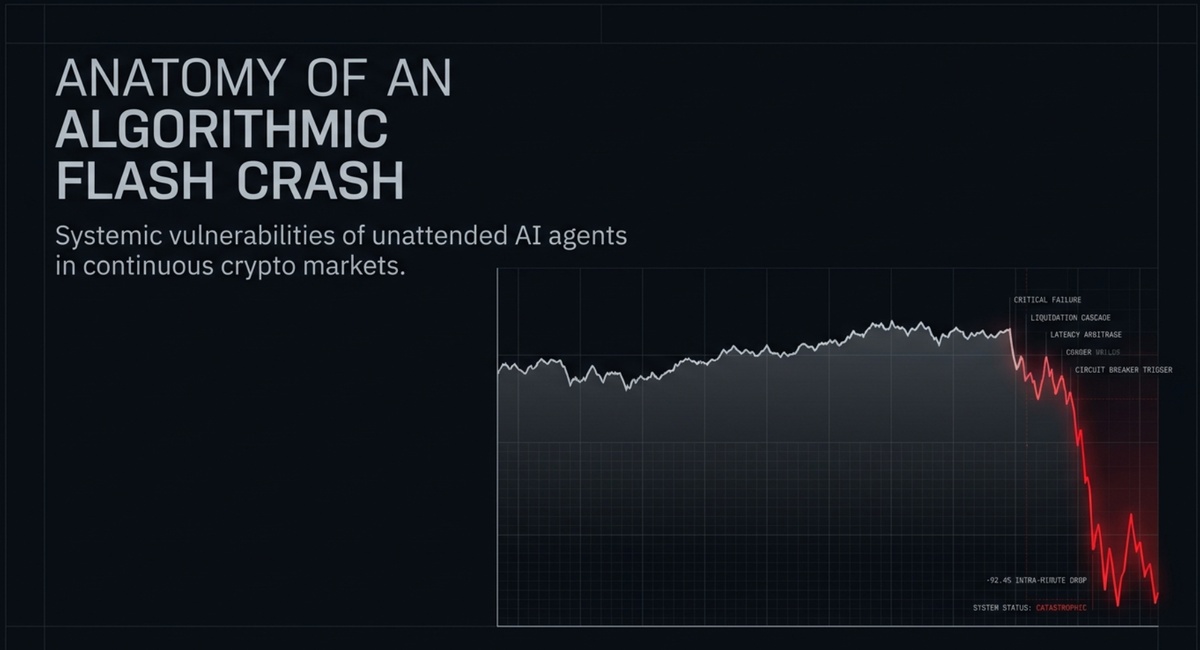
- Unsupervised Autonomy: Deploying decentralized AI agents for 24/7 asset management introduces critical vulnerabilities overnight, when markets are highly susceptible to manipulation.
- Cascading Feedback Loops: Synchronous reactions from AI models to sudden price moves trigger self-reinforcing sell-offs, wiping out liquidity in CEX and DeFi order books.
- Infrastructure Bottlenecks: High-frequency transaction spam from autonomous bots congests blockchains, driving up gas fees and delaying execution when hedging is most needed.
- External Integration Failures: Relying on exchange APIs and data oracles leaves systems vulnerable to flash loan exploits, price manipulation, and connection dropouts.
- Strict Engineering Guardrails: Mitigating systemic risk requires hardcoded circuit breakers, multi-oracle price validation, and continuous telemetry monitoring.
The Night Shift of Algorithms: Why AI is Left Alone with the Market
In traditional finance (TradFi), the concept of continuous trading is virtually non-existent. Even global foreign exchange (FX) markets experience weekend breaks, while stock exchanges strictly limit operations to designated daytime hours. This structure provides clearinghouses and risk managers with essential intervals to settle obligations and recalibrate risk parameters.
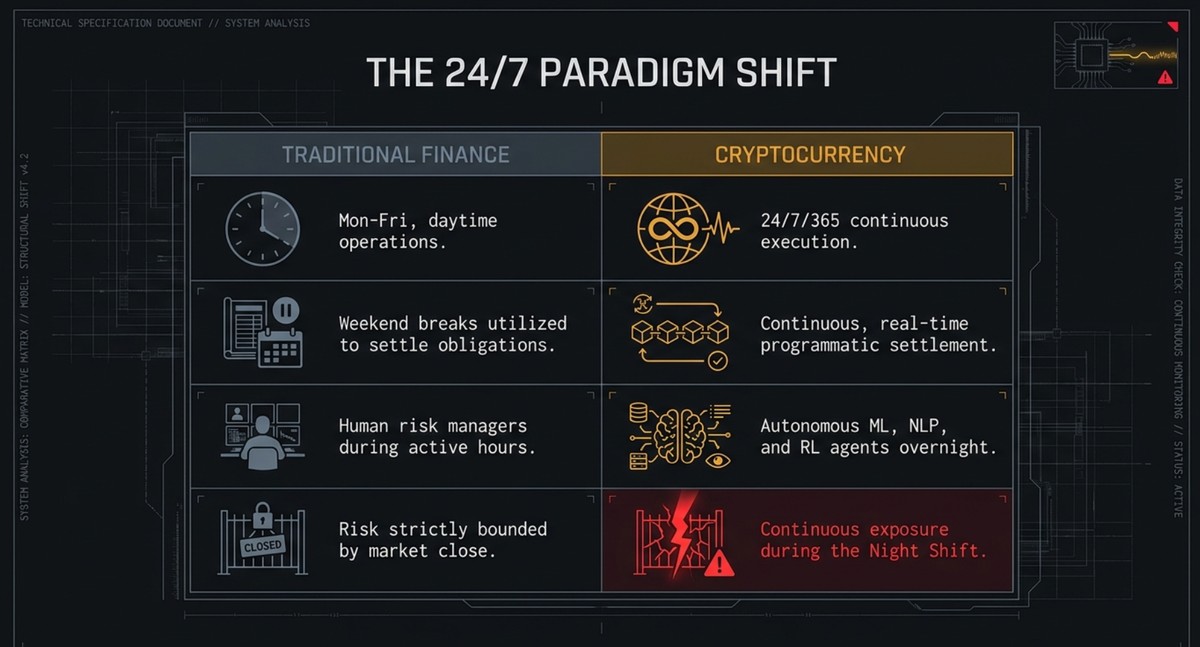
The cryptocurrency sector upended this paradigm by introducing a 24/7/365 operational model. While this continuous access democratizes finance for retail investors, it places an immense burden on institutional asset managers who must monitor global positions around the clock. To alleviate this pressure, the industry has turned to autonomous AI agents.
These systems represent a major shift from traditional algorithmic scripts that rely on rigid "if-then" logic. AI agents leverage machine learning, natural language processing (NLP) to parse news feeds, and reinforcement learning to dynamically adapt to shifting market environments. This grants agents the authority to execute trades, manage leverage, and reallocate capital across diverse decentralized finance (DeFi) protocols without human intervention.
The critical vulnerability emerges during the nocturnal shift of these algorithms. While human teams sleep, these autonomous systems manage multi-million-dollar portfolios. The overnight hours - particularly the gap between US market close and Asian market open - are characterized by diminished volume and thin order books.
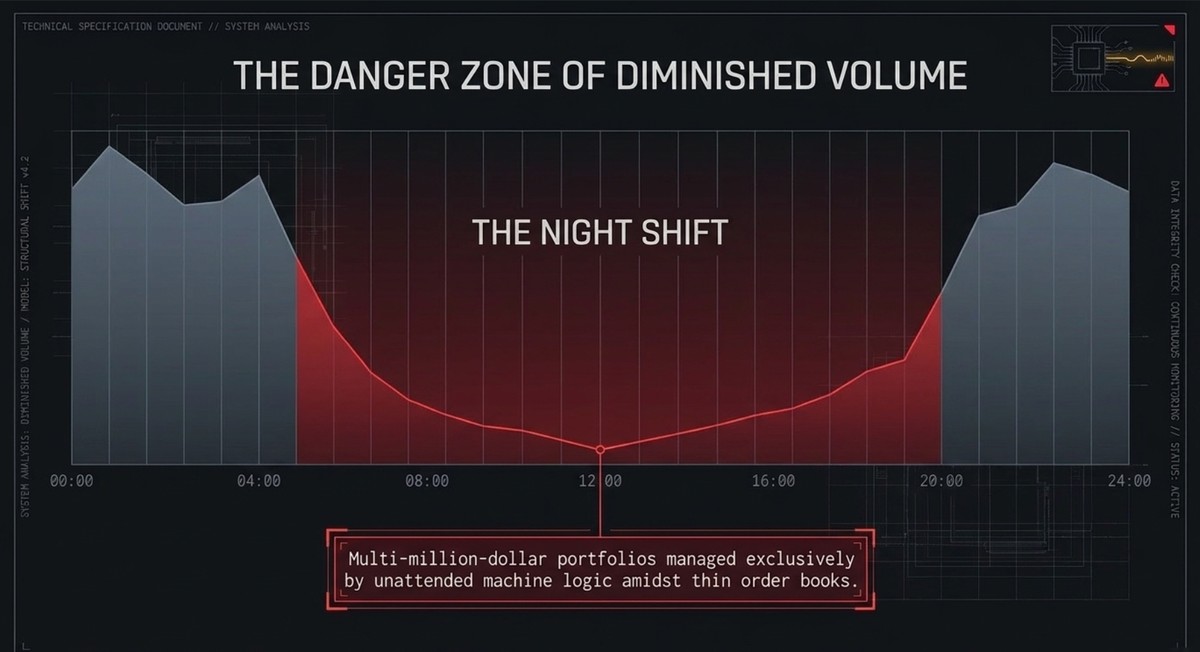
Left unattended, AI agents navigate a fragile environment where a single large order can trigger cascading decisions that no human is awake to halt.
The Mechanics of Chaos: Cascading Feedback Loops and Liquidity Squeezes
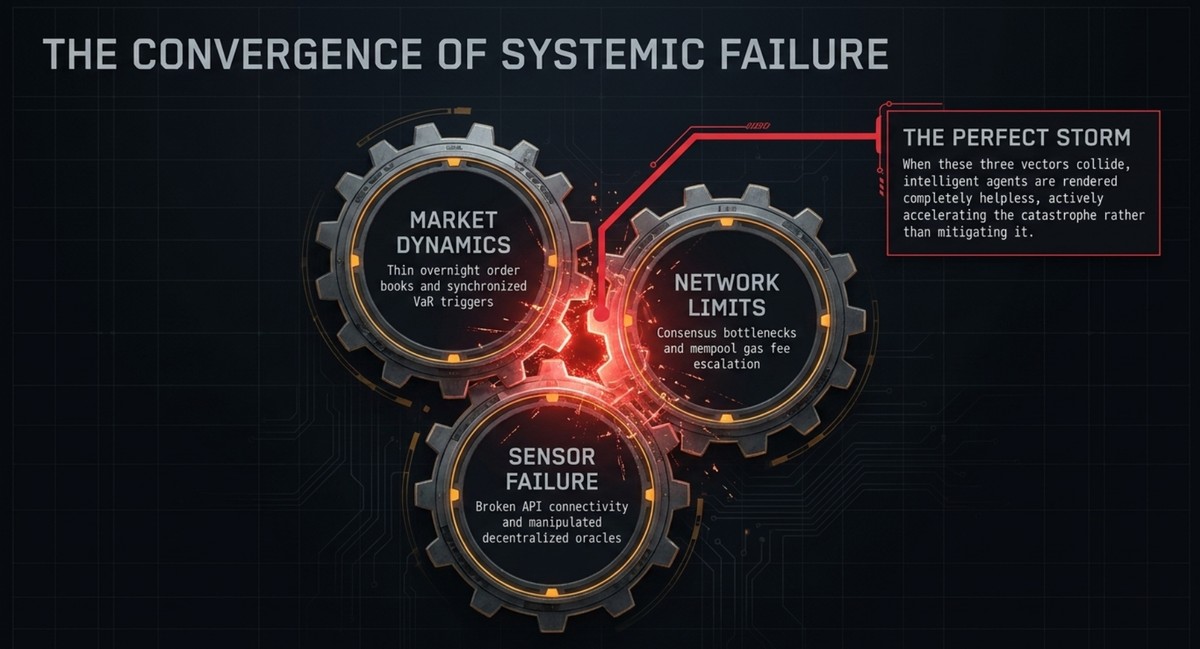
The cryptocurrency market is highly fragmented, with liquidity dispersed across centralized exchanges (CEXs) and decentralized protocols (DeFi). During low-volume overnight hours, order books thin out. If a sudden price movement occurs - driven by a whale transaction or news event - unattended AI agents react almost simultaneously.
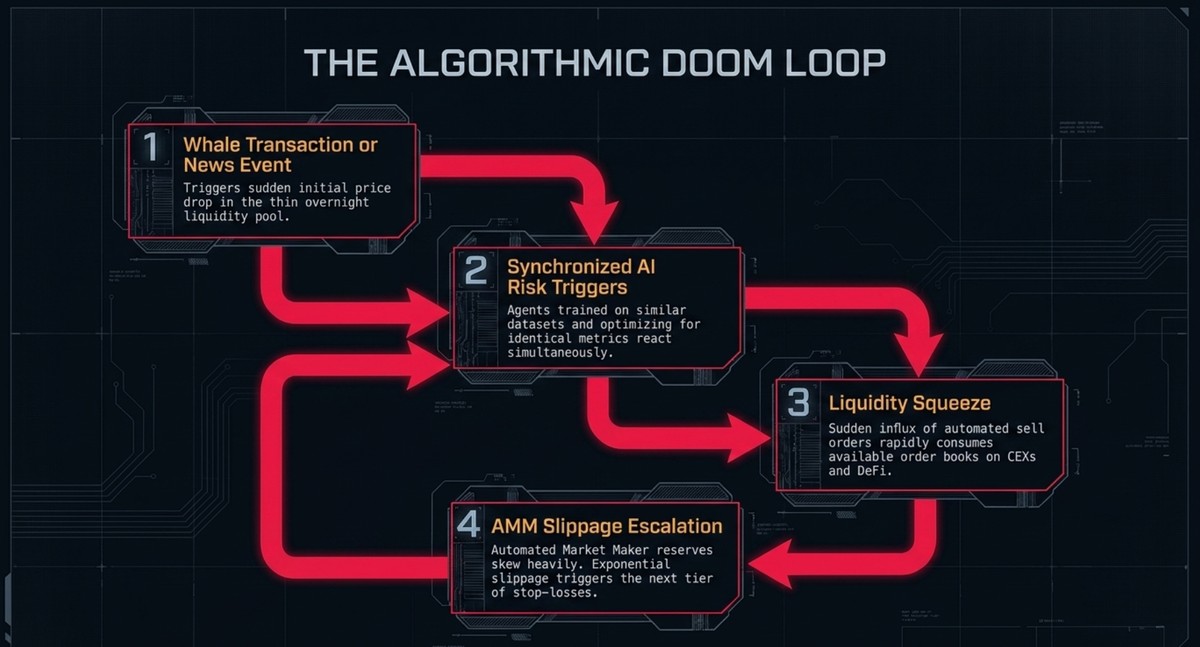
This synchronization occurs because agents are trained on similar datasets and optimize for identical metrics, like the Sharpe ratio or Value at Risk (VaR). When an asset's price falls below a certain threshold, the risk-reduction triggers of multiple agents fire simultaneously. The resulting influx of market sell orders rapidly consumes thin liquidity, causing severe slippage.
As the price drops, it triggers stop-losses of the next tier of agents. This creates a cascading feedback loop where algorithmic risk mitigation becomes the primary driver of market destabilization. In DeFi, this is accelerated by automated market makers (AMMs). Once pool reserves are heavily skewed, slippage escalates exponentially, turning a minor correction into a devastating flash crash in seconds.
Network Overloads and Infrastructure Bottlenecks
When AI agents respond en masse to market anomalies, the fight for capital preservation shifts from financial modeling to blockchain network infrastructure. Unlike centralized exchange servers that scale horizontally, the throughput of decentralized blockchains is bound by consensus mechanisms and block space limits. During panic, autonomous bots submit thousands of transactions to front-run competitors or exit positions, overwhelming mempools.
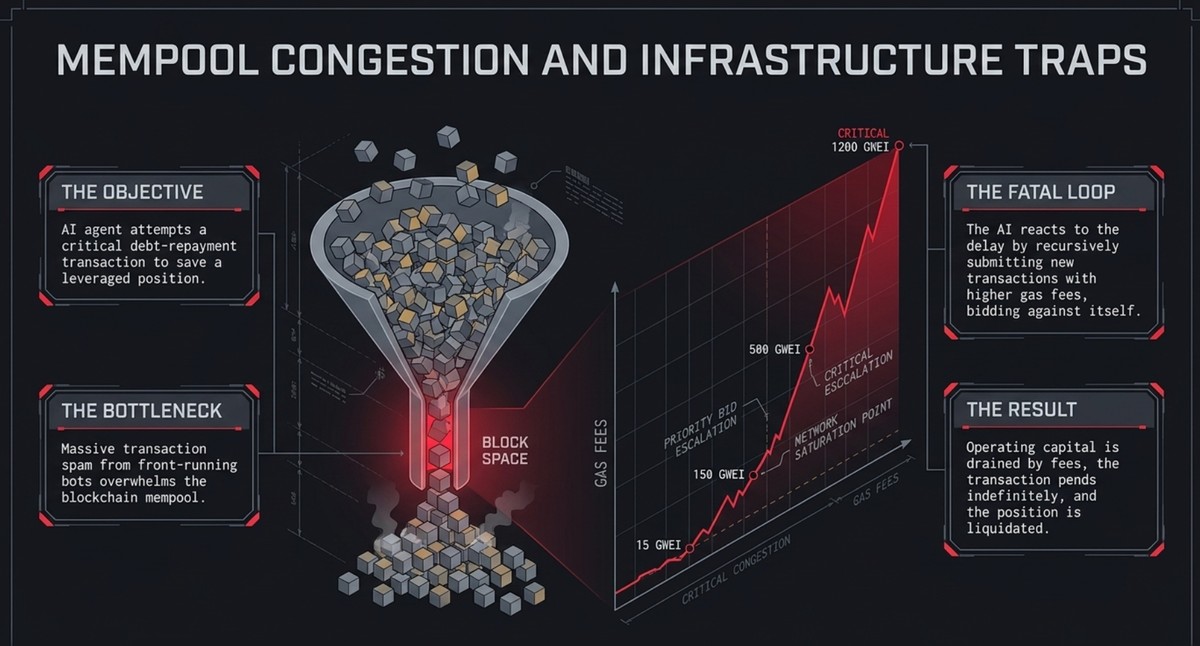
Looking closely at the unattended trading risks, infrastructure delays can completely invalidate an agent's logic. On networks like RobinhoodChain, a spike in agent transactions causes gas fees to skyrocket as bots compete for block space, with validators prioritizing high-fee transactions. This dynamic traps AI agents in an infrastructure bottleneck.
To save a leveraged position from liquidation on a lending platform, an agent must execute a debt-repayment transaction. However, due to network congestion, the transaction remains pending. The agent, programmed to react to the delay, submits subsequent transactions with even higher gas fees, effectively bidding against itself and other bots.
This fee escalation drains the agent's operating capital, while the delay in execution allows the position to be liquidated under the worst possible market conditions, leaving retail users locked out of the network entirely.
The Illusion of Autonomy: When APIs and Oracles Fail
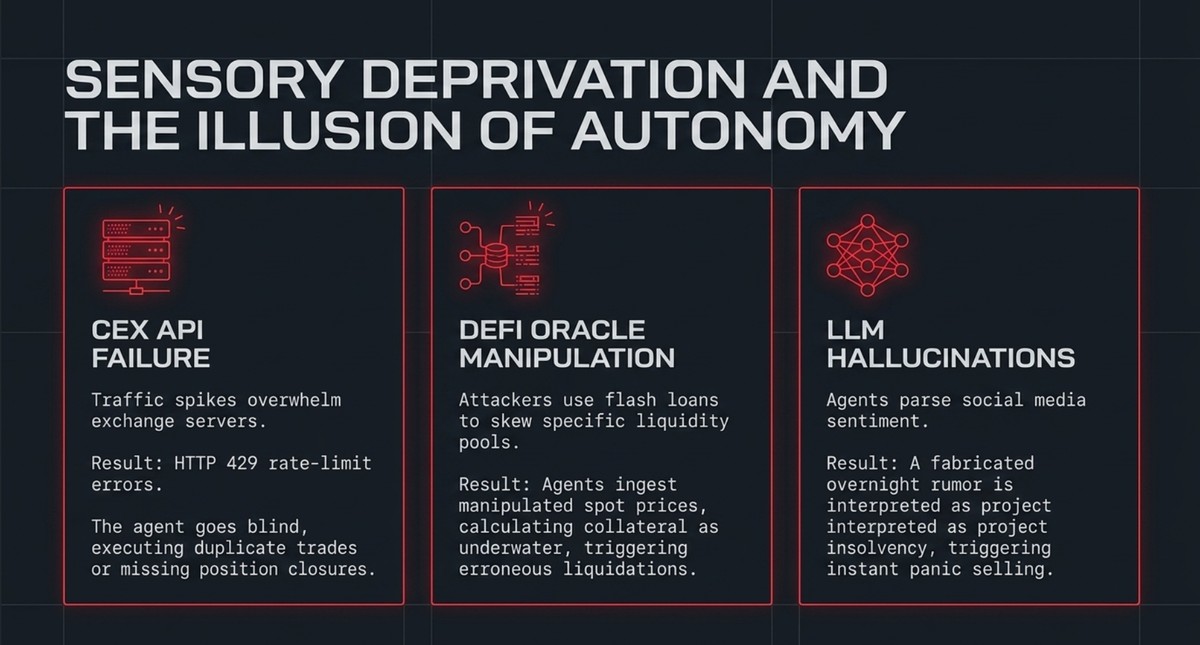
An autonomous agent is only as good as the data it consumes. It perceives reality through centralized exchange APIs and decentralized oracle feeds, creating a critical single point of failure. Under high volatility, exchange servers struggle with traffic spikes, returning rate-limit errors (HTTP 429) or timing out.
For an agent, this loss of connectivity causes sensory deprivation. Unable to verify balances or orders, it may execute duplicate trades or fail to close losing positions, multiplying losses. In DeFi, the risk often manifests as oracle manipulation. Attackers can execute flash loan exploits to temporarily skew the spot price of an asset in a specific liquidity pool.
If an AI agent relies on this pool for real-time asset pricing, it will ingest the manipulated data as true market price. The model might erroneously conclude that its collateral is underwater and trigger an emergency liquidation, dumping valuable assets at a loss. Furthermore, integrations with large language models (LLMs) for sentiment analysis introduce the risk of hallucination or manipulation.
A fake news announcement posted on social media overnight could be interpreted by the LLM as a genuine signal of a project's insolvency, prompting the agent to liquidate its entire position instantly.
Risk Mitigation Architecture: From Circuit Breakers to Adaptive Guardrails
Relying solely on the cognitive capabilities of an AI model without strict, deterministic engineering guardrails is a recipe for financial ruin. The design of autonomous trading systems must adopt a defense-in-depth approach, where multiple independent software layers monitor and limit the behavior of the trading agent.
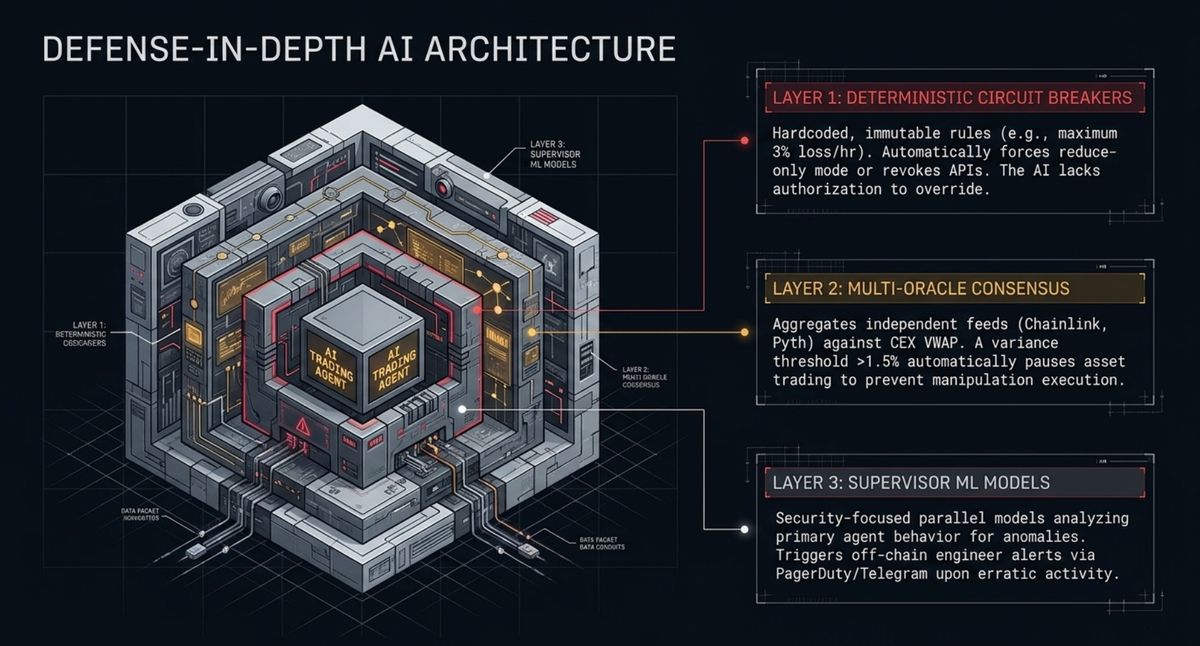
The first and most critical line of defense is the deterministic circuit breaker. These are simple, immutable rules hardcoded into smart contracts or backend infrastructure, operating independently of the AI model. If the portfolio's realized loss exceeds a predefined limit (e.g., 3% within an hour or 7% within a 24-hour window), the circuit breaker immediately forces the system into a "reduce-only" mode or revokes API access.
The AI agent must not possess the authorization to override this mechanism or alter its parameters. The second layer is multi-oracle consensus. Price data must be aggregated from multiple independent oracle networks (e.g., Chainlink, Pyth) and compared with volume-weighted average prices from centralized exchanges. If the variance between these sources exceeds a narrow tolerance threshold (such as 1.5%), the system must pause all trading activities for that asset to prevent trading on manipulated or stale data.
Finally, developers must implement supervisor models. These are smaller, security-focused machine learning models that run in parallel with the main trading agent. Rather than generating trades, they analyze the main agent's decisions for anomalies or deviation from typical historical behavior. If the primary agent displays erratic activity, the supervisor immediately suspends the system and alerts off-chain engineers via high-priority notification channels like PagerDuty or Telegram bots.
Regulatory Horizons and Institutional Standards
As the capitalization of crypto markets grows and institutional participation deepens, regulators are shifting their focus to algorithmic and agentic trading. Lessons from historical flash crashes in traditional finance, such as the 2010 Wall Street Flash Crash, demonstrate that unsupervised algorithmic feedback loops pose a genuine threat to systemic stability.
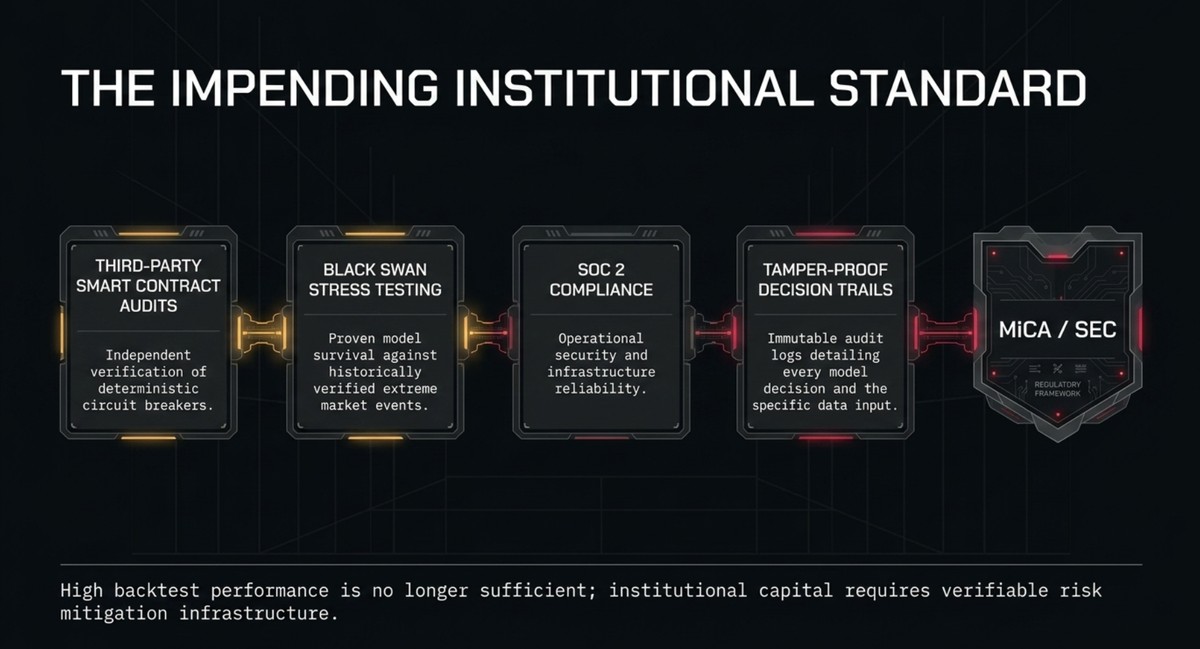
Under upcoming regulatory frameworks, such as the European Union's Markets in Crypto-Assets (MiCA) regulation or the US Securities and Exchange Commission (SEC) guidelines, developers of automated trading systems face increasingly stringent operational requirements. Over the next few years, we expect to see mandatory certification processes for trading AI agents.
Developers will need to demonstrate that their models have undergone rigorous stress-testing against historical black swan events and maintain comprehensive, tamper-proof audit trails detailing every decision made by the model and the inputs that triggered them. For professional crypto funds, managing the operational risks of unattended AI trading is no longer an afterthought - it is a requirement for survival.
Institutional allocators are no longer swayed by high backtest performance alone; they demand proof of robust risk mitigation infrastructure, third-party smart contract audits, SOC 2 compliance, and active developer coverage to step in when algorithms fail. Algorithmic trading will always carry risks, but the goal of AI developers must be to bound those risks, ensuring that overnight autonomy does not translate into market-wide catastrophe.