 Base
Base Unichain
 Robinhood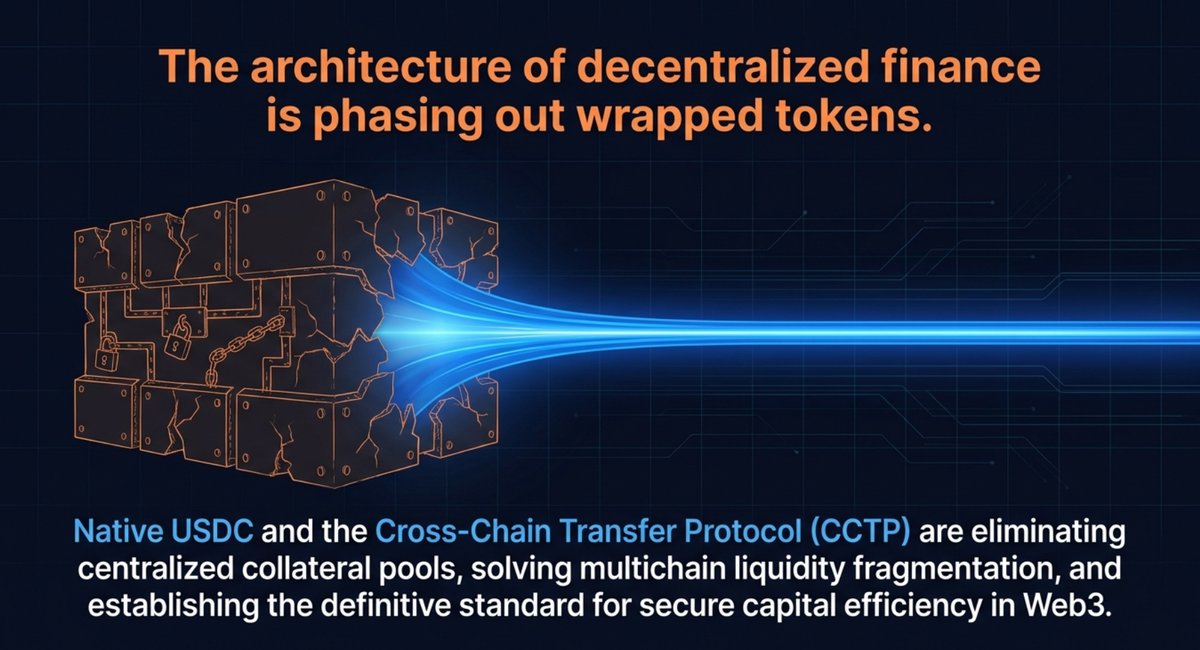
The crypto industry's transition from wrapped tokens to native stablecoins marks a fundamental shift in decentralized finance (DeFi) architecture. Historically, cross-chain bridges relying on the lock-and-mint model have been a source of systemic risk, leading to the loss of billions of dollars in exploits. Circle is redefining this landscape by introducing native USDC via its Cross-Chain Transfer Protocol (CCTP), which utilizes a secure burn-and-mint mechanism.
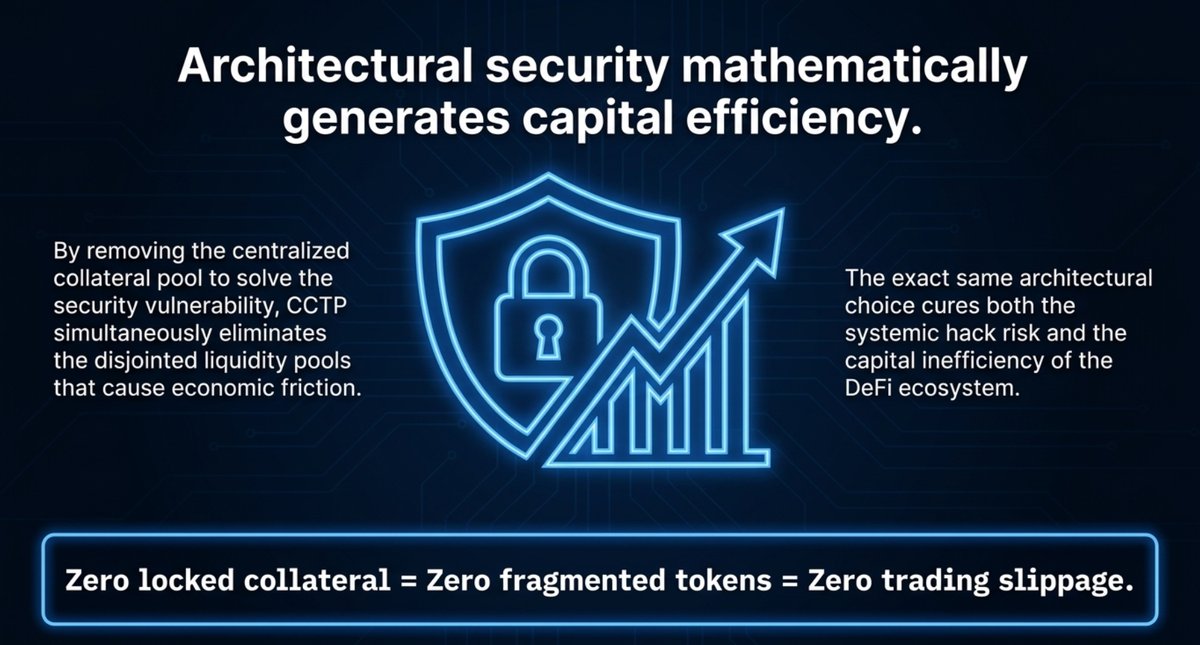
This architecture eliminates the need for centralized collateral pools and solves the problem of fragmented liquidity. Consequently, developers of modern Layer-2 rollups and DeFi protocols are phasing out wrapped versions in favor of native integrations, establishing new standards for security and capital efficiency across the Web3 space.
The Evolution of Multichain Infrastructure: From Workarounds to Standards
The development of blockchain technology has shifted from the dominance of a single Ethereum network to a complex multichain architecture comprised of independent Layer-1 (L1) and Layer-2 (L2) networks. As each new ecosystem sought to attract users and developers, it required a stable and reliable settlement asset.
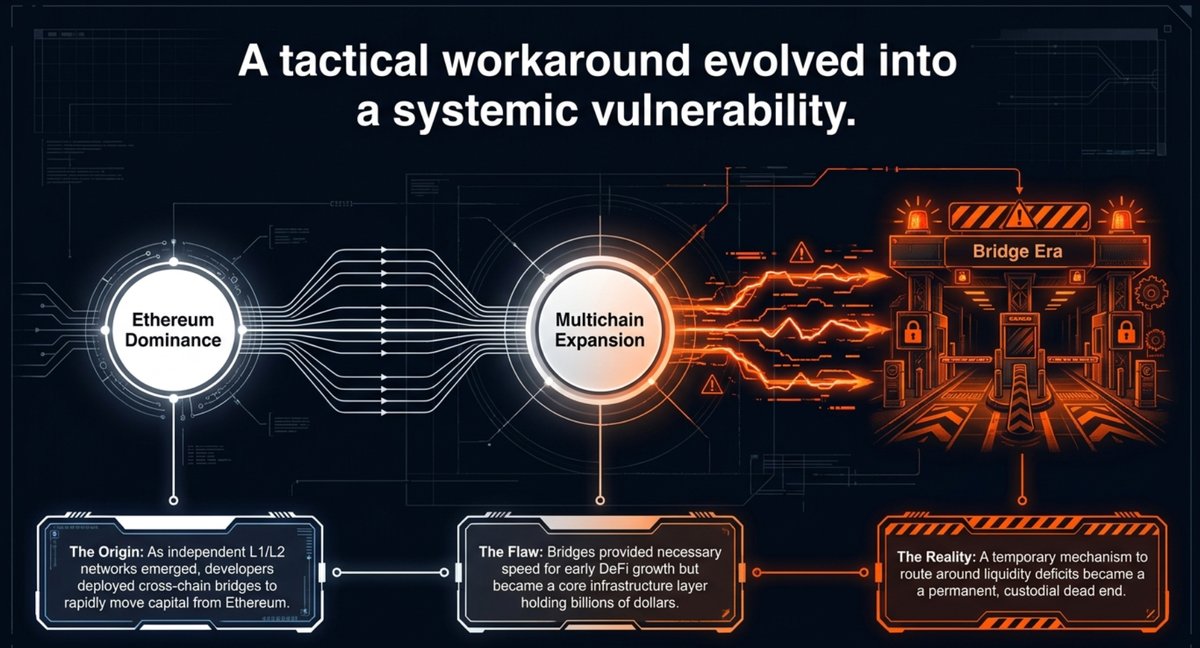
Circle's USDC stablecoin quickly filled this niche. However, in the early stages, Circle could not deploy native token issuance on every new blockchain immediately, creating a critical liquidity deficit. To overcome this bottleneck, developers and independent teams began widely deploying cross-chain bridges. These solutions seemed like an ideal temporary workaround, allowing capital to move quickly from Ethereum to emerging ecosystems.
Bridges provided the necessary flexibility and speed, facilitating the rapid growth of DeFi on alternative platforms. Unfortunately, what was initially conceived as a temporary tactical workaround quickly turned into a core infrastructure layer holding billions of dollars of user funds. Consequently, the DeFi market faced a serious issue: a single network could host native USDC alongside multiple wrapped versions issued by different bridges.
Users had to navigate these competing versions, adding friction and undermining trust among traditional institutions.
Anatomy of a Vulnerability: Why Lock-and-Mint Became a Systemic Threat
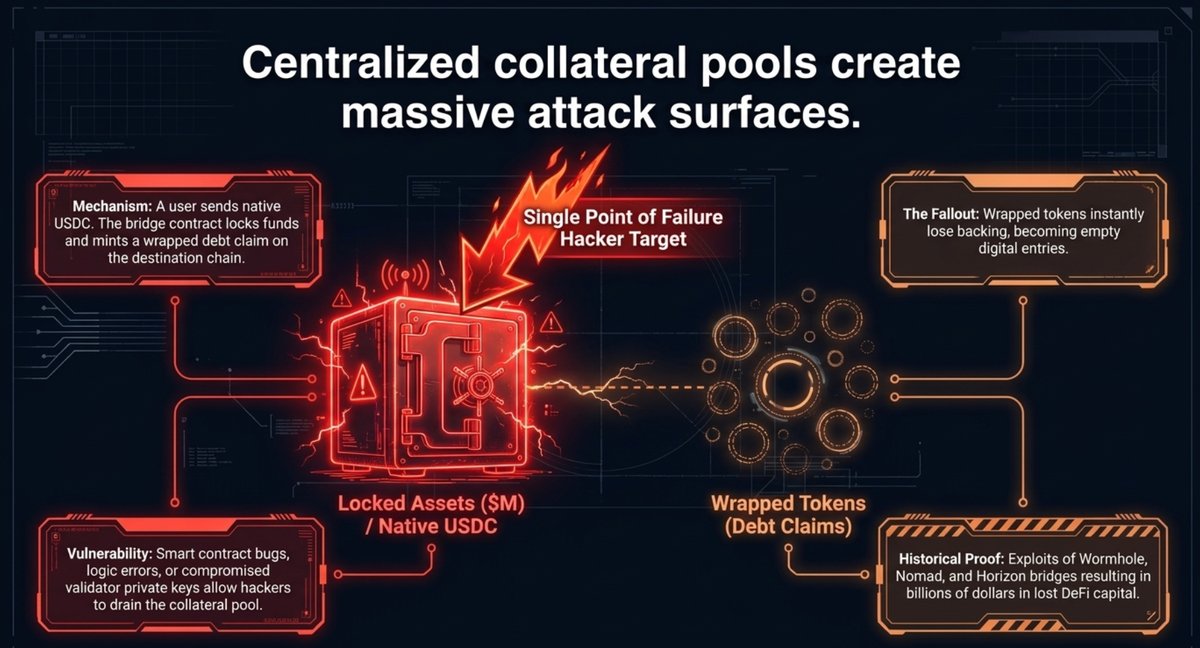
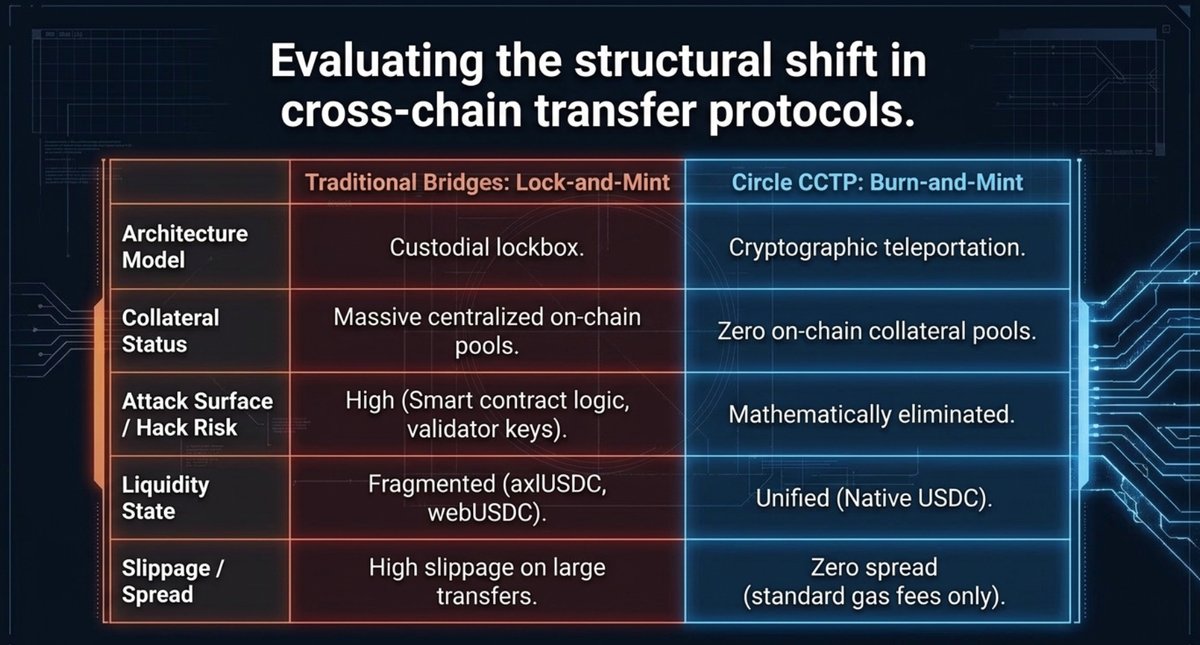
Most traditional cross-chain bridges operate on a lock-and-mint model. A user wishing to transfer stablecoins from Ethereum sends native USDC to the bridge's contract. The bridge locks these funds and signals its contract on the destination chain to mint wrapped tokens. These wrapped tokens represent a debt claim, promising to redeem the collateral on demand.
From an information security perspective, this architecture contains a critical flaw. On the source chain, the bridge's contract becomes a massive liquidity pool holding hundreds of millions of dollars in native assets. This pool of locked collateral becomes an incredibly attractive target for cybercriminals. Any vulnerability in the smart contract code, logic error in transaction validation, or compromise of validator private keys allows attackers to drain the entire collateral pool.
Once the collateral on the source chain is stolen, the wrapped tokens on the destination chain instantly lose their backing. They become empty digital entries unsupported by actual fiat reserves. The exploits of Wormhole, Nomad, and Horizon bridges demonstrated this vulnerability in practice. Total DeFi losses from bridge hacks exceeded billions of dollars, forcing the industry to recognize that the lock-and-mint model was a systemic dead end.
Liquidity Fragmentation and the Trust Crisis in Wrapped Assets
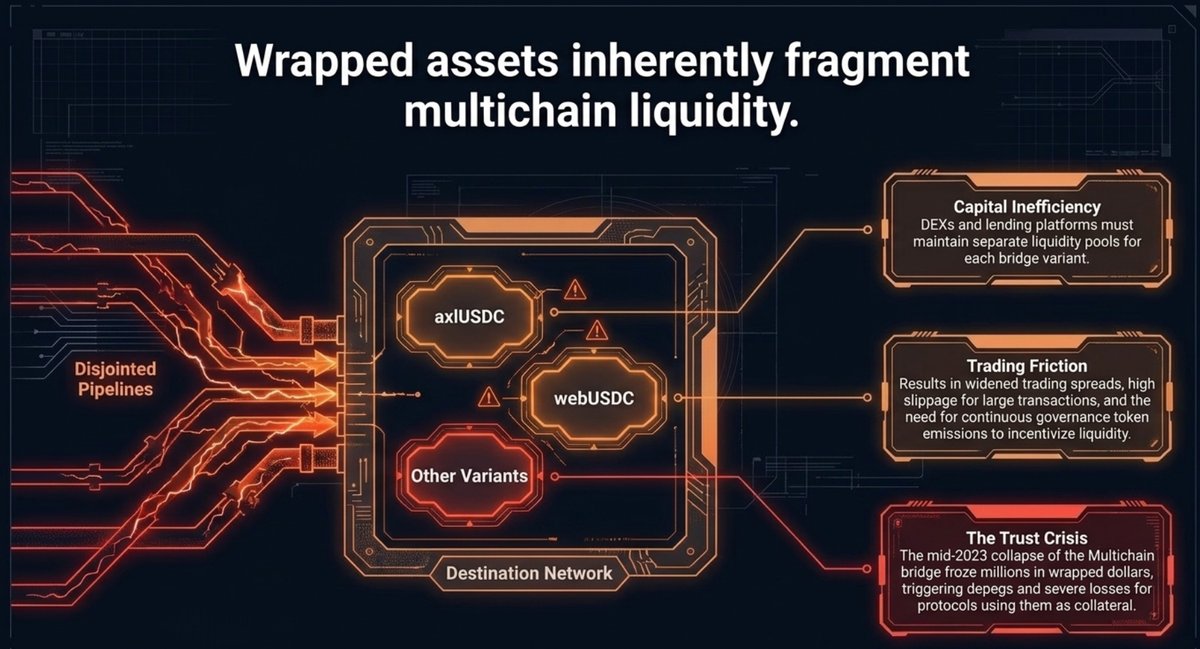
In addition to security threats, the widespread adoption of wrapped tokens inflicted severe economic damage on the DeFi space. The primary problem was liquidity fragmentation. Because each bridge issued its own version of wrapped USDC, a single network could concurrently host axlUSDC from Axelar, webUSDC from Wormhole, and other stablecoin variants from smaller bridges.
For DEXs and lending platforms, this required separate liquidity pools for each variant. Capital was distributed inefficiently, trading spreads widened, and large transactions suffered from high slippage. Instead of a single deep market, users faced disjointed pools that required continuous incentivization through governance token emissions.
The trust crisis in wrapped assets peaked in mid-2023 with the collapse of the Multichain cross-chain bridge. Following the sudden shutdown of the protocol and the loss of control over its management keys, millions of wrapped dollars across multiple networks were frozen.
This triggered depegs of wrapped stablecoins and severe losses for projects utilizing them as collateral. For venture investors and major DeFi protocols, this served as the final warning that relying on third-party bridges introduced unacceptable systemic risks.
Native USDC Architecture: The Burn-and-Mint Model and CCTP
Recognizing that the security of wrapped assets directly impacted USDC's reputation as a reliable payment tool, Circle took strategic steps to resolve the issue. The company began expanding native USDC issuance across various L1 and L2 blockchains. Native USDC is issued directly by Circle, is fully backed by reserves at a one-to-one ratio with the US dollar, and can be redeemed directly through official Circle channels.
To allow native USDC to move freely between blockchains without relying on vulnerable lock-and-mint bridges, a new technological foundation was required. This led to Circle's development of the Cross-Chain Transfer Protocol (CCTP). This protocol differs fundamentally from traditional bridges because it operates on a burn-and-mint model, completely eliminating centralized collateral pools.
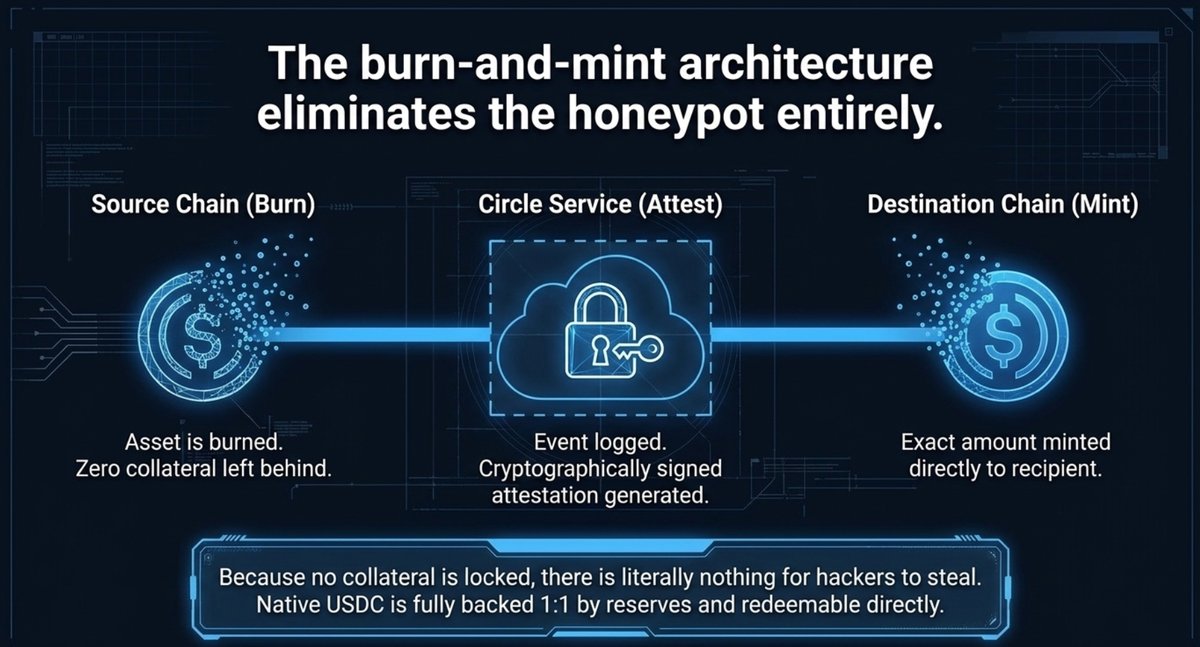
The transfer process via CCTP is highly transparent and secure. When a user initiates a transaction to transfer USDC from a source chain to a destination chain, CCTP burns the specified amount on the source chain. The smart contract logs this event and requests attestation from Circle's service.
Once the cryptographically signed attestation is received, the CCTP smart contract on the destination chain mints the exact same amount of native USDC directly to the recipient's address. Because no collateral is locked, there is nothing for hackers to steal.
Economic Advantages for DeFi Ecosystems and Developers
Transitioning to native USDC and CCTP unlocks new horizons of economic efficiency for the entire decentralized finance industry. First and foremost, the risk of asset depegs is eliminated. DeFi lending protocols can now accept USDC as collateral without the fear that a bridge hack will render the backing worthless.
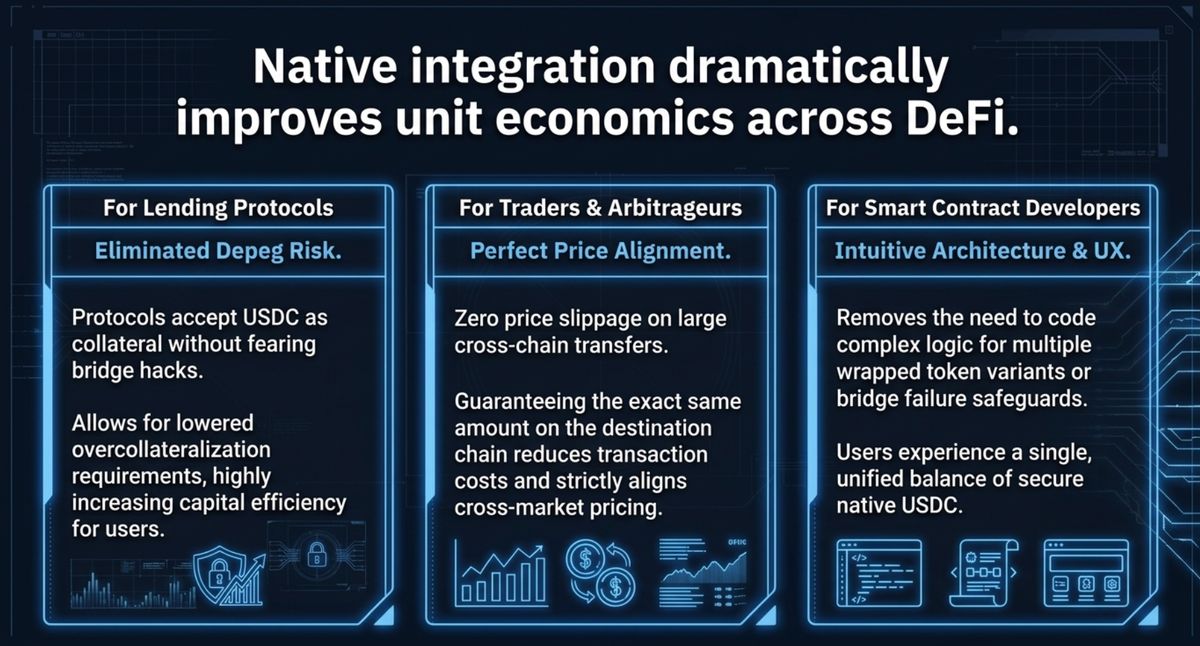
This allows protocols to lower overcollateralization requirements, making loans more capital-efficient for users. Additionally, price slippage during large cross-chain capital transfers is eliminated. With CCTP, the spread is zero: transferring any volume of stablecoins guarantees the exact same amount on the destination chain, minus standard gas fees.
This significantly reduces transaction costs for market makers and arbitrageurs, helping align prices across different trading venues. For smart contract developers, integrating CCTP simplifies application architecture. There is no longer a need to maintain complex logic for handling multiple wrapped versions of a token or write safeguards for potential bridge failures.
The user interface of decentralized applications becomes intuitive: users see a single balance of secure native USDC that works seamlessly across all supported networks.
The Unichain Case Study: Phasing Out Traditional Bridges
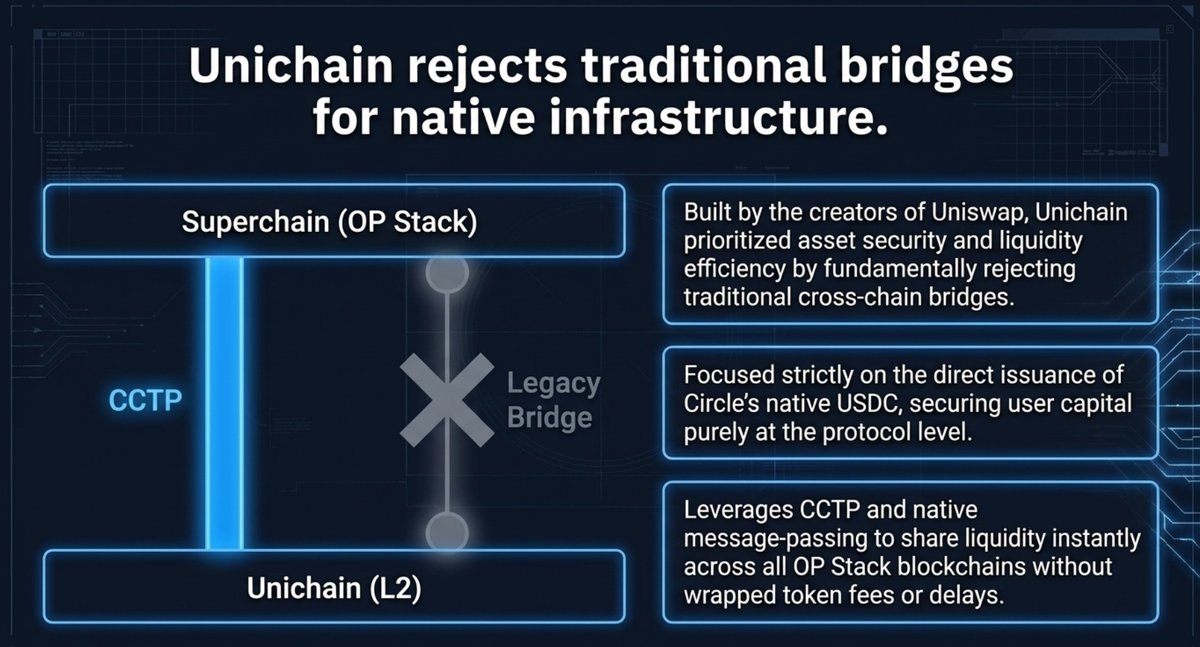
A clear validation of this paradigm shift in blockchain infrastructure design is Unichain, a specialized L2 network optimized for DeFi transactions developed by the creators of Uniswap. When designing the network's architecture, the team prioritized asset security and liquidity efficiency, making a strategic decision to reject traditional cross-chain bridges.
Instead of utilizing wrapped tokens that carry hack risks and fragment liquidity, Unichain focused on direct integration of native assets. The planned USDC native integration in favor of direct issuance of Circle's native USDC sets a new standard for L2 solutions. This eliminates unreliable intermediaries from the settlement chain and guarantees that user capital is secured at the protocol level.
This approach also addresses interoperability within the Superchain ecosystem. Through integration with CCTP and native message-passing mechanisms, Unichain can share liquidity with other OP Stack blockchains instantly and securely. This creates a unified, seamless environment where capital moves without delays or wrapped token fees, making trading on DEXs more attractive to a wider range of investors.
A New Role for Cross-Chain Protocols: From Custodians to Transport Layers
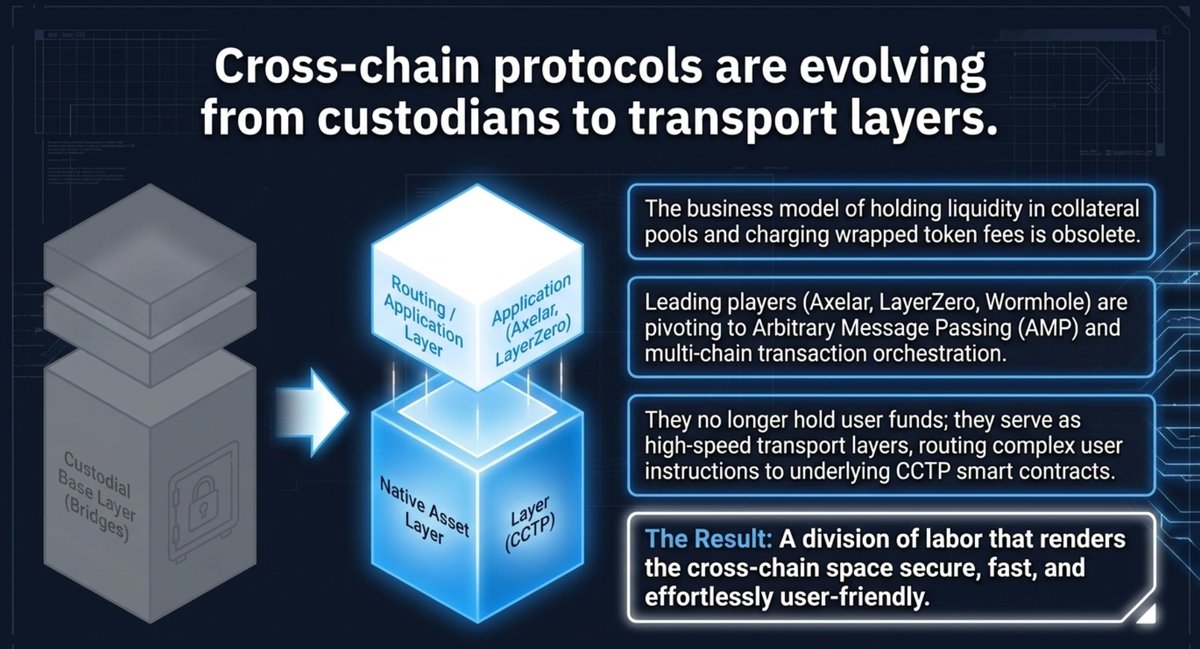
The widespread displacement of wrapped tokens by native assets forces traditional bridge developers to radically transform their business models. Bridges can no longer monetize by holding liquidity in collateral pools and charging high fees for issuing wrapped tokens. Their previous role as financial custodians is rapidly losing relevance.
However, this process does not mean cross-chain platforms will disappear from the Web3 landscape. Instead, we are witnessing their qualitative evolution. Leading players such as Axelar, LayerZero, and Wormhole are pivoting to offer Arbitrary Message Passing (AMP) and multi-chain transaction orchestration. They are integrating Circle's CCTP directly into their infrastructure.
In this new model, cross-chain protocols serve as transport layers. They do not hold user funds on their balance sheets; instead, they route calls to CCTP smart contracts to burn and mint tokens while executing complex user instructions (such as purchasing an NFT or depositing into a lending protocol on the destination chain in a single transaction).
This division of labor makes the cross-chain space secure, fast, and user-friendly.