
 Base
Base Unichain
 Robinhood
- Public blockchains are inherently transparent, exposing wallet balances, transaction histories, and business logic to everyone.
- Zero-Knowledge proofs verify statements privately, but they cannot perform shared computations over encrypted public states.
- Fully Homomorphic Encryption (FHE) allows smart contracts to perform mathematical calculations directly on encrypted data without decrypting it.
- Pioneered by frameworks like Zama fhEVM and networks like Fhenix, FHE enables confidential DeFi trading, private voting, and secure on-chain gaming.
The defining feature of public blockchains has always been radical transparency. Every transaction, contract balance, token swap, and liquidation threshold is broadcast to an open, decentralized network of thousands of validators. While this transparency eliminated the need for blind faith in corruptible banking intermediaries, it simultaneously erected an insurmountable wall against enterprise adoption. In traditional business, total transparency is completely unworkable. Companies cannot publish their wholesale supply chain costs, private employee salaries, or confidential trade algorithms on an open public bulletin board.
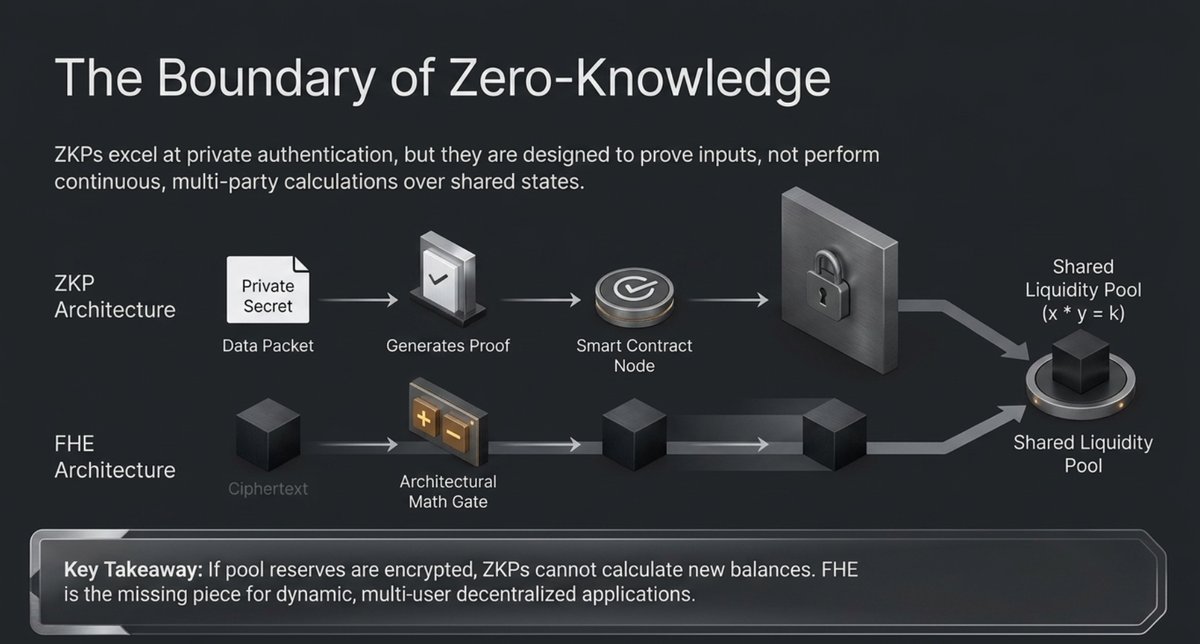
For years, the industry championed Zero-Knowledge Proofs (ZKPs) as the definitive answer to the privacy dilemma. While ZKPs excel at private authentication and batch compression, they possess an inherent architectural limitation: they are designed to prove knowledge of private data, not to perform continuous, multi-party calculations over shared confidential states. Fully Homomorphic Encryption (FHE) represents the missing cryptographic puzzle piece, enabling smart contracts to execute complex business logic directly on encrypted data without ever exposing the underlying numbers.
The Limitation of Zero-Knowledge in Shared Environments
To appreciate why FHE is transformative, one must understand the boundary where Zero-Knowledge cryptography stops. A ZKP allows Alice to prove to a smart contract that she possesses more than ten dollars in her balance without revealing her exact net worth. The smart contract verifies the cryptographic proof and processes Alice's transaction.
However, consider an Automated Market Maker (AMM) like Uniswap. An AMM requires a shared public state: it holds pooled reserves of Token X and Token Y. When Alice submits an order, the mathematical formula (x * y = k) must update both reserves simultaneously based on her swap amount.

Zero-Knowledge Privacy:
User holds private secret ---> Generates Proof ---> Contract verifies proof (Shared state must be public)

Fully Homomorphic Encryption (FHE):
User encrypts $100 [Ciphertext] ---> Submits to Contract ---> Contract calculates: [A] + [B] = [C]
                                                                (Data remains 100% encrypted during math!)
With ZKPs alone, smart contracts cannot perform this shared state calculation in private. If the pool reserves are encrypted, no single user has the private key to calculate the new pool balances, and giving the decryption key to a validator destroys privacy entirely. This fundamental constraint is why ZK privacy has largely remained confined to private balance transfers (like Zcash or Tornado Cash) rather than dynamic, multi-user decentralized applications.
How Fully Homomorphic Encryption Works: Computation in the Dark
Fully Homomorphic Encryption solves this problem through an elegant mathematical property: it allows arithmetic operations to be evaluated directly on encrypted ciphertexts, producing an encrypted result that, when decrypted, matches the output of the operations as if they had been performed on unencrypted plaintext.
Mathematically, if Enc(m) represents the encrypted value of message m, an FHE scheme satisfies:
Enc(A) + Enc(B) = Enc(A + B)Enc(A) * Enc(B) = Enc(A * B)
Leading cryptography organizations, including Zama with their fhEVM (Fully Homomorphic Ethereum Virtual Machine), have adapted these theoretical mathematical primitives into functional on-chain developer environments.
- User Encryption: Alice encrypts her input data (for example, a bid of 50 tokens) on her local device using the network's public encryption key.
- Encrypted On-Chain Submission: Alice sends the ciphertext to the smart contract. To miners, validators, and chain observers, the transaction looks like a meaningless string of pseudorandom characters.
- Homomorphic Execution: The smart contract executes its standard logic. If it needs to add Alice's bid to a prize pool, it simply adds Alice's ciphertext to the pool's existing ciphertext. The EVM handles the encrypted math natively without ever decrypting the numbers.
- Decryption Protocol: When the final result is needed (such as declaring an auction winner), a threshold decryption network cooperatively decrypts only the final outcome, leaving individual private bids permanently confidential.
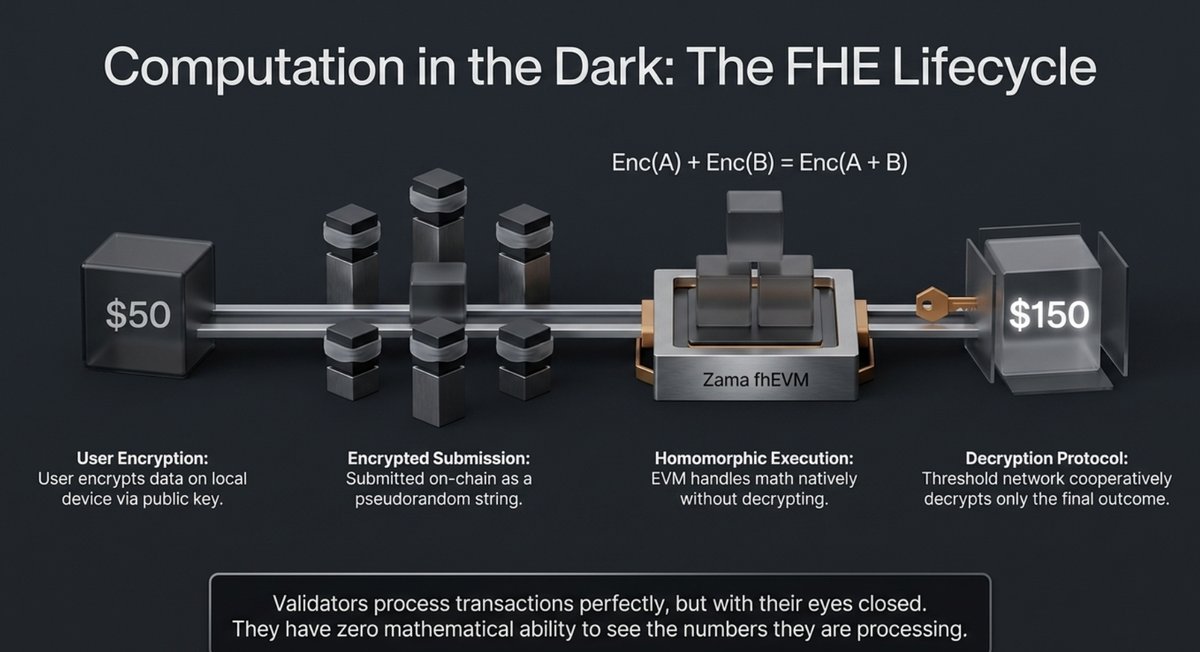
Under FHE, validators process transactions with their eyes closed: they execute the business logic perfectly, but they have zero mathematical ability to see what numbers they are processing.
Practical Applications: Beyond Obfuscated Transfers
The introduction of homomorphic computation unlocks use cases that were historically impossible on decentralized ledgers:
- Sealed-Bid Auctions and True Dark Pools: In current on-chain auctions, frontrunning bots monitor the mempool, observe incoming bids, and outbid users by a fraction of a cent. With FHE, every bid is encrypted. Liquidity pools can execute orders without revealing price limits or size, completely eliminating toxic frontrunning and MEV extraction.
- Confidential Institutional Credit: Enterprises can verify on-chain collateral and borrow assets without disclosing their commercial balance sheets to competitors.
- Decentralized Secret Voting in DAOs: In existing DAO governance, voters are heavily influenced by the running tally of votes cast by influential whales early in the voting window. FHE voting keeps the running tally encrypted until the voting deadline expires, eliminating psychological anchoring and voter coercion.
- On-Chain Gaming With Hidden Information: Classic card games (like poker) and strategy games require imperfect information (such as hidden hands or fog of war). FHE makes it possible to build fully on-chain poker where not even the node operators can peek at the dealt cards.
The Engineering Frontier: Latency and Hardware Acceleration
While FHE represents the holy grail of blockchain confidentiality, it historically suffered from a severe computational penalty. Calculating mathematical operations on encrypted polynomials is orders of magnitude more resource-intensive than processing raw integers on a standard CPU.
However, the technology has reached a tipping point. Modern FHE schemes (like TFHE) have optimized latency down to milliseconds for basic operations. Furthermore, the advent of specialized Application-Specific Integrated Circuits (ASICs) and GPU acceleration hardware is dramatically reducing proving overhead.
By solving the paradox of public computation over private data, Fully Homomorphic Encryption transforms blockchain technology from an open financial fishbowl into a secure, enterprise-ready computational substrate for global commerce.