 Base
Base Unichain
 Robinhood
- Standard Layer-2 rollups still bundle transactions into two-second blocks, creating latency in trading and interactive applications.
- Flashblocks are a streaming block architecture on Base that emits pre-confirmations every 200 milliseconds.
- Developed in partnership with Espresso Systems, Flashblocks provide users with sub-second cryptographic finality without sacrificing L1 security.
- This technology eliminates frontrunning latency, tightens DEX spreads, and makes on-chain mobile apps feel as responsive as traditional Web2 services.
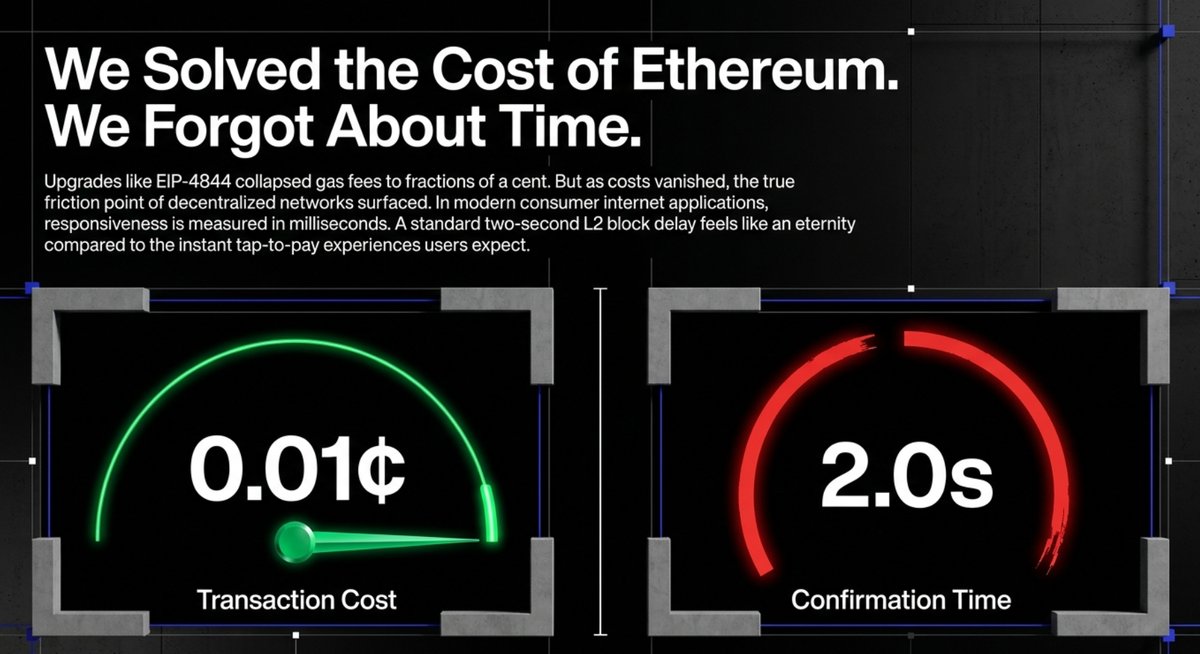
For years, the standard narrative around Ethereum Layer-2 (L2) rollups focused almost exclusively on transaction fees. Protocol upgrades like EIP-4844 dramatically reduced gas costs, making transfers on networks like Base cost mere fractions of a cent. However, as transaction costs collapsed, another critical friction point surfaced: latency. In modern consumer internet services, responsiveness is measured in milliseconds. Waiting two to three seconds for a blockchain transaction to confirm feels sluggish compared to the instant tap-to-pay experiences of modern financial applications.
Base, the Ethereum Layer-2 incubated by Coinbase, has tackled this responsiveness challenge through the introduction of Flashblocks. Designed as an incremental streaming block construction mechanism, Flashblocks reduce transaction confirmation times down to 200 milliseconds. This architectural advancement bridges the experiential gap between decentralized finance and centralized exchanges, unlocking entirely new categories of high-frequency consumer applications without weakening underlying security.
The Limitation of Standard L2 Block Times
To understand how Flashblocks operate, we must examine the conventional lifecycle of an L2 transaction. In standard optimistic rollups, the centralized sequencer receives user transactions from an L2 mempool, sequences them into an order, and packages them into a block roughly every two seconds. Once that block is produced, the state update is sent back to connected nodes and Remote Procedure Call (RPC) endpoints.
While two seconds is vastly superior to the twelve-second block interval of Ethereum mainnet, it introduces significant obstacles for interactive consumer and financial use cases:
- DEX Slippage and Price Discrepancies: In decentralized trading, two seconds is an eternity. Arbitrageurs exploit latency differences between centralized order books (like Binance or Coinbase) and automated market makers on L2, leading to adverse selection and wider bid-ask spreads for retail traders.
- Mobile Application UX: In decentralized social networks, micro-tipping systems, or consumer gaming, a two-second delay breaks the psychological feedback loop required for an engaging user experience. Users repeatedly tap buttons, assuming the interface is frozen.
- MEV Extraction Windows: Longer block times provide searchers with wider time windows to detect pending user transactions and execute sandwich attacks or frontrunning strategies in the pending block queue.
The Architecture of Flashblocks: Streaming Partial Blocks
Flashblocks replace the traditional batch-and-wait model with continuous streaming execution. Rather than waiting for a full two-second interval to expire before packaging hundreds of transactions together, the Base sequencer operates a pipelined streaming engine developed in collaboration with Espresso Systems.
Every 200 milliseconds (five times per second), the sequencer assembles an incremental batch of incoming transactions into a partial block, formally termed a Flashblock. This sub-block is immediately signed by the sequencer and broadcast over a high-speed peer-to-peer gossip network directly to full nodes and RPC providers.
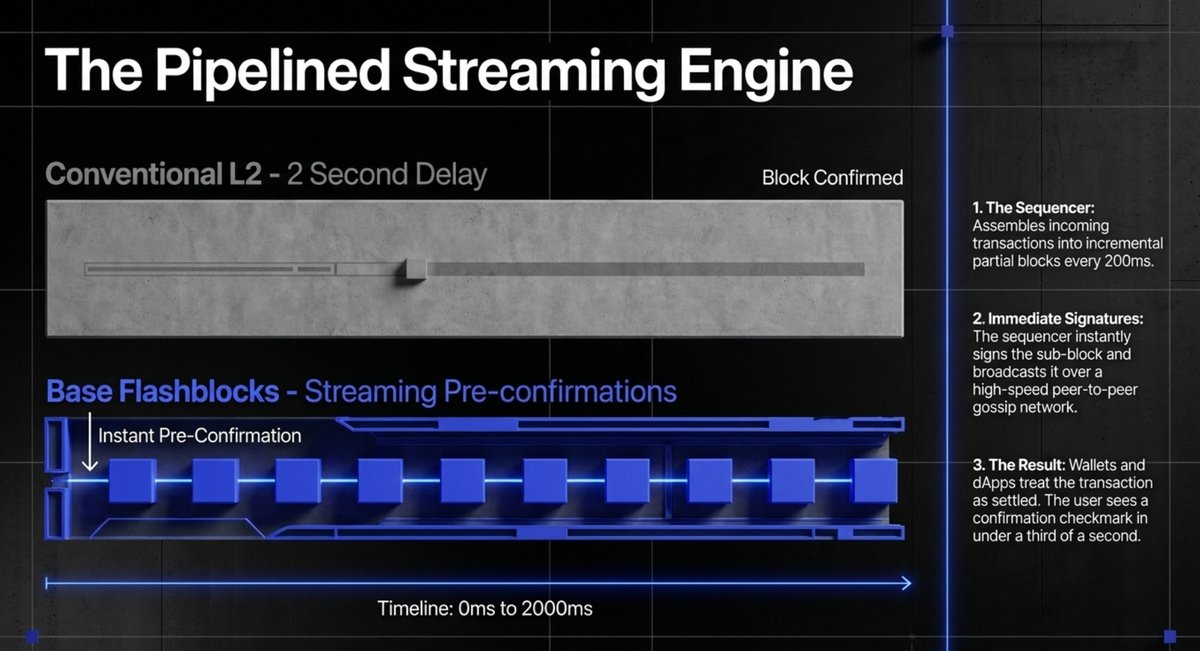
Conventional L2 (2-Second Delay):
[User Tx] ---------------------- 2000ms ----------------------> [Block Confirmed]

Base with Flashblocks (Streaming Pre-confirmations):
[User Tx] -> [Flashblock 1 (200ms)] -> [Flashblock 2 (400ms)] -> ... -> [Full 2s L1 Batch]
                 ^ Instant Pre-Confirmation Delivered
Because the signature on each Flashblock represents a cryptographic commitment from the sequencer regarding the exact ordering and state execution of that batch, wallets and dApps can treat the transaction as settled almost instantaneously. The user sees a confirmation checkmark in their wallet in under a third of a second, while the full two-second rollup block is assembled quietly in the background before being batched down to Ethereum Layer-1 for permanent data availability.
Preserving Consensus and L1 Security Guarantees
A critical architectural question is whether streaming partial blocks compromises the security or decentralization of the network. The answer lies in the clear separation between execution pre-confirmations and settlement finality.
Flashblocks do not alter the underlying cryptographic security of optimistic rollups. The formal state transitions of the network remain governed by the L1 smart contracts and the OP Stack dispute framework documented on the official Base developer platform.
- Pre-Confirmation Level: The Flashblock provides a fast, soft pre-confirmation backed by the sequencer's cryptographic signature. If a dApp trusts the sequencer not to equivocate (double-spend), it can safely credit the user's account in 200 milliseconds.
- L2 Block Level: Every two seconds, ten consecutive Flashblocks are aggregated into a canonical L2 block.
- L1 Settlement Level: The rollup compresses these canonical blocks and posts them to Ethereum Layer-1 as data blobs (via EIP-4844). Once posted to L1, the transaction inherits Ethereum's multi-billion-dollar economic security and becomes subject to standard fault proofs.
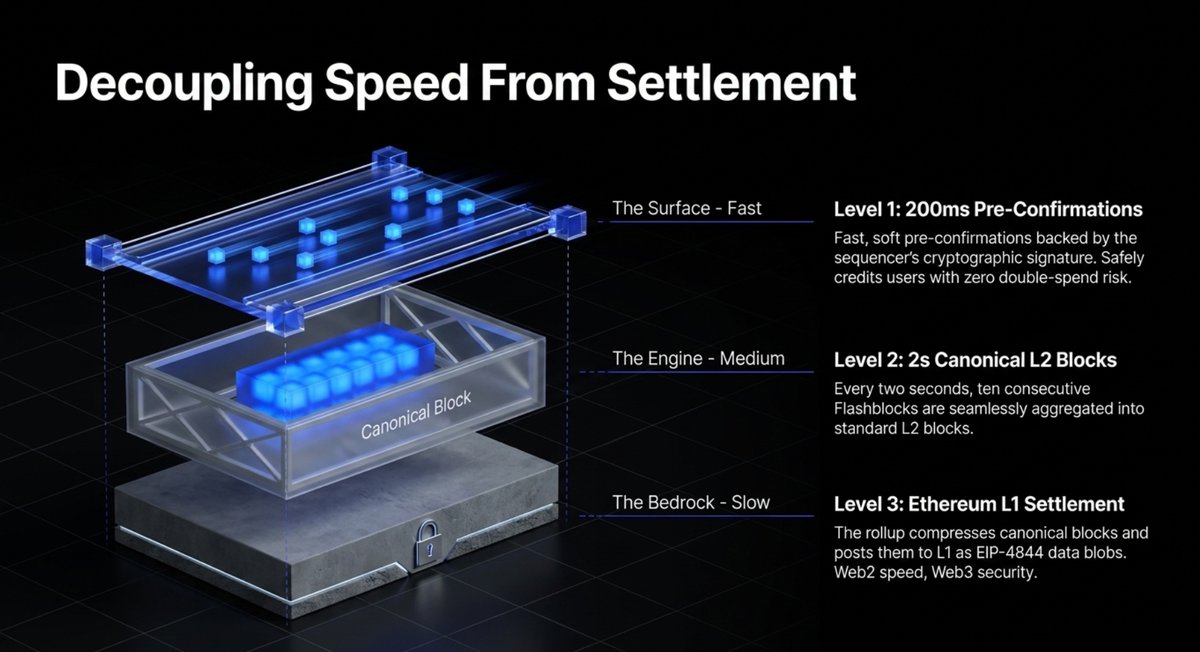
Flashblocks decouple user-facing latency from base-layer settlement, allowing applications to offer Web2 responsiveness while maintaining full Ethereum security guarantees.
Eliminating Toxic MEV and Leveling the Playing Field
Beyond improving raw user interface responsiveness, the 200-millisecond block interval fundamentally re-engineers the micro-structure of decentralized financial markets on Base. In traditional two-second blocks, high-frequency MEV searchers possess a substantial time window to scan the mempool, identify profitable retail swaps, and bribe sequencers to insert sandwich attacks.
Because Flashblocks stream transactions every 200 milliseconds, the pending queue window shrinks by an order of magnitude. A retail swap that enters the sequencer is included and pre-confirmed almost before external searcher bots can execute off-chain arbitrage calculations. By dramatically accelerating the cycle of execution, Flashblocks compress the profitability of latency arbitrage, ensuring that user transactions execute at prices much closer to the true market equilibrium.
The Technical Plumbing: Server-Sent Events and Node Infrastructure
The deployment of Flashblocks required substantial modernization across the RPC infrastructure supporting Base. Traditional web3 frontends interact with nodes via polling JSON-RPC queries (eth_getTransactionReceipt), which repeatedly query the server until a transaction confirms. Under a 200-millisecond streaming regime, standard polling would completely overwhelm node providers with redundant HTTP requests.
To deliver instantaneous updates efficiently, Base node infrastructure introduced streaming communication channels based on Server-Sent Events (SSE) and bi-directional WebSockets. When a mobile wallet or trading terminal submits a transaction, it opens a persistent streaming socket. The node pushes Flashblock execution receipts down to the client the instant the sequencer signs the sub-block. This architecture mirrors the high-performance telemetry used in institutional financial exchanges, enabling seamless real-time data flows without polling overhead.
Economic Implications for Liquidity Providers and Market Makers
Sub-second block production also creates profound economic benefits for automated market makers (AMMs) and on-chain liquidity providers. In conventional L2 architectures with two-second block intervals, liquidity providers suffer from a persistent cost known as Loss-Versus-Rebalancing (LVR). Because off-chain prices on centralized venues move continuously, arbitrage bots repeatedly trade against stale on-chain quotes during the two-second gap, extracting capital from passive liquidity pools.
With Flashblocks updating on-chain prices every 200 milliseconds, liquidity pool quotes stay synchronized with global market feeds in near real time. Arbitrageurs have five times fewer opportunities to execute stale-price trades against passive pools. As a direct consequence, decentralized liquidity providers experience significantly reduced impermanent loss, which encourages institutional capital allocators to deposit deeper liquidity reserves into decentralized exchanges on Base.
What Sub-Second Latency Unlocks for Developers
The practical implications of 200-millisecond execution extend across the entire Web3 design space. In decentralized finance, automated market makers can update liquidity pool prices at five times the frequency, dramatically shrinking the window for toxic arbitrage and allowing market makers to quote tighter bid-ask spreads. On-chain central limit order books, which historically suffered from severe latency penalties compared to centralized exchanges, become viable on Layer-2.
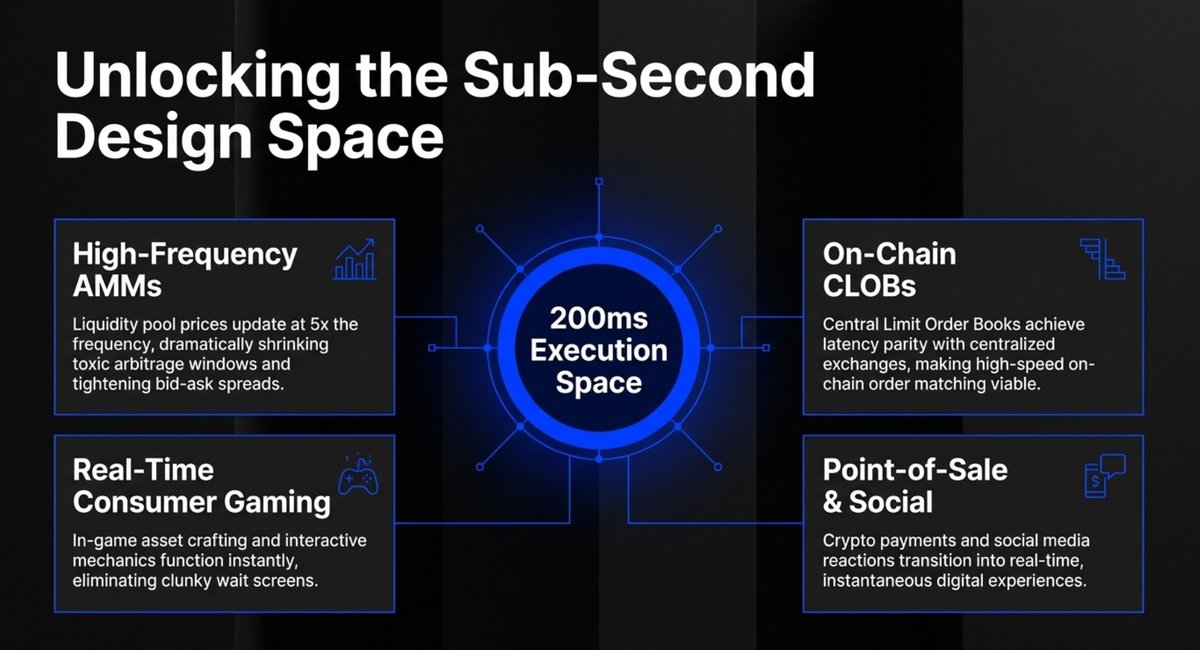
For consumer applications, the psychological impact is profound. Point-of-sale crypto payments, in-game asset crafting, and social media reactions on Base transition from asynchronous, clunky interactions into real-time digital experiences. By transforming L2 performance from a waiting game into an instantaneous background utility, Flashblocks establish the foundational infrastructure required to bring the next billion users on-chain.