
 Base
Base Unichain
 Robinhood

A public company that holds a basket of altcoins loves to show a single number: market capitalization divided by the value of its net assets. This number, called mNAV, stays convenient only while markets are calm. The moment turnover drops, spreads widen and buyers disappear, the elegant ratio stops describing reality. Investors do not need the coefficient itself. They need an answer to a harder question: at what price and with what losses can the treasury turn its portfolio into cash on a bad day.
The difference between market risk and construction risk decides everything here. Market risk is visible to everyone, since a coin price can fall and that is the honest cost of exposure. Construction risk hides deeper, inside custody rules, sale rights, debt structure and disclosure quality. It is the risk that most often turns a reasonable idea into a loss, because even a correct bet is worthless when management cannot act in time.
What actually sits behind mNAV
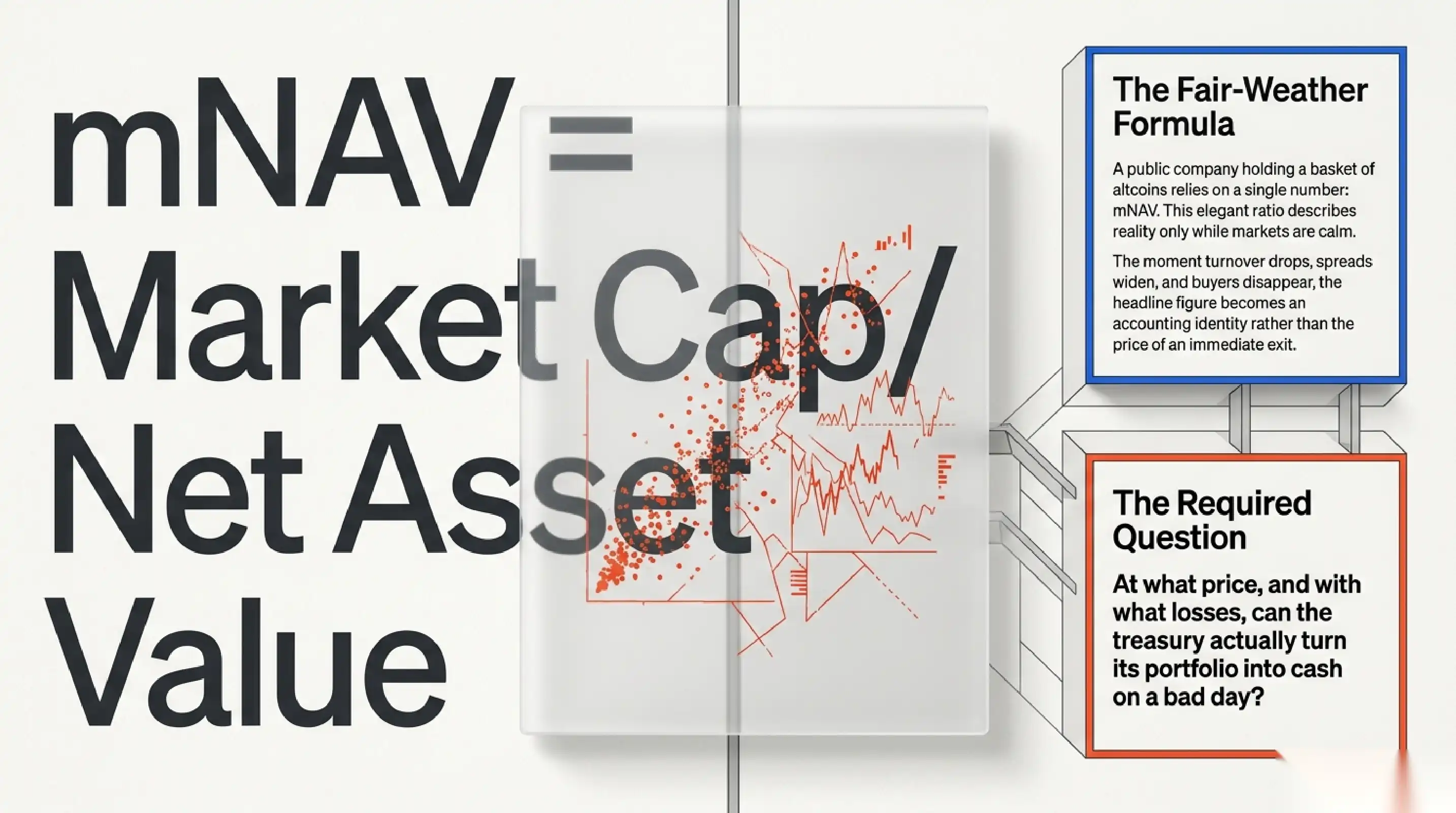
The ratio compares a company’s market value with the net value of its assets, yet net value depends entirely on what the portfolio is made of. Liquid bitcoin, a staked token, a locked venture allocation and a cash balance are equal only on paper. Under an urgent exit their prices diverge sharply. If every position is marked at the last quote, the headline figure easily overstates how much cash the company can actually raise.
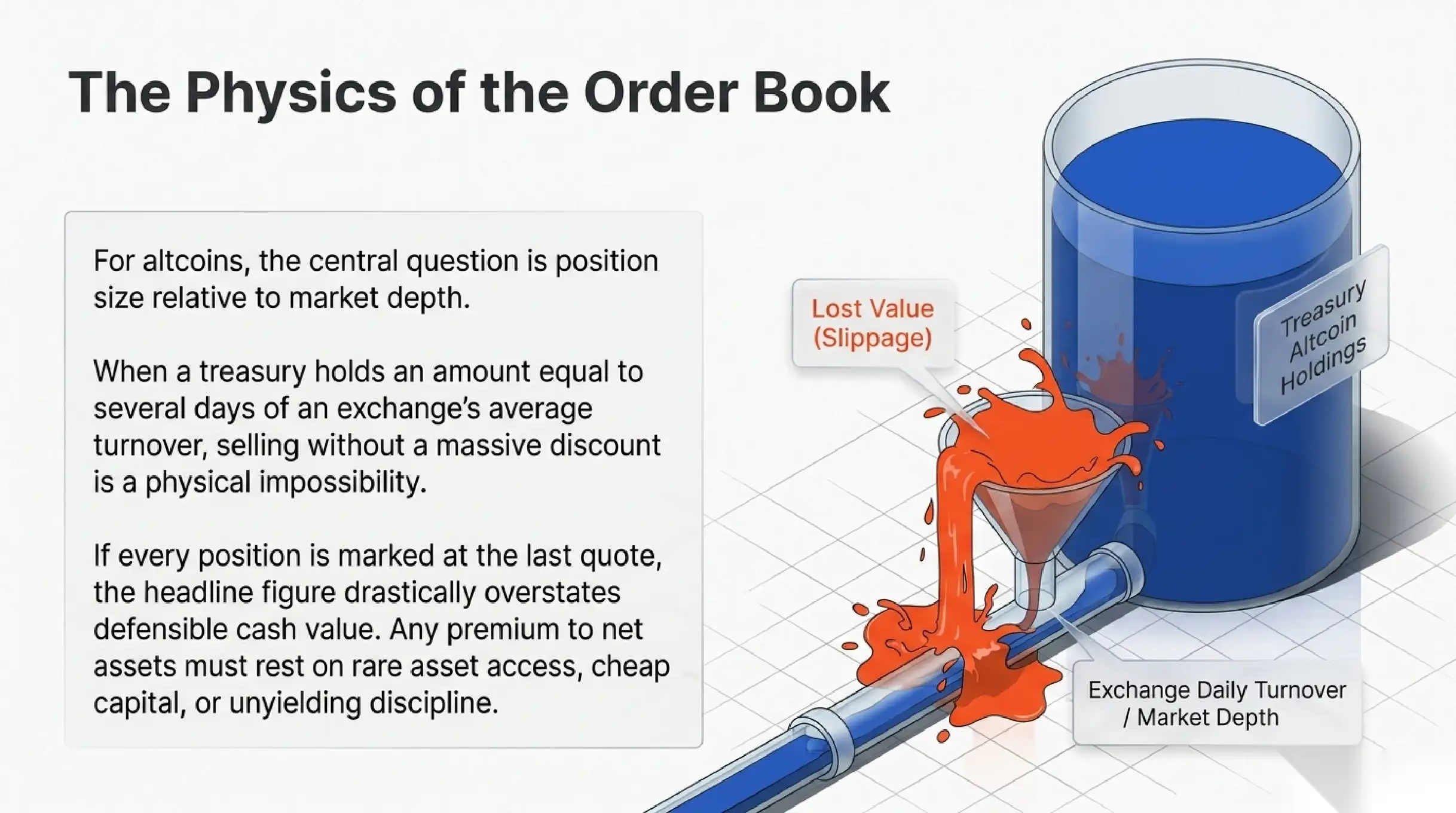
For altcoins the central question is position size relative to market depth. When a company holds an amount equal to several days of an exchange’s average turnover, selling it without a discount is physically impossible. In that case mNAV shows an accounting identity, not the price of an immediate exit. Any premium to net assets should therefore rest on something stronger than hype: rare access to an asset, a tax wrapper, cheap capital or discipline that a single investor cannot reproduce alone.
The source of the valuation deserves separate attention. If a participant sees a number but cannot tell who calculates it, how often it updates and what happens when it is wrong, the evidentiary value of that number is close to zero. In a financial structure, losses rarely come from a flawed thesis. Far more often they come from being unable to execute the required action at the required second, and the more complex the product, the more expensive that delay becomes.
Why altcoins break the simple formula
The same percentage gain in two tokens does not imply the same balance sheet quality. A token of a major network with a deep market and a thin protocol token with a few hundred thousand dollars of daily volume demand completely different haircuts. A treasury that prints its portfolio as one line hides the most important facts: what can be sold today, what is staked, what a contract has locked and what depends on the will of one counterparty.
A strong valuation splits assets into working buckets. Liquid coins sit close to market price. Staking positions get an adjustment for the unbonding period, validator slashing risk and yield after fees. Venture tokens require a discount for lock-up, thin markets and the odds of future issuance inside their own network. Borrowed and derivative positions must be checked by margin and counterparty reliability rather than by face value.
When an indicator blends capital, turnover, fees and expected yield into one appealing signal, it stops being an analytical tool and becomes a sales tool. The sensible response is simple: break the number into its parts and test each part on its own. Only then does a comparison with other treasuries make sense, because you are comparing like with like instead of two marketing slogans dressed as data.
The premium as fuel and as a trap
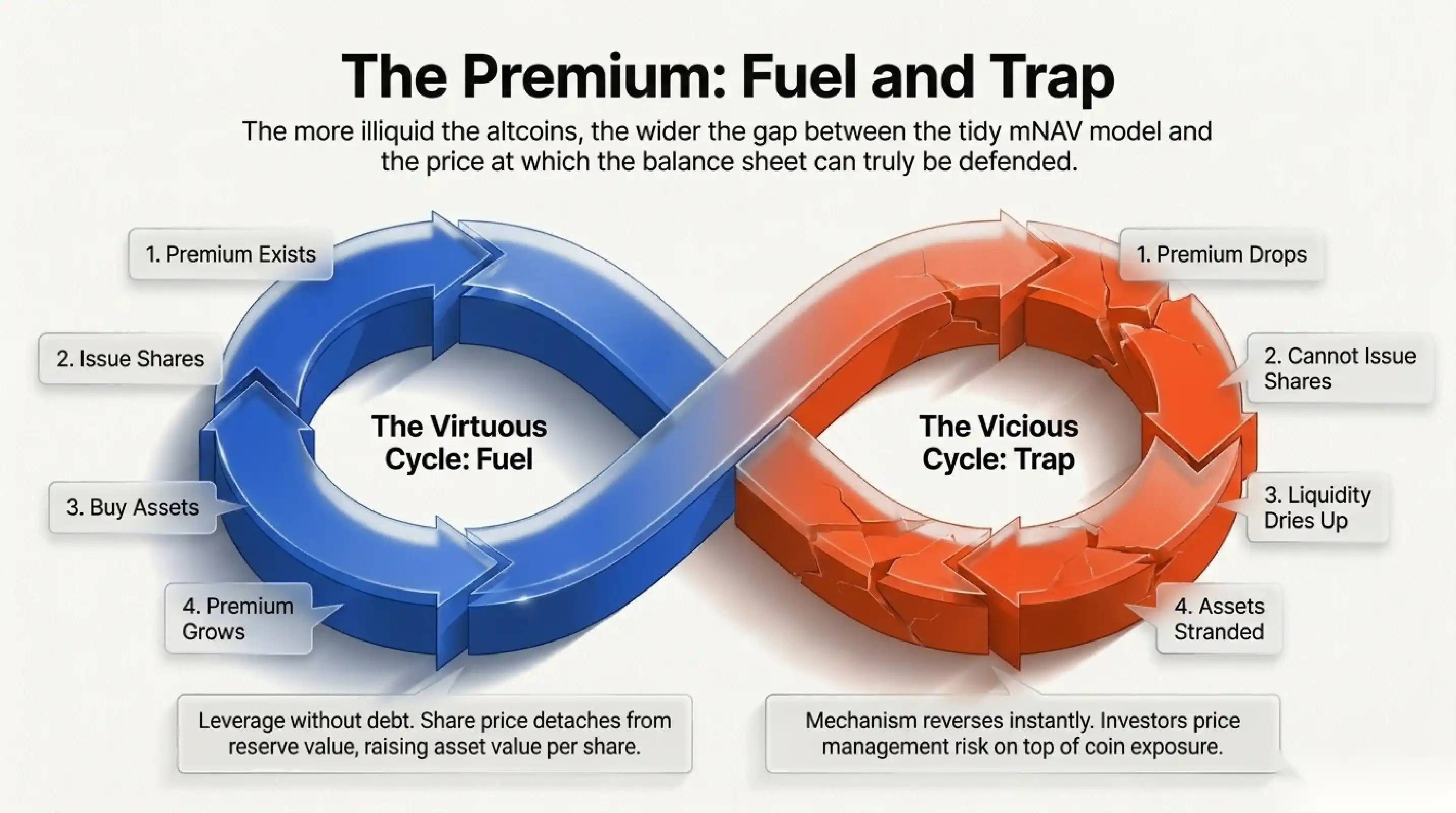
A premium to net assets can sometimes work for a company. While shares trade above assets, new issuance raises asset value per share, provided the proceeds are deployed into the portfolio without heavy slippage. This resembles leverage without traditional debt, but it survives on one condition: the market must trust the strategy and agree to pay the markup. Once belief fades, the mechanism fades with it.
The reversal arrives quickly. Premium compression turns a former advantage into pressure. The company can no longer issue shares on attractive terms, and investors start pricing management risk on top of coin exposure. The more illiquid altcoins sit in the portfolio, the wider the gap between a tidy model and the price at which the balance sheet can truly be defended under stress.
Liquidity also depends on how concentrated the participants are. One large market maker, one custodian or one main pool keeps order during quiet periods while creating a single point of failure. Treasury quality is therefore measured not by the average fee on a calm day, but by how the system behaves when the main liquidity provider steps away. If a backup channel is not described in advance, resilience remains a word from a slide deck.
The people behind the balance sheet
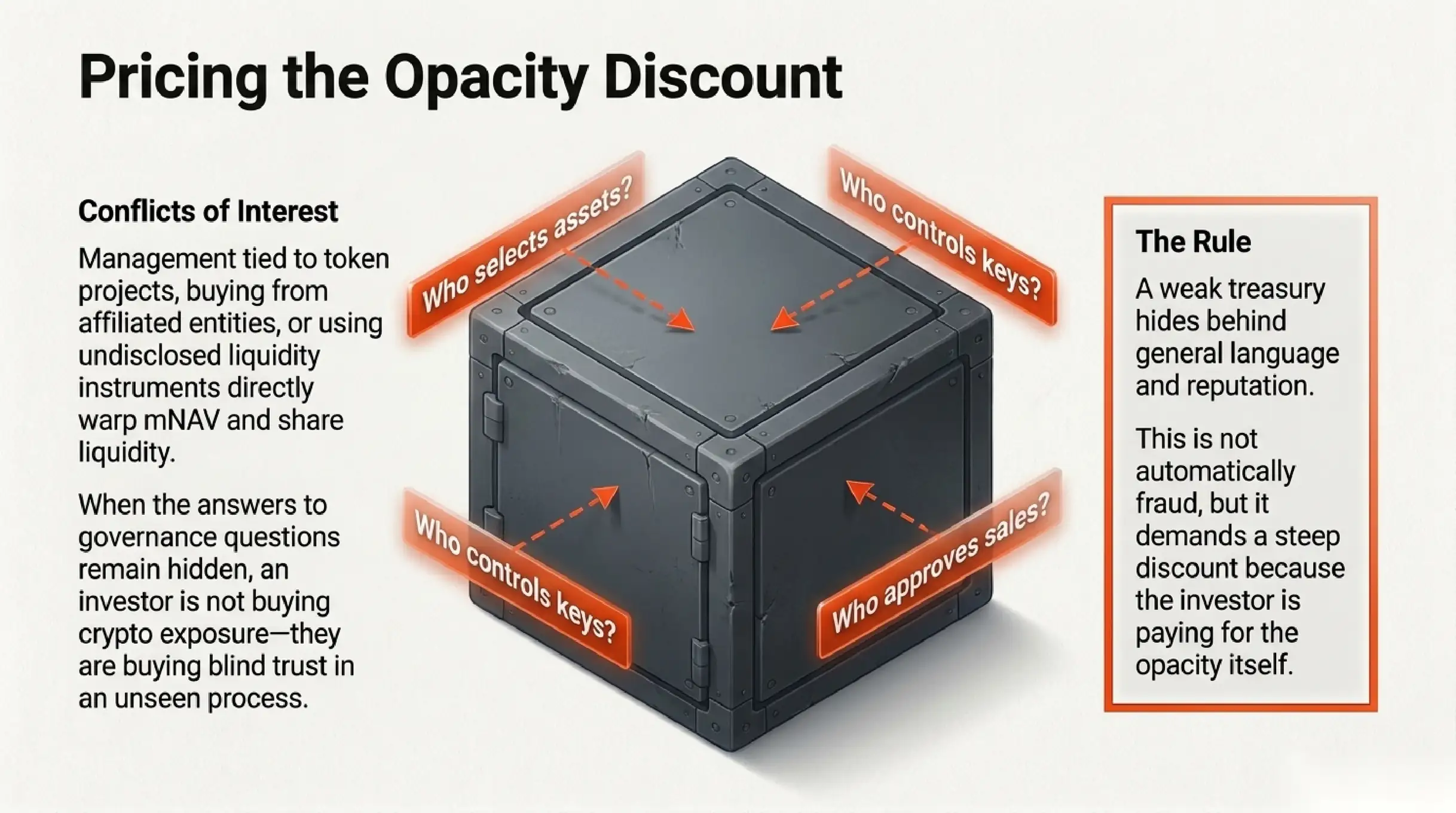
A treasury looks passive, yet every day someone makes decisions that reshape the risk profile. Who selects assets, who sets limits, who approves sales, who signs deals with market makers, who controls the wallet keys, who authorizes the use of derivatives. When the answers stay hidden, an investor is buying not crypto exposure but trust in a process they cannot see.
Conflicts of interest deserve particular scrutiny. Management is sometimes tied to projects whose tokens land on the balance sheet. A company may buy assets from affiliated entities or support liquidity with instruments that never appear in a standard report. For a public market this is no small thing, because such decisions directly affect mNAV, share liquidity and whether the premium can survive pressure.
There is a simple test for this. A good treasury discloses wallet addresses where possible, shows the unlock schedule, names the custodian and explains its sale policy. A weak treasury hides the portfolio behind general language and asks you to trust its reputation. The second case is not automatically fraud, but it demands a larger discount, because you are also paying for the opacity itself.
A stress scenario instead of a forecast
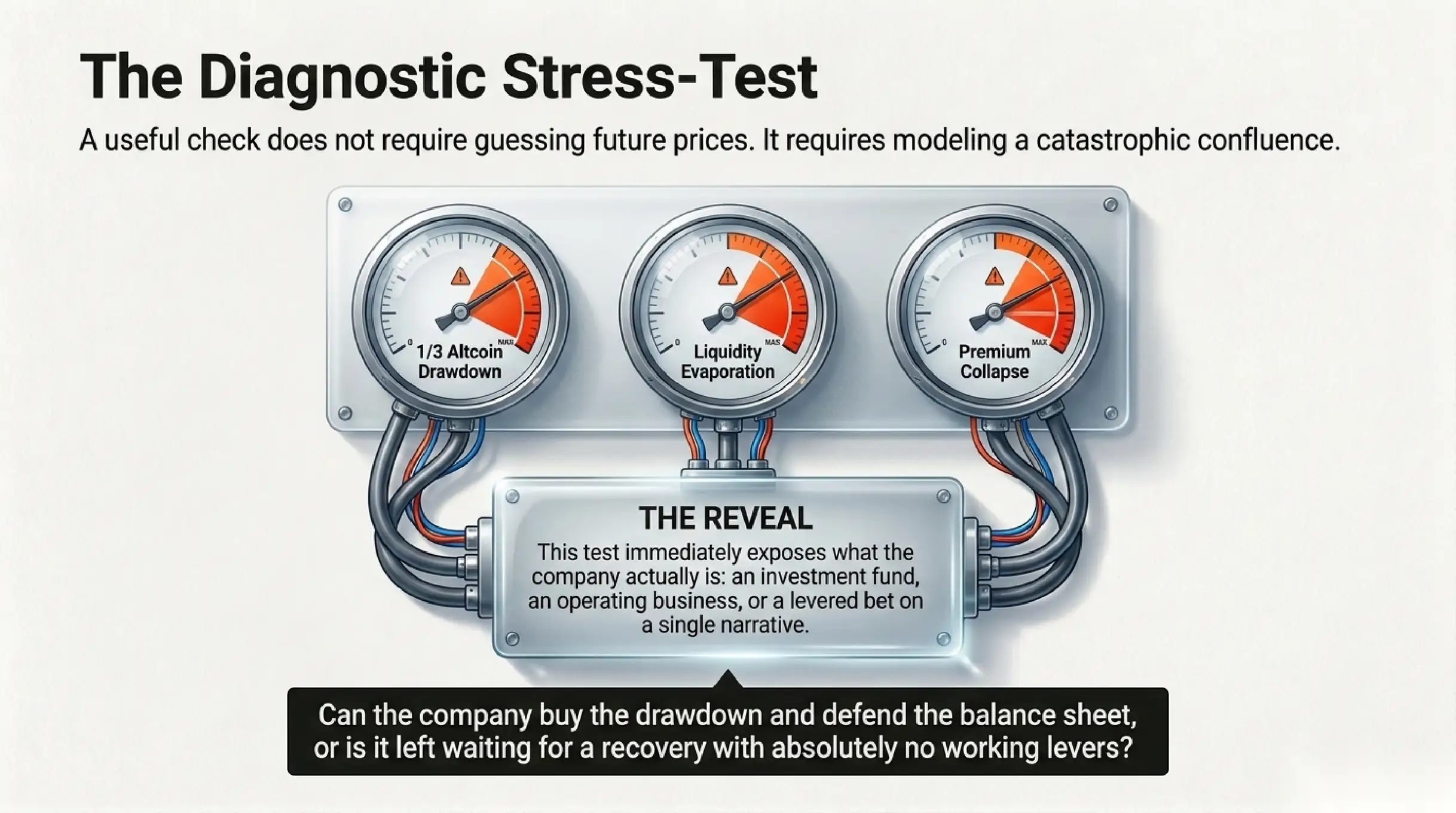
A useful check does not require guessing the future price. It is enough to model a simultaneous one third drawdown in altcoins, a fall in exchange liquidity and the disappearance of the premium. If the share then stops trading above assets, market capitalization can fall faster than the portfolio itself. Add debt, convertible notes or commitments to make future purchases, and the pressure grows further still.
This test immediately reveals what the company really is: an investment fund, an operating business or a levered bet on a single narrative. In a calm phase the difference is invisible. In a weak phase it determines everything, from whether the company can buy the drawdown and defend the balance sheet to whether it can sell assets, issue shares or is left waiting for a recovery with no working lever at all.
The legal layer here is not an attachment but a load-bearing wall. Documents decide whether a holder has a right to the asset, a redemption right, a clear procedure during failure and a path to complain. If a contract grants the operator broad power to suspend operations or change terms, that is not a defect by itself, but it is a material risk parameter that must be priced in advance rather than surfacing in the middle of a dispute.
A short checklist before deciding
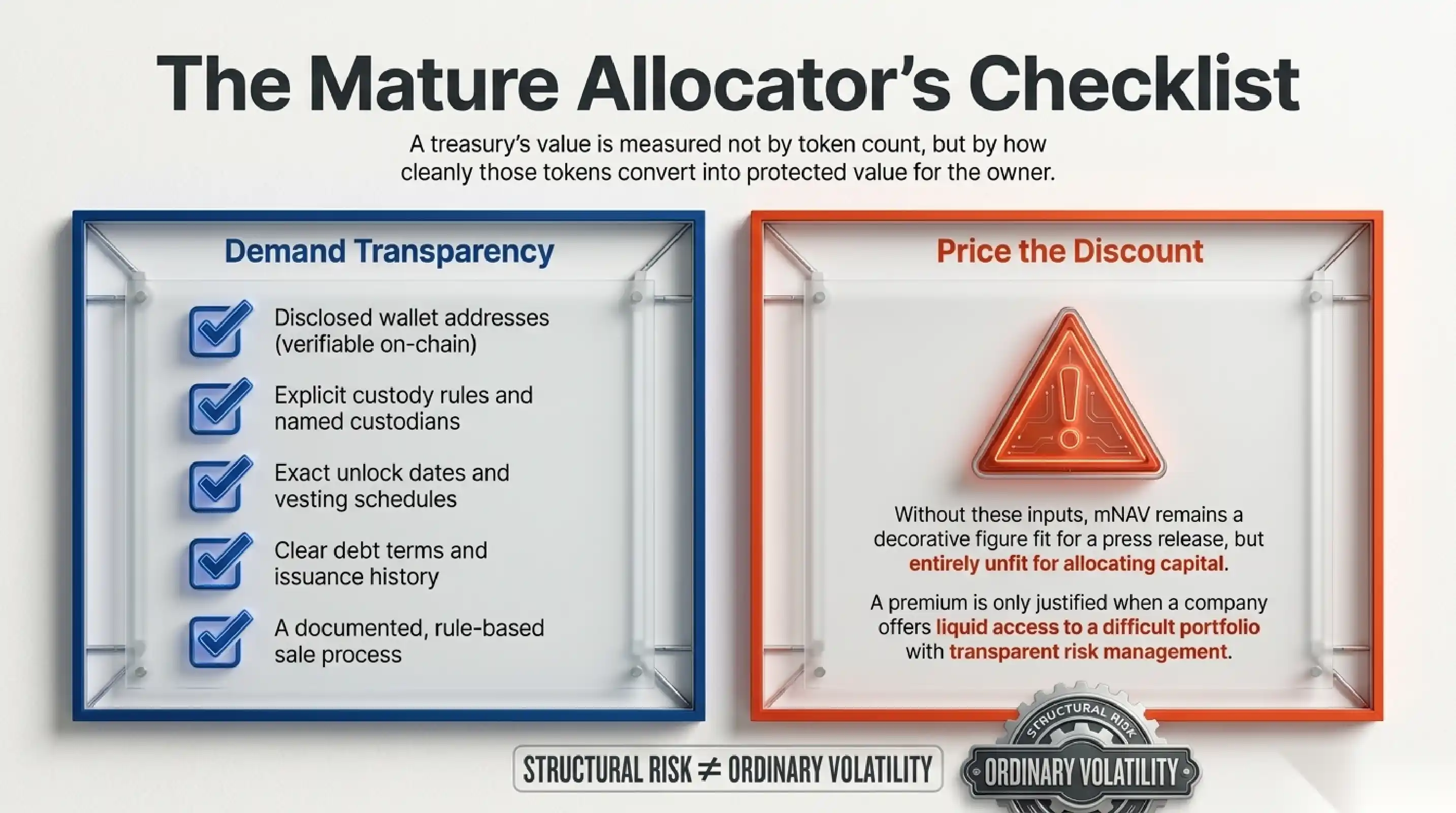
The final review begins with a table: assets, liabilities, restrictions. You need wallet addresses where disclosed, custody rules, unlock dates, debt terms, issuance history, the sale process and the quality of reporting. Without these inputs mNAV remains a decorative figure, fit for a press release but not for allocating capital.
A premium is justified when a company offers liquid access to a difficult portfolio, manages risk more transparently than peers and avoids diluting shareholders for the sake of headlines. A discount is justified when the portfolio is poorly disclosed, the assets are thin, governance is closed and growth depends on constant issuance. A treasury’s value is measured not by token count but by how cleanly those tokens convert into protected value for the owner.
A good conclusion has to be neither optimistic nor grim. It should map the range of conditions under which the instrument works and the conditions under which it stops matching expectations. That understanding separates structural risk from ordinary volatility and stops anyone from confusing technological novelty with investment reliability. For a mature investor, that distinction matters more than any short-term move in price.
Why a treasury is not the same as a fund
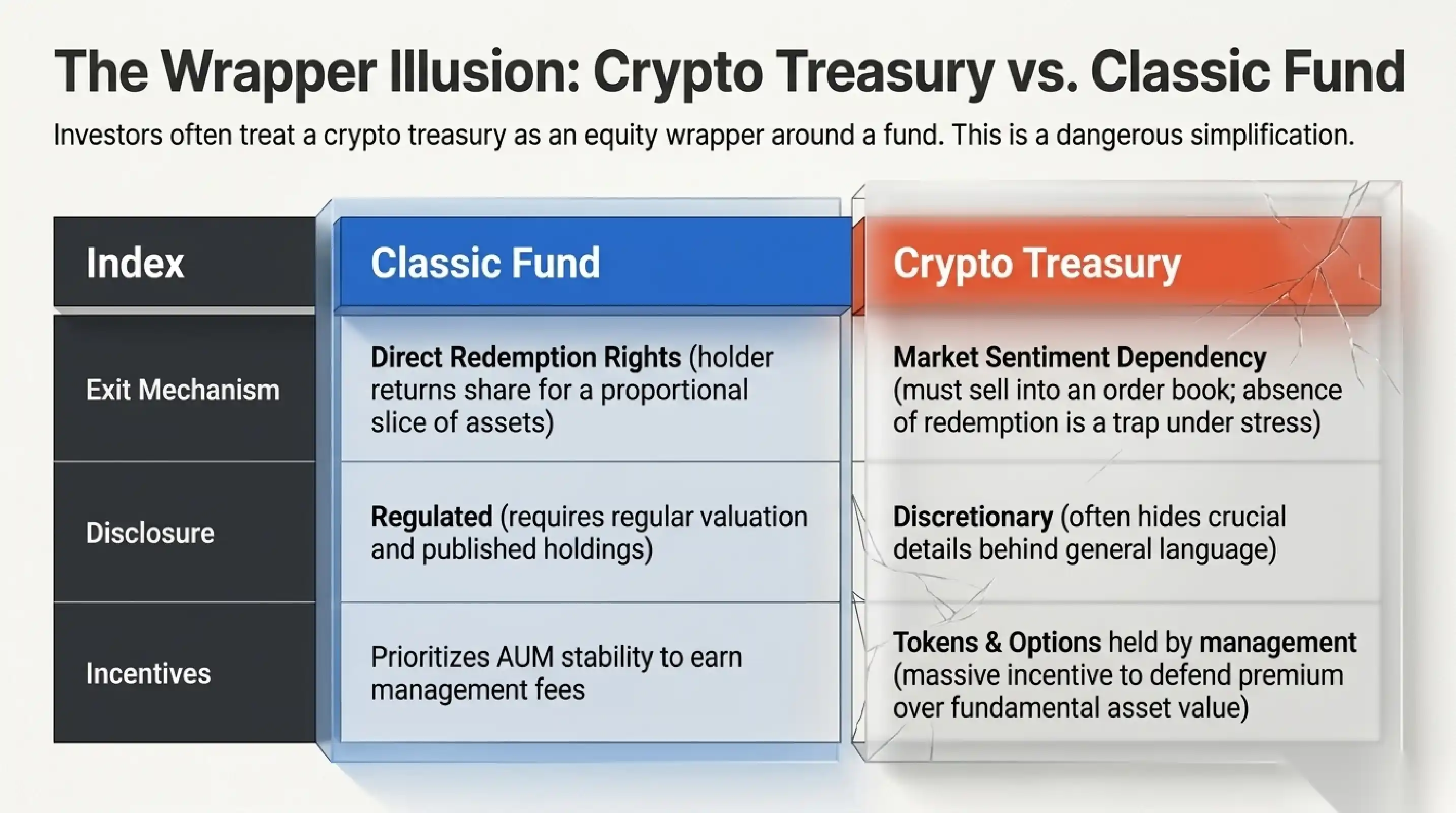
Investors often treat a crypto treasury as an equity wrapper around a fund, but that is a dangerous simplification. A classic fund usually has a redemption mechanism: a holder can return a share and receive a proportional slice of the assets. A public treasury almost never grants that right. A shareholder can only sell the share to another market participant at whatever price that buyer will pay. So the link between share price and asset value rests not on an exit right but on market sentiment.
An important consequence follows. When the premium is large, the absence of redemption does not hurt, because the market already pays more than the assets are worth. When the premium disappears, the absence of redemption becomes a trap: a holder cannot claim their slice of the portfolio directly and is forced to sell into an order book that turns thin in a stress phase. That is why a treasury without a redemption mechanism should be judged more strictly than a fund that has one, all else equal.
The second difference is disclosure. A regulated fund must publish its holdings regularly and follow valuation rules. A treasury discloses exactly as much as it chooses and often hides the most important details behind general language. An investor who carries fund habits into the treasury world easily overrates transparency and underrates construction risk. The sensible response is to demand at least the disclosure a regulated fund would give and to apply a discount wherever that level is not met.
Finally, there is a difference in management incentives. A fund manager earns on a fee for assets under management and prefers stability. A treasury team often holds its own tokens and options, so it has a stronger incentive to defend the premium and the narrative. This is not a flaw, but it is a factor that changes how any public figure should be read.
Examples and sources
The best known example of a corporate crypto treasury is Strategy (formerly MicroStrategy), which holds its core reserve in Bitcoin and publishes figures on the premium to net asset value. Its disclosures work well as a study case for reading mNAV, because you can see how the share price detaches from the value of the reserve.


.png)