 Base
Base Unichain
 Robinhood
- Traditional Ethereum executes transactions sequentially in a single thread, creating a severe throughput bottleneck.
- Parallel EVM processes independent transactions concurrently using multi-core processor architecture and Optimistic Concurrency Control.
- If two transactions access the exact same state or balance, the engine automatically detects the conflict, aborts, and reruns them in order.
- Projects like Monad, Sei v2, and MegaETH bring Web2 performance to the EVM ecosystem while maintaining full compatibility with existing Solidity code.
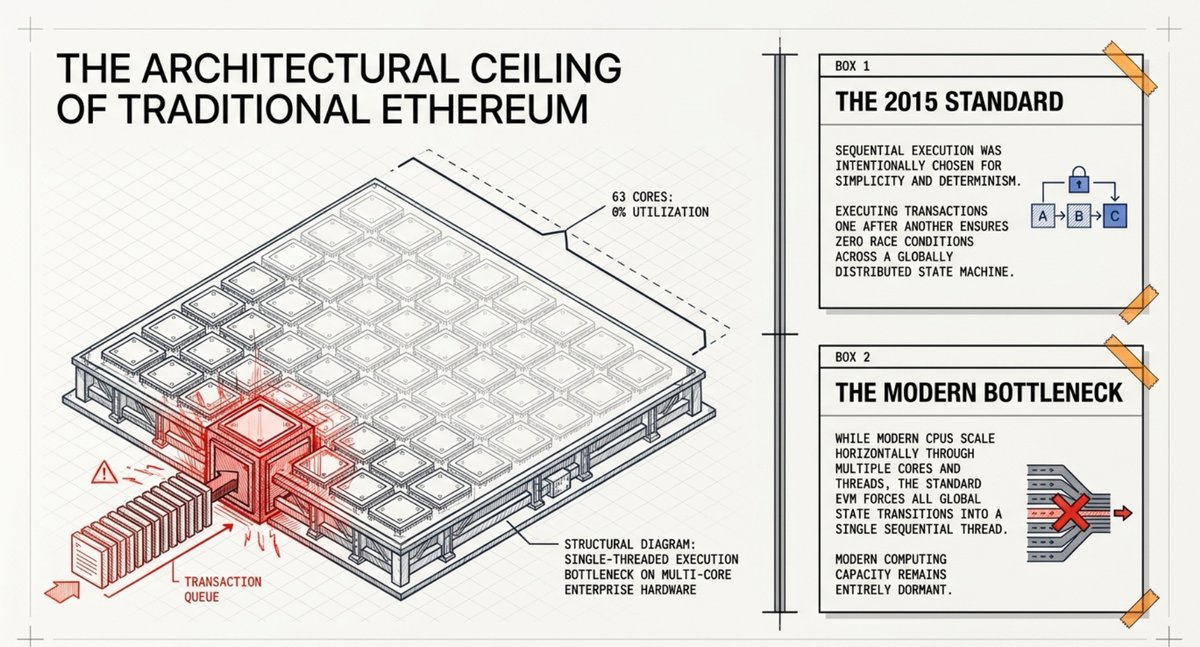
The Ethereum Virtual Machine (EVM) serves as the foundational operating system of decentralized finance. Over the last decade, developers have written hundreds of thousands of smart contracts in Solidity, establishing standards, security practices, and financial primitives that secure tens of billions of dollars in economic value. However, the classical EVM architecture contains a fundamental engineering constraint: it is strictly single-threaded. Standard Ethereum nodes process transactions one by one in a single sequential queue, precisely like shoppers standing in a single line at a grocery store checkout counter.
When user activity surges during volatile market events or major token releases, this single-threaded model hits an immediate performance ceiling. Gas prices spike dramatically, transactions stall in mempools, and the network slows down. Crucially, this slowdown does not occur because modern server hardware lacks raw computing power. It occurs because the EVM software architecture artificially restricts execution to a single CPU core, leaving modern multi-core processors largely underutilized. Parallel EVM represents an engineering breakthrough that preserves total bytecode compatibility with Ethereum while enabling multi-core processors to execute thousands of transactions concurrently.
Why the Traditional EVM Executes in a Single Queue
To understand the mechanics of parallel execution, we must first examine how standard blockchains handle state transitions. At its technical core, a blockchain is a deterministic distributed state machine. When an Ethereum block is proposed, it contains an ordered list of transactions. The node executes transaction 1, updates account balances in memory, executes transaction 2, updates balances again, and continues sequentially until the block gas limit is reached.
This sequential model was intentionally adopted in 2015 for safety, simplicity, and determinism. Because thousands of independent validator nodes scattered around the globe must arrive at the exact same cryptographic state root, executing transactions sequentially eliminates race conditions. If Alice transfers 100 USDC to Bob, and Bob immediately swaps that 100 USDC into ETH on Uniswap, executing these operations in strict chronological order guarantees that Bob cannot spend funds before they actually arrive in his wallet.
However, modern computer hardware has evolved significantly. CPU manufacturers no longer achieve performance gains by increasing single-core clock speeds. Instead, performance scales horizontally by adding multiple physical cores and threads. In standard Ethereum, an enterprise server equipped with a modern 64-core processor still dedicates only one single core to smart contract calculations, leaving the remaining 63 cores completely idle. Parallel EVM unlocks this dormant hardware capacity, transforming sequential execution into an efficient multi-lane highway.
How Parallel Execution Actually Works: Optimistic Concurrency Control
The primary technical challenge of parallel blockchain execution is managing state dependencies. If Transaction A interacts with an Aave lending market, and Transaction B transfers an ERC-20 token between two private wallets on another continent, these two transactions touch completely separate memory slots. There is zero technical reason to force Transaction B to wait for Transaction A. They can be executed at the exact same millisecond on separate CPU cores.
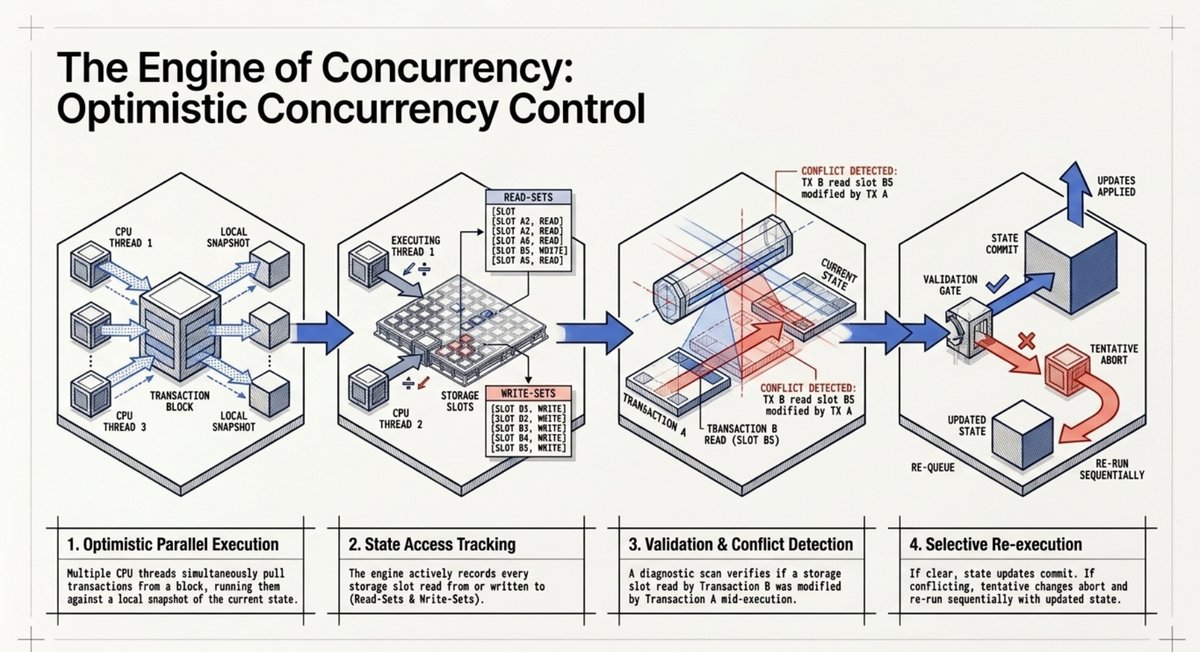
To achieve this safely, leading parallel EVM networks utilize an architectural framework known as Optimistic Concurrency Control (OCC), often implemented via algorithms such as Block-STM (Software Transactional Memory). Rather than analyzing complex transaction dependencies before execution, the network optimistically assumes that transactions will not conflict with each other.
Incoming Block of Transactions
      |
      +---> Core 1: Processes Tx 1 (Alice -> Bob) ---------> Committed Successfully
      +---> Core 2: Processes Tx 2 (Swap on Uniswap) ------> Conflict Detected -> Aborted & Re-run
      +---> Core 3: Processes Tx 3 (Mint NFT on Base) -----> Committed Successfully
The execution lifecycle under Optimistic Concurrency Control proceeds through four coordinated stages:
- Optimistic Multi-Threaded Execution: The execution engine distributes incoming transactions across all available CPU cores simultaneously. Each core executes its assigned transaction against an isolated memory snapshot of the pre-block state.
- Access Tracking (Read-Sets and Write-Sets): Throughout execution, the engine meticulously logs every memory location and storage slot that a transaction reads from and writes to.
- Conflict Detection and Validation: Before writing state changes to the global ledger, the system checks whether any storage slot read by Transaction B was modified by Transaction A during execution.
- Selective Re-execution: If no memory overlap occurred, the transactions commit their state updates permanently. If a conflict is discovered, Transaction B is cleanly rolled back, its intermediate computations are discarded, and it is re-executed with the newly updated state.
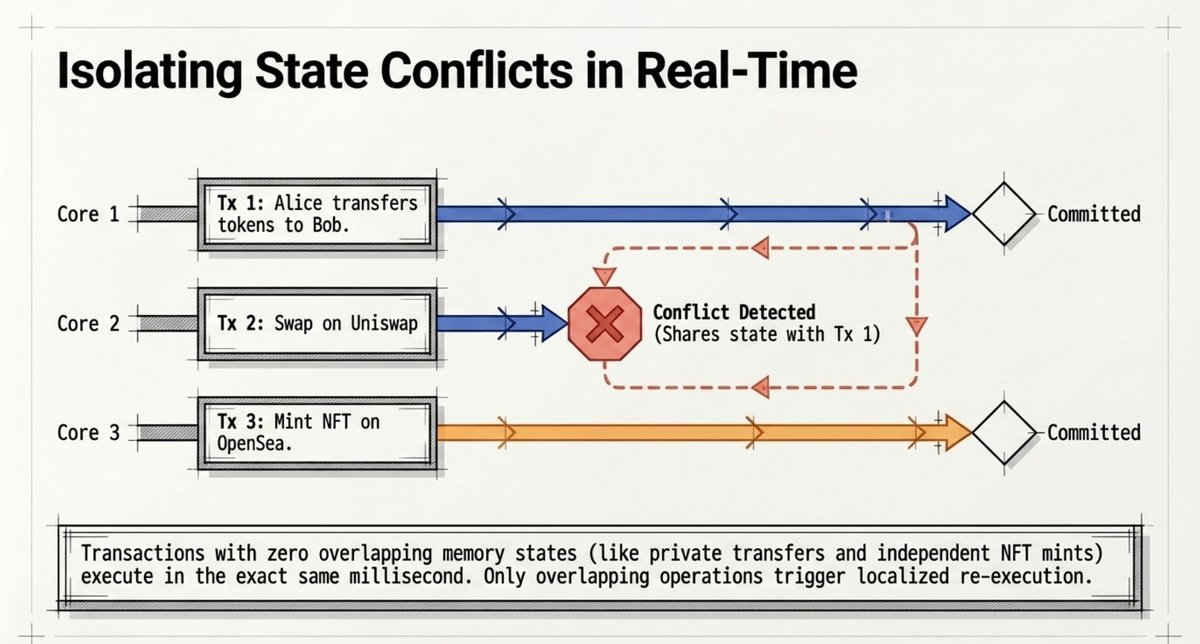
Because the vast majority of real-world blockchain transactions do not touch the same liquidity pool or wallet balance, over 90 percent of operations pass validation on the first attempt, yielding massive throughput improvements.
The Hidden Bottleneck: Storage I/O Versus Raw Computation
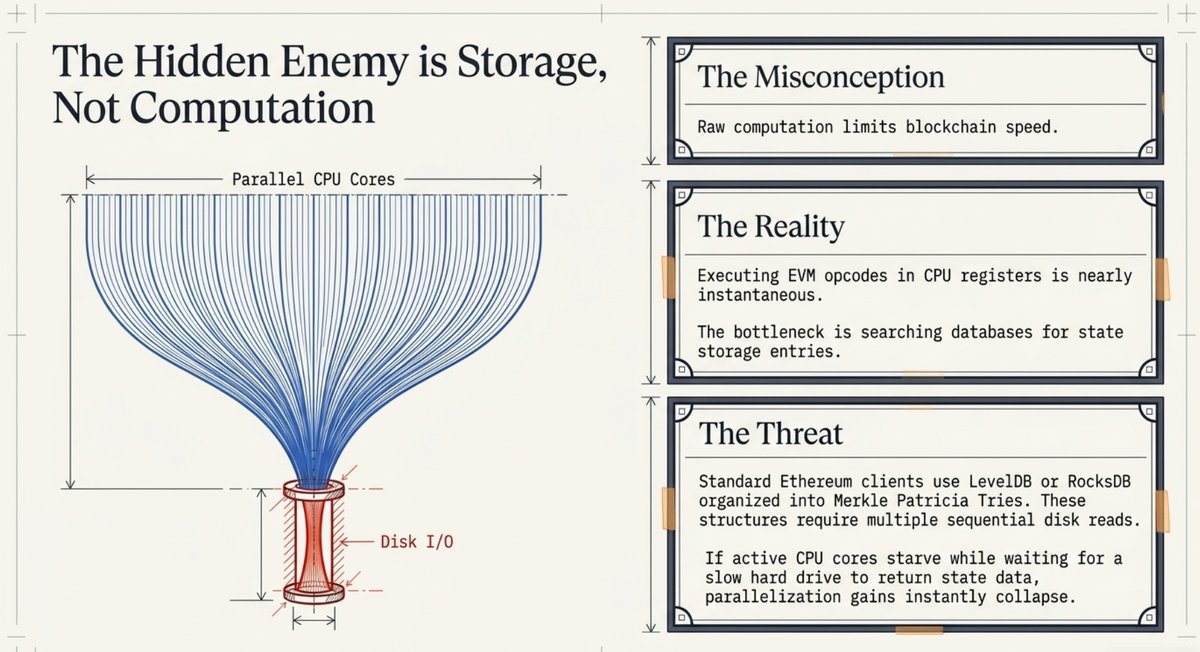
A widespread misconception among market observers is that computational speed is the main bottleneck of smart contracts. In reality, executing arithmetic opcodes in CPU registers requires negligible time. The genuine bottleneck that slows down blockchains is disk input/output (I/O) operations. Every time a contract verifies an account balance or updates pool reserves, it must read data from or write data to a physical storage drive.
Standard Ethereum clients store state in key-value databases like LevelDB or RocksDB, structured as complex Merkle Patricia Tries. In this traditional setup, retrieving a single balance requires multiple sequential disk reads through layers of tree nodes. If ten CPU cores run transactions in parallel, but all ten cores stall while waiting for a single slow hard drive to return state queries, the performance benefits of parallel processing completely evaporate.
To overcome this structural barrier, advanced parallel EVM projects design specialized, hardware-optimized database architectures. For instance, Monad developed MonadDb, a custom database engine built from scratch to support asynchronous I/O and non-blocking parallel disk reads. By aligning the database read patterns directly with multi-threaded CPU schedules, storage access occurs concurrently, ensuring that CPU threads are continuously supplied with necessary state data without stalling.
Comparing Parallel EVM Implementations
Several prominent engineering teams are approaching parallel execution with distinct architectural designs:
| Project | Execution Engine | Storage Architecture | Primary Engineering Focus |
| :---------- | :------------------------------ | :----------------------------- | :------------------------------------------------------- |
| Monad | Custom Parallel EVM (Block-STM) | MonadDb (Asynchronous I/O) | High throughput Layer-1 with 10,000 TPS target |
| Sei v2 | Optimistic Parallel EVM | SeiDB (Optimized state access) | Low-latency trading and cross-ecosystem liquidity |
| MegaETH | Real-time Parallel Execution | In-memory State Architecture | Sub-millisecond latency using specialized hardware nodes |
Each implementation recognizes that transaction parallelization must be accompanied by state access optimization to prevent secondary bottlenecks from emerging elsewhere in node software.
Developer Experience and Ecosystem Continuity
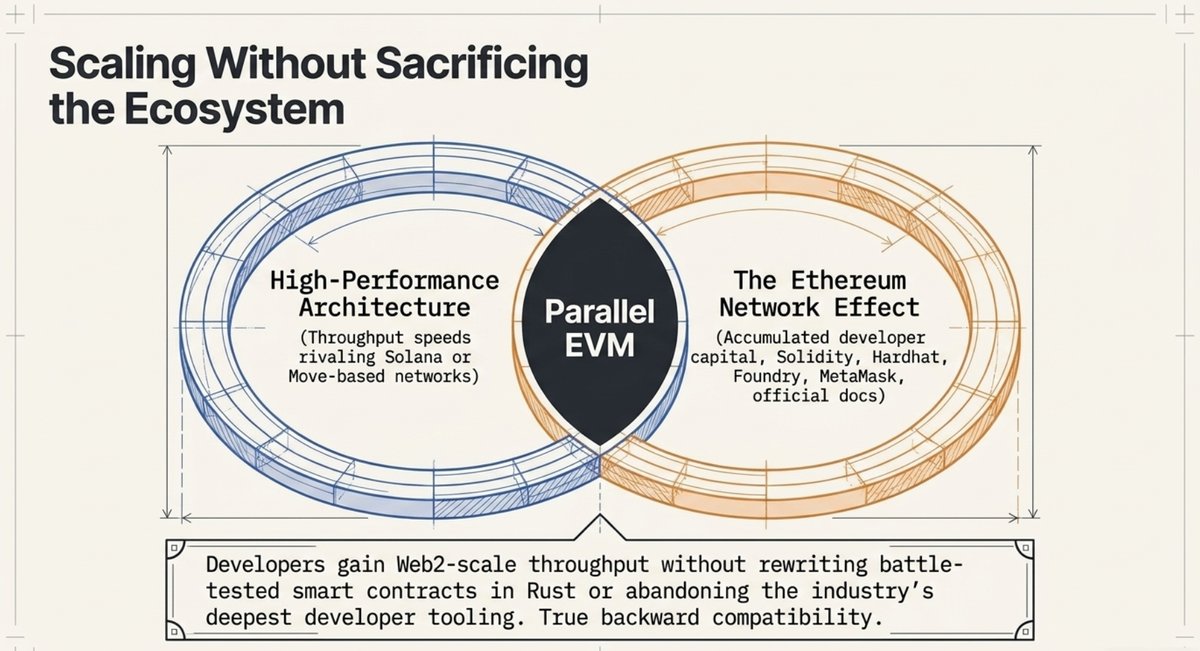
The decisive advantage of Parallel EVM over alternative platforms (such as Solana or Move) is total ecosystem preservation. In the past, achieving high throughput meant abandoning the EVM entirely, forcing teams to rewrite code in Rust, audit new libraries, and re-educate developers.
With Parallel EVM, developers continue writing standard Solidity code. The underlying parallelization is managed autonomously by the node client software. Smart contract developers do not need to manage thread locks, manually define state dependencies, or change their deployment pipelines. Existing developer tools, including the Ethereum official developer documentation, Hardhat, Foundry, MetaMask, and established testing frameworks, continue functioning seamlessly.
By removing the single-threaded speed limit, Parallel EVM elevates decentralized finance into a viable competitor for traditional financial infrastructure. Central limit order books with sub-second cancellations become economically feasible on-chain. Complex market makers can update parameters continuously without pricing out retail traders, ensuring that open financial systems scale globally while retaining security.