 Base
Base Unichain
 Robinhood
The launch of Friend.tech in August 2023 on the Base blockchain was hailed as a breakthrough in the decentralized social media sector (SocialFi). Within months, the project generated millions of dollars in fees and attracted major venture capital funding. However, by mid-2024, user activity on the platform had plummeted to near zero, and the developers officially renounced control over the smart contracts.
This collapse exposed the systemic flaws of speculative tokenomics and the lack of real consumer utility in Web3 social networks. At the same time, this failure accelerated a global shift: a profound Base paradigm shift away from speculative Web3 social games toward practical financial infrastructure.
Instead of high-risk entertainment, capital and developers are now choosing Base merchant migration, driving a major transition of traditional merchants onto low-cost decentralized payment rails.
The Rise and Fall of the SocialFi Flagship
The rise of Friend.tech was one of the most explosive events in recent crypto history. Launched in August 2023, the application introduced a simple yet highly addictive financialized concept: it allowed users to purchase and sell "keys" (originally called shares) representing ownership in the social profiles of X (formerly Twitter) creators.
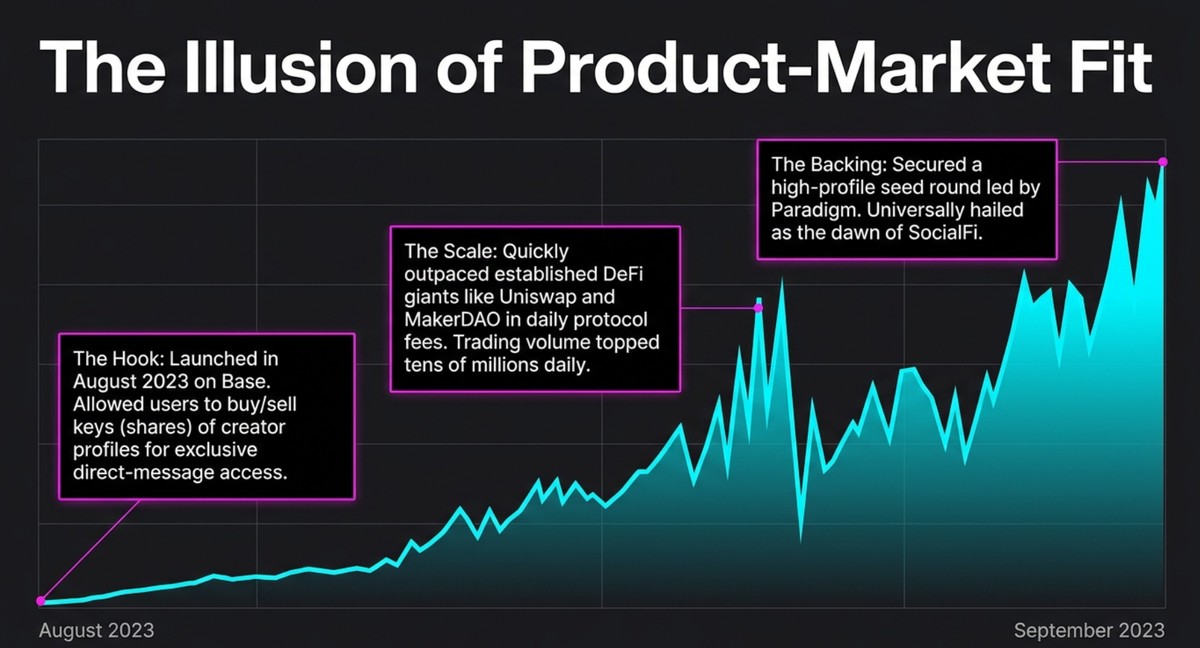
Owning a creator's key granted the buyer access to an exclusive, direct-message group chat with that creator, while also offering the potential to resell the key at a higher price as demand grew. During its first few weeks of operation, Friend.tech generated more daily protocol fees than established decentralized finance giants like Uniswap and MakerDAO.
Daily trading volume routinely topped tens of millions of dollars, and Paradigm, a premier venture capital firm, led the project's seed round. It was widely praised as the dawn of SocialFi, a new vertical that would onboard millions of mainstream users by combining social media with financial incentives.
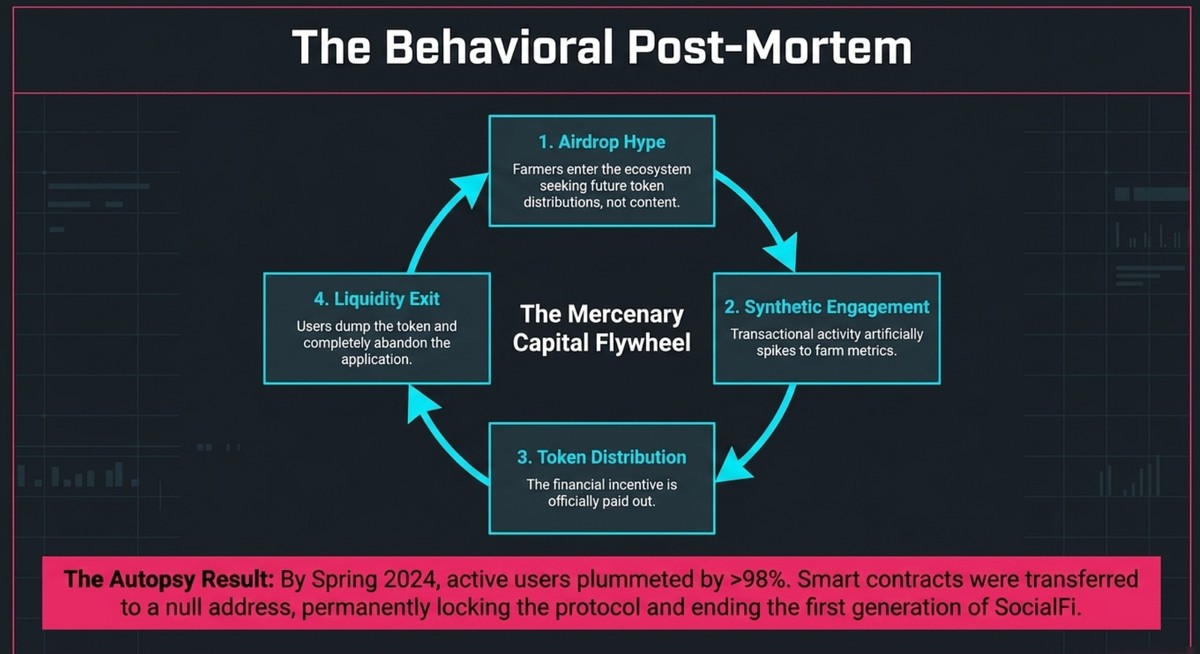
Yet, this speculative frenzy was short-lived. By the spring of 2024, the initial hype had completely evaporated. Active user numbers and trading volumes plummeted by more than 98% from their peaks. High-profile creators stopped posting in their private channels, leaving buyers holding worthless keys. The final blow came in September 2024, when the developers transferred ownership of the smart contracts to a null address, locking the protocol in its current state and eliminating any future updates or fee collections.
This action marked the official death of Friend.tech and symbolized the collapse of the first generation of SocialFi.
The Vicious Cycle of the Bonding Curve
The primary structural flaw that doomed Friend.tech was its mathematical pricing model. To price its keys, the platform used a quadratic bonding curve: P = S^2 / 16,000 ETH, where P is the price of the next key and S is the number of keys currently in circulation.
While this pricing mechanism succeeded in generating intense fear of missing out (FOMO) and paper wealth for early buyers, it made long-term user retention mathematically impossible. Under this quadratic curve, key prices scaled exponentially. For a popular creator with 100 keyholders, the 101st key would cost roughly 0.63 ETH (over $1,000 at the time).
This price was prohibitive for the vast majority of a creator's actual followers, effectively locking them out. The model was designed for speculators, not genuine fans. When the influx of new capital inevitably slowed, the same mathematical curve accelerated the downward spiral. Even a small number of sellers caused the price of keys to crash rapidly.
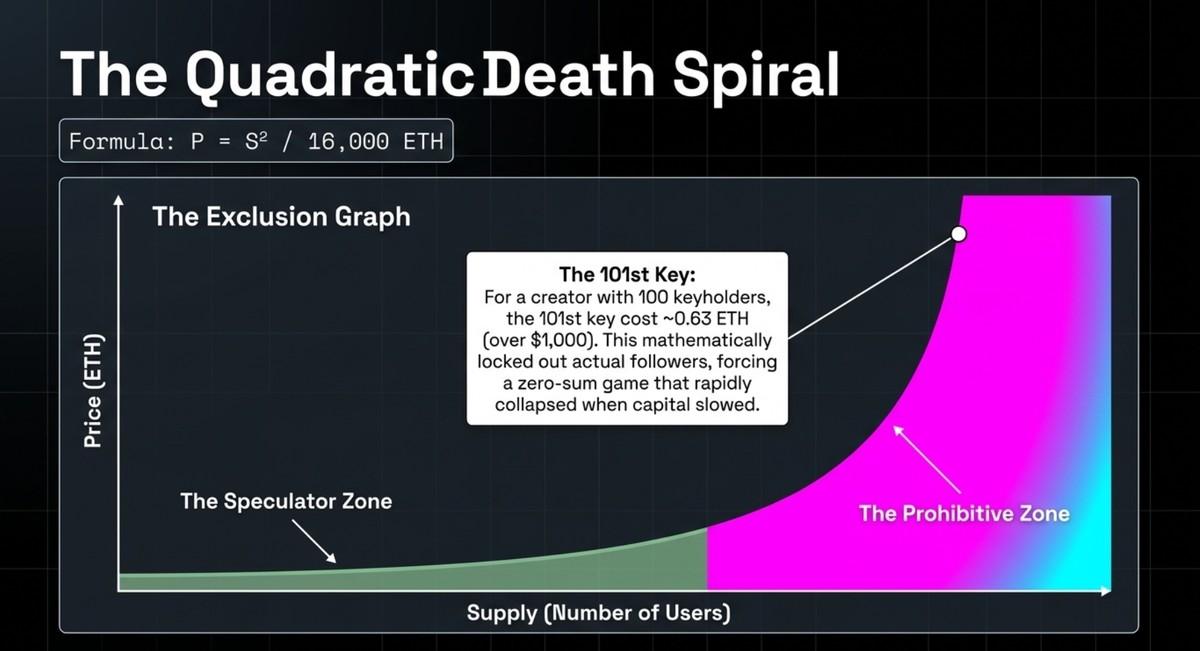
This triggered panic selling as users rushed to cash out before their assets became worthless. The bonding curve created a zero-sum game where early participants could only profit at the expense of later entrants, preventing the formation of stable, organic communities.
Social Utility vs. Pure Speculation
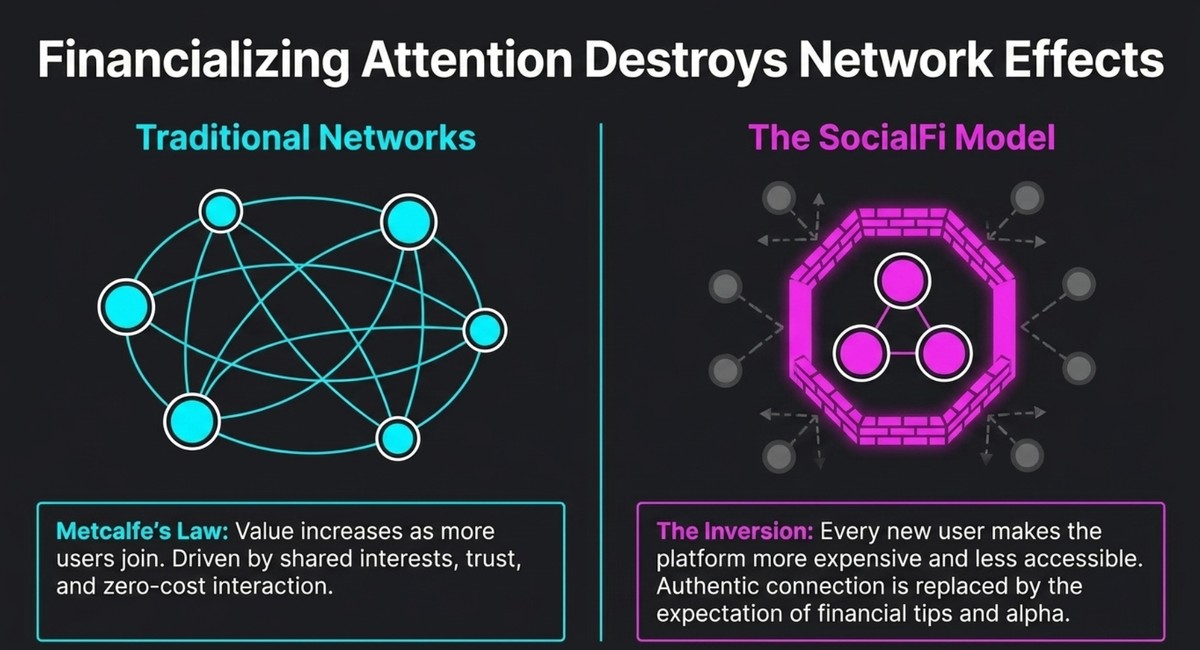
Although Friend.tech marketed itself as a social network, it was fundamentally a speculative trading platform disguised as a messaging app. In traditional social networks, the value of the platform increases as more users join, a phenomenon known as Metcalfe's law. In Friend.tech, however, the financial design meant that every new user made the platform more expensive and less accessible for others.
Furthermore, the product's features were incredibly rudimentary. The application provided only a basic text-chat interface without search options, media sharing, or moderation tools. The entire social experience was transactional, with users expecting financial tips or exclusive market insights ("alpha") from creators. When it became clear that most creators could not provide consistent financial returns, the underlying value of the keys evaporated.
The SocialFi experiment attempted to replace authentic human connection with direct financial incentives. However, financial incentives are highly volatile and inherently selfish. Social networks require trust, shared interests, and low-cost interaction to thrive. By putting a price tag on every conversation, Friend.tech destroyed the possibility of authentic social engagement.
The Systemic Failure of Web3 Social Experiments
The collapse of Friend.tech is not an isolated incident; it represents a broader systemic crisis within the Web3 social landscape. Rival platforms like Farcaster and Lens Protocol, despite employing more conservative economic models, have also struggled to maintain high user retention rates once speculative incentives fade.
The core issue lies in the nature of Web3 audiences, which are heavily dominated by mercenary capital. Many active users in the decentralized social ecosystem are airdrop farmers. They engage with platforms not for the content, but to qualify for future token distributions. Once a platform launches its token and distributes the airdrop, user engagement metrics routinely crash.
Web3 social apps have failed to deliver a user experience that is genuinely superior to established Web2 giants like Twitter, Telegram, or Discord. Moreover, decentralization and censorship resistance are not compelling enough selling points for the general public when weighed against high transaction fees, complex wallet setups, and empty networks.
The failure of Friend.tech proved that financializing human attention is a recipe for extreme volatility, not a foundation for a sustainable social ecosystem.
The Paradigm Shift of Base: From Hype to Utility
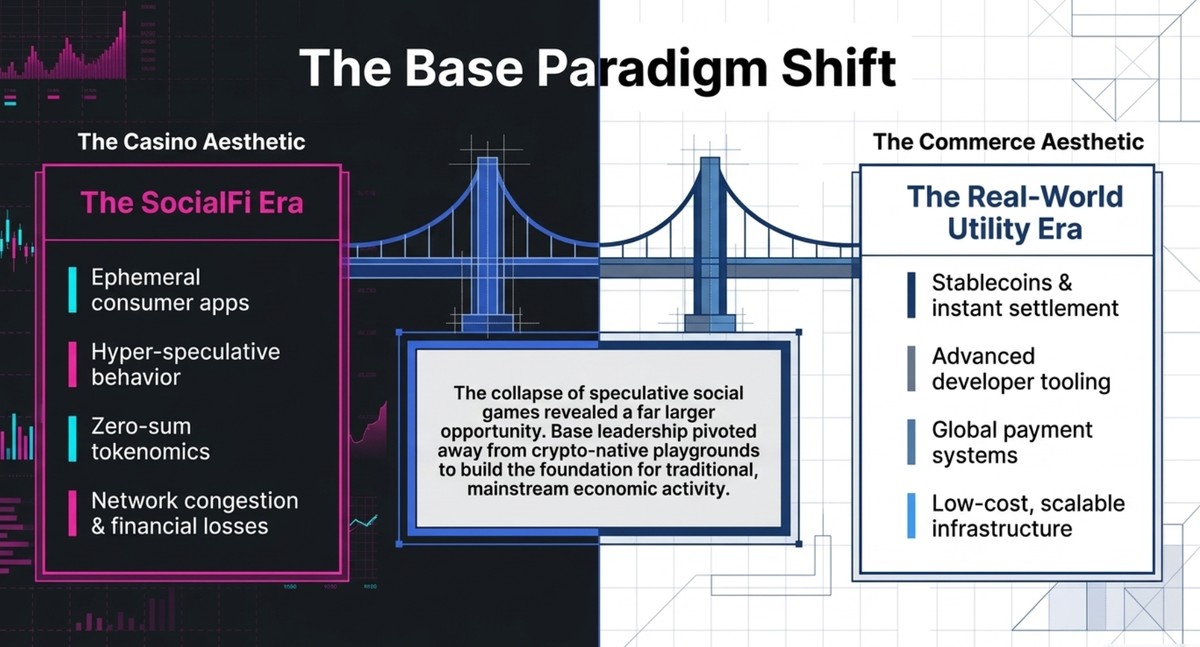
Despite the failure of its flagship social application, the Base network emerged from the SocialFi era with valuable insights. Developed by Coinbase and launched in mid-2023, Base originally rode the wave of SocialFi activity. Friend.tech was instrumental in bringing liquidity and attention to the network, but it also caused congestion and exposed users to massive financial losses.
The realization that speculative SocialFi was a dead end led to a significant strategic pivot. The Base paradigm shift saw the network move away from high-risk, speculative applications toward building a highly efficient infrastructure for real-world utility. Base leadership shifted their focus from ephemeral consumer apps to stablecoins, developer tooling, and global payment systems.
This strategic evolution marks a transition from a crypto-native playground to a mainstream financial rail. Coinbase is leveraging Base to build an on-chain economy centered on low-cost, instant transactions. By moving away from speculative social tokens, Base is building the foundation for stable, long-term economic activity that can support traditional businesses.
The Merchant Migration: A New Payment Paradigm
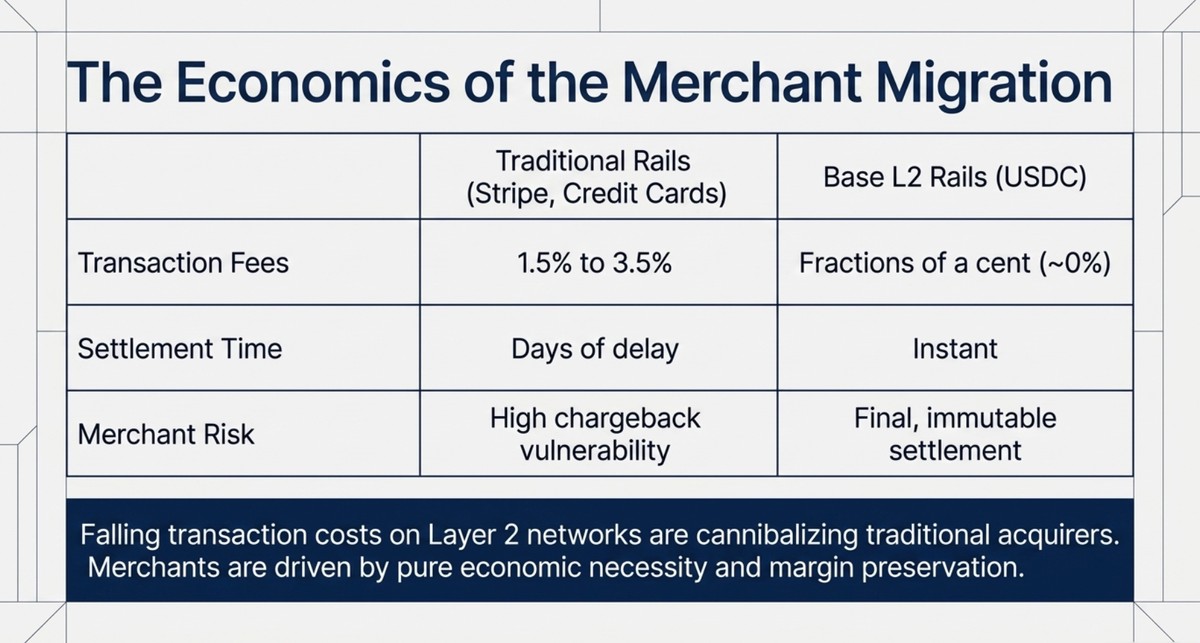
The decline of speculative apps has opened the door for a much larger and more sustainable trend: the merchant migration. As transaction costs on Layer 2 networks like Base fall to fractions of a cent, businesses are recognizing the immense cost savings of on-chain payments compared to traditional credit card processing.
Traditional payment acquirers like Stripe, PayPal, and major credit card networks charge merchants fees ranging from 1.5% to 3.5% per transaction, along with settlement delays of several days and the risk of chargebacks. In contrast, Base merchant migration offers instant settlement and transaction fees that are virtually zero.
This allows merchants to accept stablecoins like USDC and immediately convert them or use them to pay suppliers.
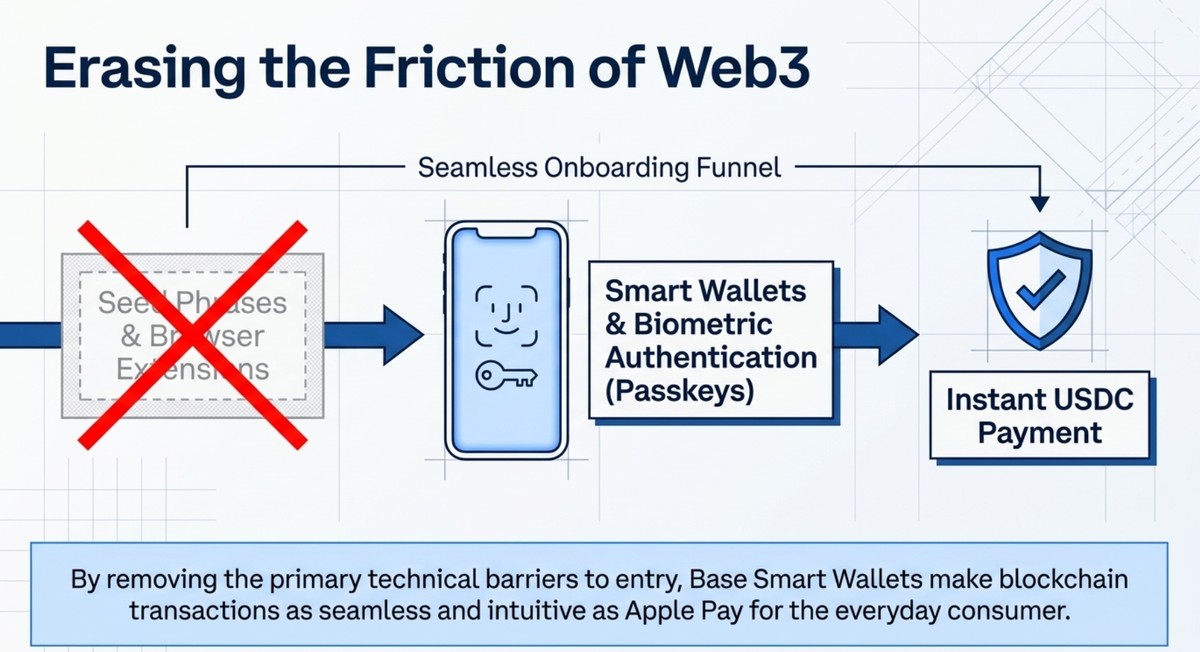
To facilitate this transition, Coinbase has introduced Smart Wallets, which use biometric authentication (Passkeys) to eliminate the need for recovery phrases or browser extensions. This removes the primary barrier to entry for everyday consumers, making blockchain transactions as seamless as Apple Pay. The merchant migration is driven by economic necessity and efficiency, representing a massive shift in how value is moved globally.
Conclusion: Pragmatism Over Hype
The demise of Friend.tech is a classic example of Web3 hubris, but it represents a necessary maturation process for the blockchain industry. The era of using decentralized technology solely for financial speculation is giving way to a more pragmatic phase focused on solving real-world inefficiencies.
While Web3 social networks may eventually find a sustainable model through open protocols rather than tokenized chat rooms, their short-term future remains uncertain. On the other hand, the migration of merchants to Layer 2 networks is a structural change that will likely reshape digital commerce.
By focusing on reducing transaction costs and friction for real businesses, Layer 2 networks are proving that their true value lies not in speculative speculation, but in building the new rails of global finance.