 Base
Base Unichain
 Robinhood
- Forcing new Web3 users to buy native ETH just to pay transaction fees has been the single greatest bottleneck to mainstream crypto adoption.
- Account Abstraction (ERC-4337) and the Paymaster standard (ERC-7677) allow smart contracts to sponsor gas on behalf of users.
- On Base, applications utilize Paymasters to offer gasless onboarding, seamless in-app subscriptions, and fee payments in stablecoins like USDC.
- By making transaction fees invisible or payable in familiar digital dollars, Base transforms on-chain applications into intuitive consumer software.
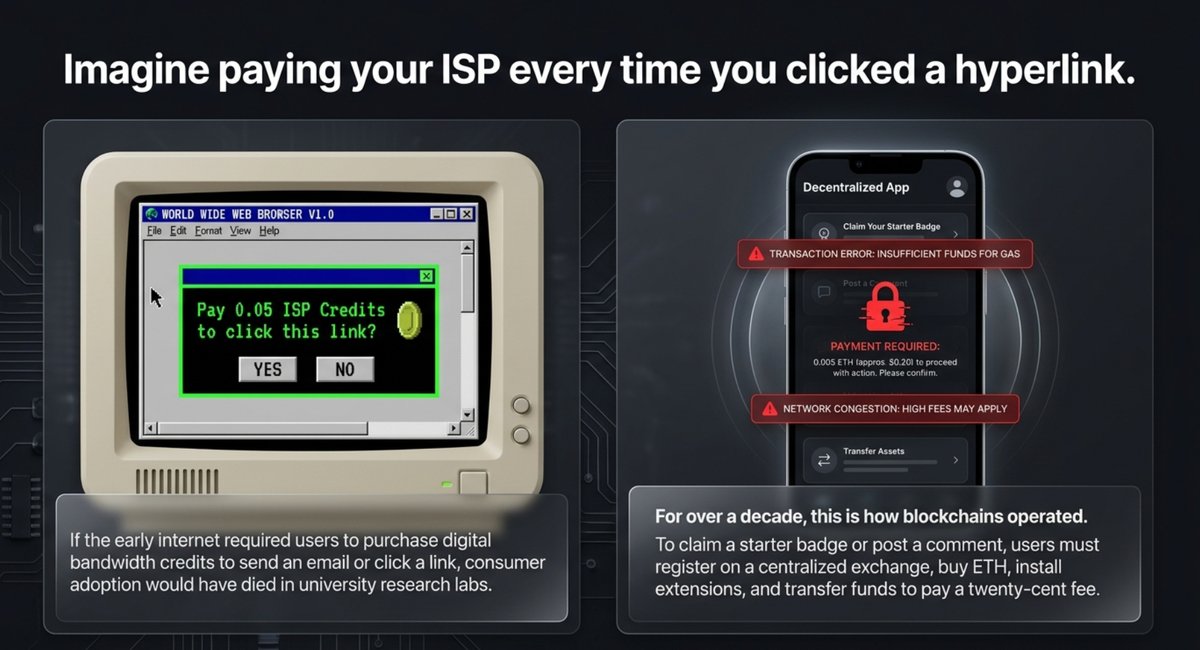
Imagine if the early World Wide Web required users to purchase digital bandwidth credits from an internet service provider every time they clicked a hyperlink or sent an email. If browsing a website required managing micro-payments for server computation, consumer adoption would have stalled in university research laboratories. Yet, for over a decade, that is precisely how public blockchains operated. To interact with any decentralized application, a newcomer was forced to register on a centralized exchange, complete identity verification, purchase native tokens like ETH, set up a complex browser extension, and transfer funds just to pay a twenty-cent network fee.
This gas payment dilemma represents the highest barrier to user acquisition in Web3. Base, built on a mission to bring the next billion users on-chain, has systematically attacked this problem by embracing the Paymaster architecture defined under Account Abstraction standards. By enabling developers to sponsor network fees or allow users to pay for gas in stablecoins like USDC, Base is pioneering the zero-gas consumer experience.
The Flaw of the Externally Owned Account (EOA)
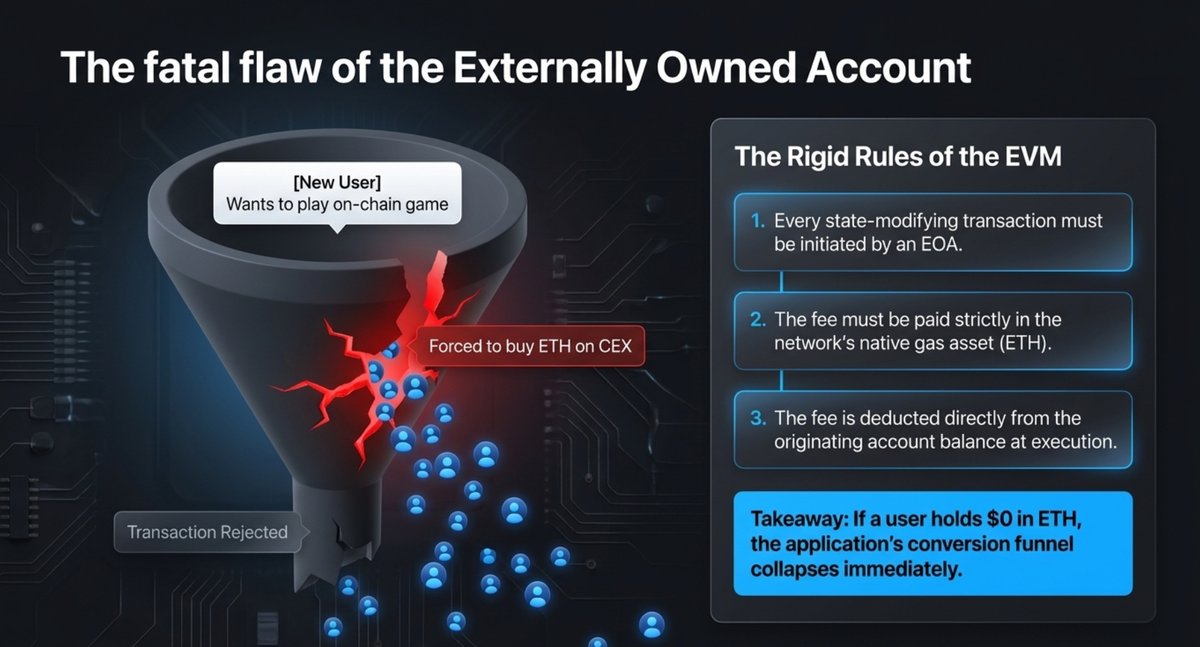
To understand how Paymasters operate, one must examine the fundamental limitation of standard Ethereum wallets, known as Externally Owned Accounts (EOAs). In a traditional MetaMask-style wallet, an account is tied directly to an asymmetric cryptographic keypair derived from a seed phrase.
The EVM's base protocol dictates that:
- Every state-modifying transaction must be initiated by an EOA.
- The transaction fee must be paid strictly in the network's native gas asset (ETH).
- The fee must be deducted directly from the originating account balance at the moment of execution.
Traditional EOA Bottleneck:
[New User] ---> Wants to play on-chain game ---> Has $0 in ETH ---> Transaction Rejected
                                                     |
                                         Forced to buy ETH on CEX

With Base Paymaster (ERC-4337 / ERC-7677):
[New User] ---> Interacts with game ---> [Paymaster Contract Sponsors Gas] ---> Success!
                                                    |
                                       Game Developer covers fee via ETH pool
If a user installs a Web3 mobile game or joins a decentralized social platform on Base, but holds zero ETH in their account, they cannot take a single on-chain action. They cannot mint a free profile, post a comment, or claim a starter badge. The application's conversion funnel collapses immediately.
Inside the Paymaster Architecture: ERC-4337 and ERC-7677
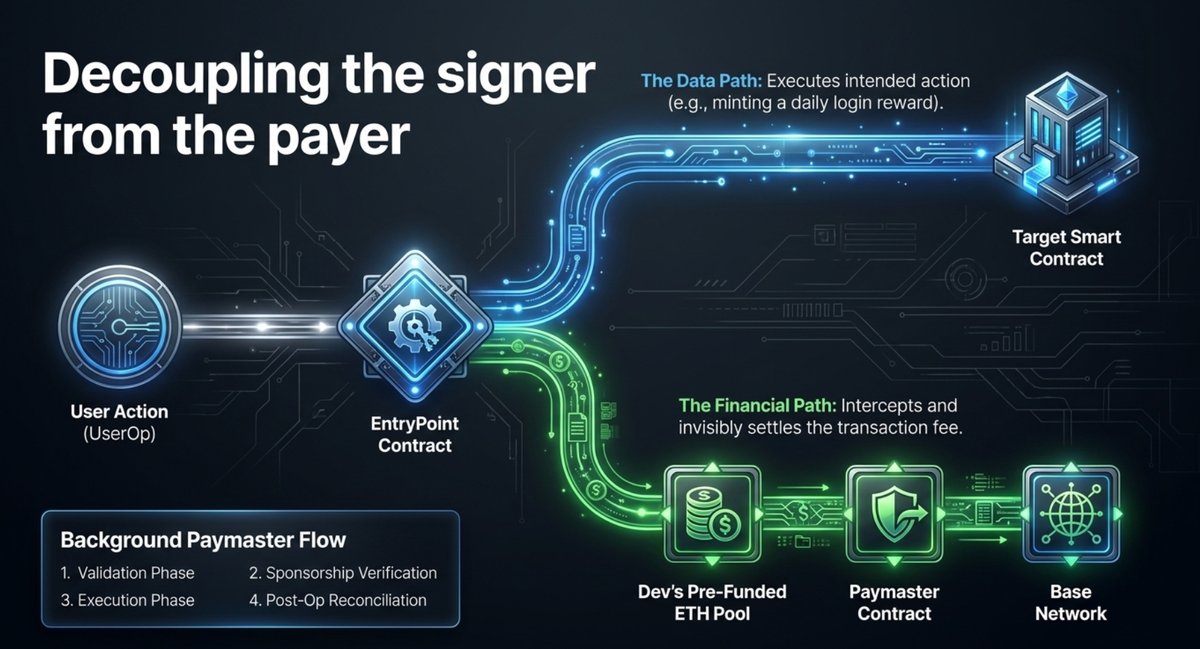
Account Abstraction decouples the entity signing a transaction from the entity paying for its execution. Under the ERC-4337 standard, users do not send raw blockchain transactions. Instead, they sign an off-chain data structure called a UserOperation.
These operations are bundled together by specialized network relayers (Bundlers) and submitted to a centralized singleton smart contract known as the EntryPoint. This is where the Paymaster contract enters the execution flow:
- Validation Phase: When the
EntryPointprocesses a user's operation, it inspects whether a Paymaster address is specified. TheEntryPointcalls the Paymaster'svalidatePaymasterUserOpfunction. - Sponsorship Verification: The Paymaster contract checks its internal logic. For example, a gaming dApp's Paymaster might verify: "Is this user minting a daily login reward? If yes, approve sponsorship." Alternatively, a DeFi Paymaster might verify: "Does this user hold sufficient USDC to cover the gas fee at current market rates?"
- Execution Phase: If approved, the Bundler executes the transaction. The
EntryPointdeducts the gas cost directly from a pre-funded ETH deposit maintained by the Paymaster contract. - Post-Op Reconciliation: In the
postOphook, if the transaction was an ERC-20 fee payment, the Paymaster automatically transfers the corresponding USDC from the user's smart wallet to replenish its balance.
To standardize communication between smart wallets and off-chain Paymaster infrastructure services, the developer community established ERC-7677. This standard provides a uniform API interface, allowing any smart wallet (including the Coinbase Smart Wallet on Base) to request paymaster sponsorship from any infrastructure provider without writing bespoke code.
Real-World Implementations Across Base
On Base, the practical application of Paymaster technology has fundamentally altered consumer metrics across multiple sectors:
- 100% Sponsored Consumer Onboarding: Social apps and consumer dApps pre-fund a Paymaster contract with a modest ETH budget. Because Layer-2 transactions on Base cost fractions of a cent, a developer can sponsor tens of thousands of new user interactions for less than the cost of a typical Web2 advertising campaign.
- Gas Payment in Stablecoins: Users who maintain funds strictly in digital dollars (USDC) can interact with DeFi lending markets and swap interfaces without holding any ETH. The Paymaster seamlessly settles the gas in the background, deducting a few cents of USDC from the user's swap output.
- Enterprise Subscription Models: Corporate platforms can sponsor the gas costs of their employees or enterprise partners, treating blockchain infrastructure as an operational overhead expense rather than pushing crypto-economic complexity onto end users.
By abstracting gas, Paymasters transform the blockchain from an intimidating financial instrument into an invisible infrastructure layer.
Sustainable Economics: Who Actually Pays for Gas?
A natural skepticism arises when discussing gasless transactions: who pays the miners and sequencers? In a decentralized network, computation is never free.
Paymaster architecture does not eliminate gas; it simply reallocates who pays it and how. In Web2, users do not pay for the Amazon Web Services hosting costs of the websites they visit; the business absorbs those costs as customer acquisition expenses, monetizing through subscriptions, enterprise services, or premium features.
On Base, Paymasters enable the exact same business model. A decentralized game can subsidize onboarding gas costs, knowing that engaged players will eventually purchase optional in-game digital goods. By allowing developers to treat transaction fees as a flexible customer acquisition cost, Paymasters remove the single greatest point of friction preventing decentralized applications from reaching mainstream consumer scale.