 Base
Base Unichain
 Robinhood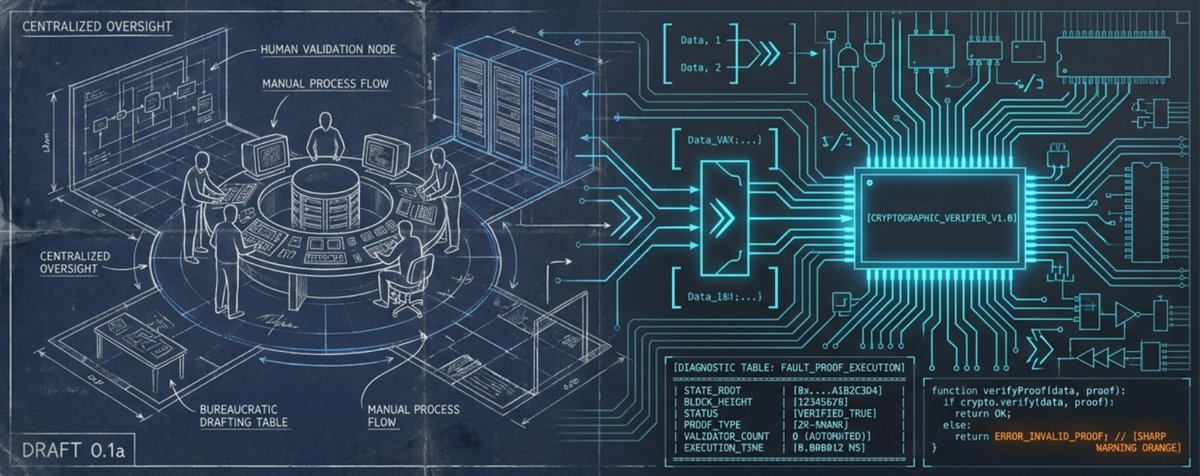
- In early rollup architecture, network security relied on trusted sequencers and centralized multisig security councils.
- Fault Proofs introduce permissionless dispute games to Base, allowing anyone to mathematically challenge an invalid state root.
- The OP Stack dispute engine (Cannon) isolates disagreements down to a single execution opcode verified directly on Ethereum L1.
- This milestone moves Base to Stage 1 decentralization, removing centralized training wheels while preserving high-speed performance.
When Layer-2 (L2) rollups were first conceived, the cryptocurrency community accepted an explicit design compromise. To achieve immediate scaling relief for Ethereum, early optimistic rollups launched with centralized components, commonly referred to by Ethereum researchers as "training wheels." The rollup sequencer proposed state roots to Ethereum Layer-1 (L1), while emergency multisignature contracts (Security Councils) retained the authority to override incorrect states. This setup, classified under Vitalik Buterin's framework as "Stage 0," delivered rapid transactions and low fees, but it lacked the core tenet of crypto-economic security: permissionless verification.
Base, developed on the open-source OP Stack, achieved an essential architectural milestone by activating permissionless Fault Proofs. By replacing centralized administrative trust with decentralized game-theoretic dispute games, Base transitioned toward "Stage 1" decentralization. This upgrade ensures that the integrity of the network is protected not by the reputation of Coinbase, but by immutable mathematical proofs verified directly by Ethereum consensus.
The Problem With Stage 0 Rollups
To understand why fault proofs are monumental, one must examine the baseline vulnerability of a Stage 0 optimistic rollup. In standard operation, an L2 sequencer processes transactions, computes the resulting state changes (such as token balances), and posts a cryptographic commitment (a state root) to a smart contract on Ethereum L1.
Because optimistic rollups operate on the principle of optimism, the L1 contract assumes the posted state root is valid unless challenged. In the absence of a live fault-proof system:
- Centralized Protection: Only whitelisted institutional validators can challenge an incorrect state root.
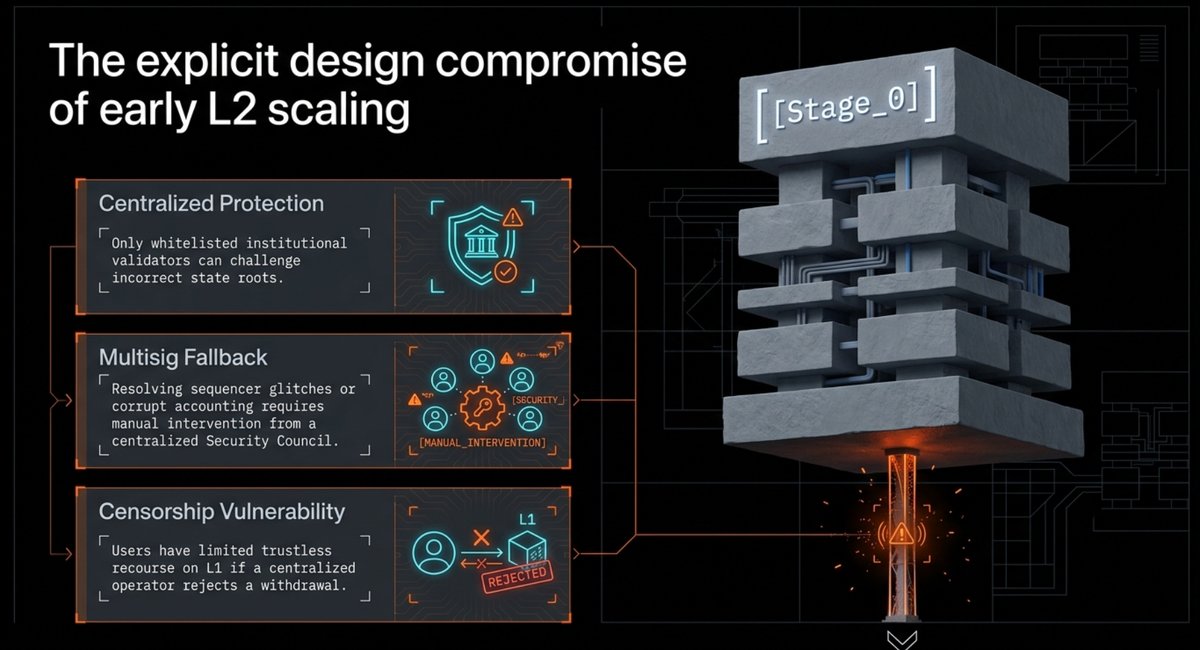
- Multisig Fallback: If the sequencer experiences an internal glitch, submits corrupted accounting, or is compromised by an attacker, the network relies on a centralized Security Council to intervene manually.
- Censorship Vulnerability: If a centralized operator chooses to reject a user's withdrawal, the user has limited trustless recourse on L1.
While this architecture allowed Base to scale rapidly and safely during its initial growth phase, long-term sustainability requires eliminating any single point of failure.
The Architecture of Dispute Games: How Cannon Works
The fault-proof system powering Base operates on the OP Stack dispute framework, driven by an open-source execution engine called Cannon, as detailed on the official Optimism documentation portal.
The system operates via an interactive dispute game. If a validator observes that the sequencer posted an invalid state root to Ethereum L1, the validator can post a financial bond and initiate a dispute.
Dispute Progression (Interactive Bisection):
[Sequencer Claims State X] <--- DISPUTED BY ---> [Challenger Claims State Y]
                                     |
                          1. Bisect Block Execution
                                     |
                          2. Narrow Down to 1 Instruction
                                     |
                          3. Single MIPS Opcode Run on L1
                                     |
[L1 Contract Slashing Winner]- Interactive Bisection Game: Rather than re-executing millions of transactions on Ethereum (which would exceed the L1 block gas limit), the challenger and the defender engage in a binary search algorithm on L1. Over several rounds, they bisect the timeline of the disputed block, cutting the disagreement in half at each step: from a whole block down to a single transaction, and finally down to a single individual execution step.
- Single-Instruction Proof on L1: Once the dispute is narrowed down to one single assembly instruction (such as a 32-bit MIPS or RISC-V operation), that lone instruction is loaded and executed directly inside an L1 smart contract.
- Automated Slashing: The L1 contract acts as an impartial mathematical referee. If the sequencer's state root contradicted the outcome of that single opcode, the dispute engine immediately slashes the sequencer's bond, rejects the fraudulent state root, and awards the challenger a portion of the financial deposit.
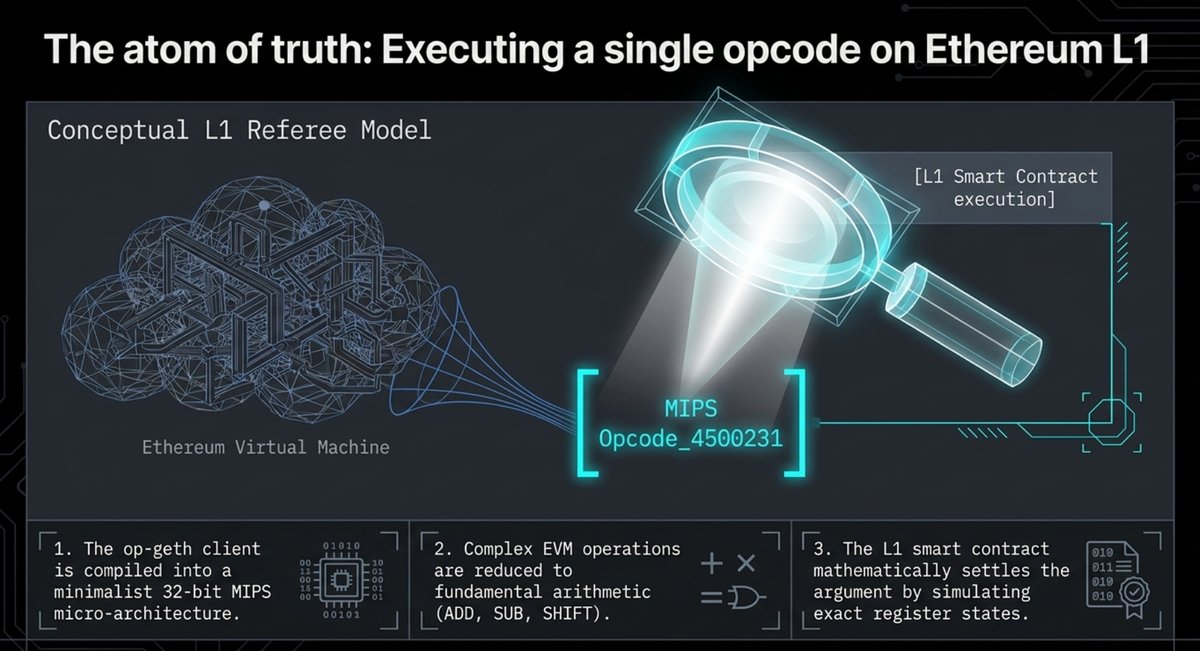
The genius of interactive fault proofs is computational efficiency: Ethereum only needs to execute one single CPU instruction to mathematically settle an entire disputed block.
Economic Game Theory and Griefing Resistance
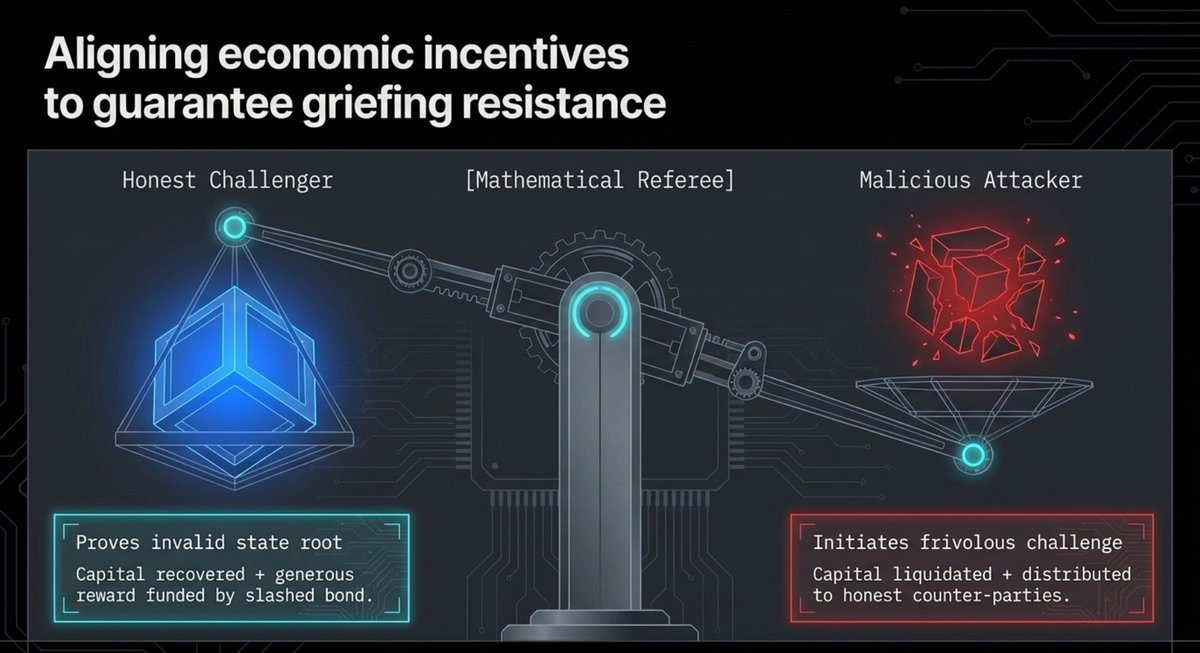
A vital component of dispute game design is economic security. If challenging a state root were completely free, malicious actors could flood Ethereum with bogus challenges, perpetually delaying legitimate user withdrawals and creating a denial-of-service (DoS) condition on the bridge.
To prevent griefing attacks, the OP Stack dispute framework requires challengers to deposit significant economic bonds at each turn of the dispute game. If a challenger acts honestly and successfully proves that the sequencer proposed an invalid state root, the challenger recovers their capital along with a generous reward funded by the slashed sequencer bond. Conversely, if an attacker initiates a frivolous challenge, their capital is liquidated and distributed to honest counter-parties. This dynamic aligns economic incentives strictly in favor of network integrity.
The Cannon MIPS Virtual Machine
The technical engine behind this proof mechanism is Cannon, an emulator that compiles the standard Go Ethereum execution client (op-geth) into a minimalist 32-bit MIPS micro-architecture. Compiling the EVM into a simplified instruction set is essential because simulating complex EVM opcodes directly on Ethereum L1 is computationally prohibitive.
By reducing the entire execution environment to fundamental arithmetic instructions (add, subtract, bitwise shift), an L1 smart contract can simulate the exact execution of a single instruction with minimal gas. If the challenger and defender disagree on whether memory register $t0 contained value A or value B after instruction 4,500,231, the L1 contract runs that exact instruction, checks the register state, and settles the argument irreversibly.
Stage 1 Decentralization: Removing the Training Wheels
Under the rollup maturity framework established by L2BEAT and the Ethereum Foundation, rollups progress through three developmental stages:
- Stage 0 (Full Training Wheels): Sequencer is centralized; dispute mechanisms are either disabled or restricted to whitelisted actors.
- Stage 1 (Limited Training Wheels): Dispute proofs are open and permissionless; any independent participant can challenge state roots; a Security Council remains only as a backstop against undiscovered code bugs.
- Stage 2 (No Training Wheels): Fully automated cryptographic governance with multiple independent proving systems and no human overrides.
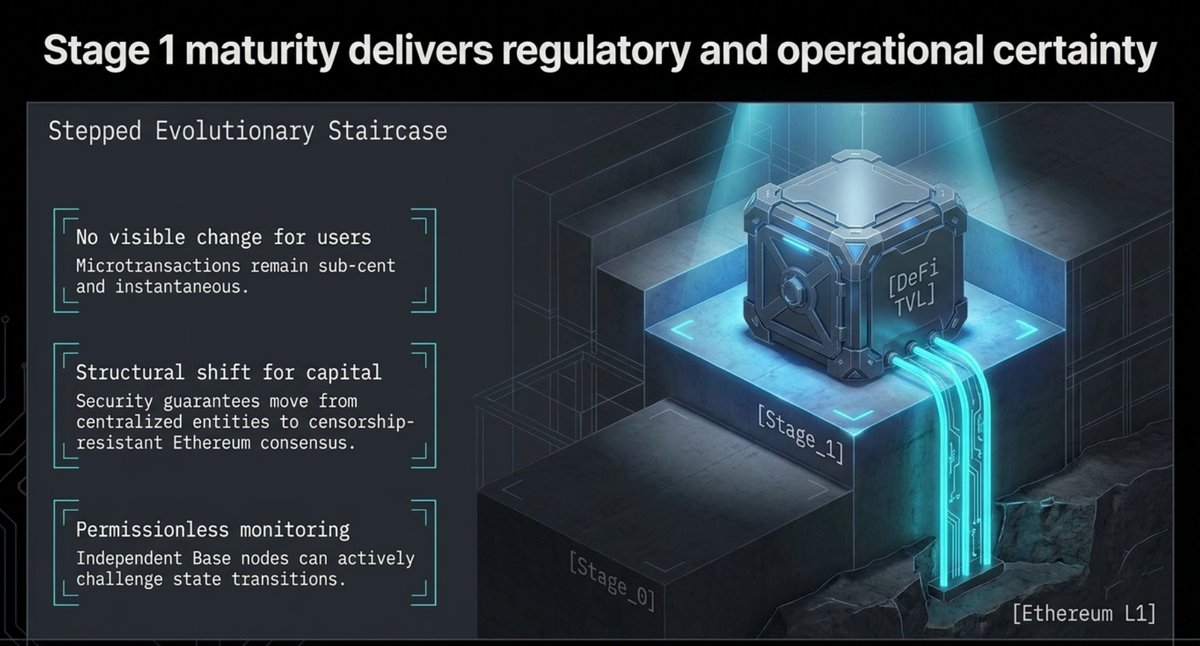
By enabling open fault proofs, Base crossed the threshold into Stage 1. Anyone running an independent Base node can actively monitor state transitions, detect discrepancies, and initiate challenges on Ethereum mainnet without requiring permission from Coinbase or any centralized authority.
Why This Matters for the End User
To the average user sending microtransactions on Base, the activation of fault proofs produces no visible change in daily application usage. Transaction fees remain fractions of a cent, and execution speeds remain instantaneous.
However, the underlying security guarantees undergo a structural transformation. For institutional capital allocators, large-scale financial institutions, and DeFi protocols securing hundreds of millions of dollars in total value locked (TVL), Stage 1 status provides regulatory and operational certainty. Capital stored on Base is no longer secured merely by the corporate reputation of a centralized entity; it is anchored directly in the battle-tested, censorship-resistant consensus of Ethereum itself, creating a bulletproof foundation for the decentralized financial future.
The Multi-Proof Roadmap Toward Full Autonomy
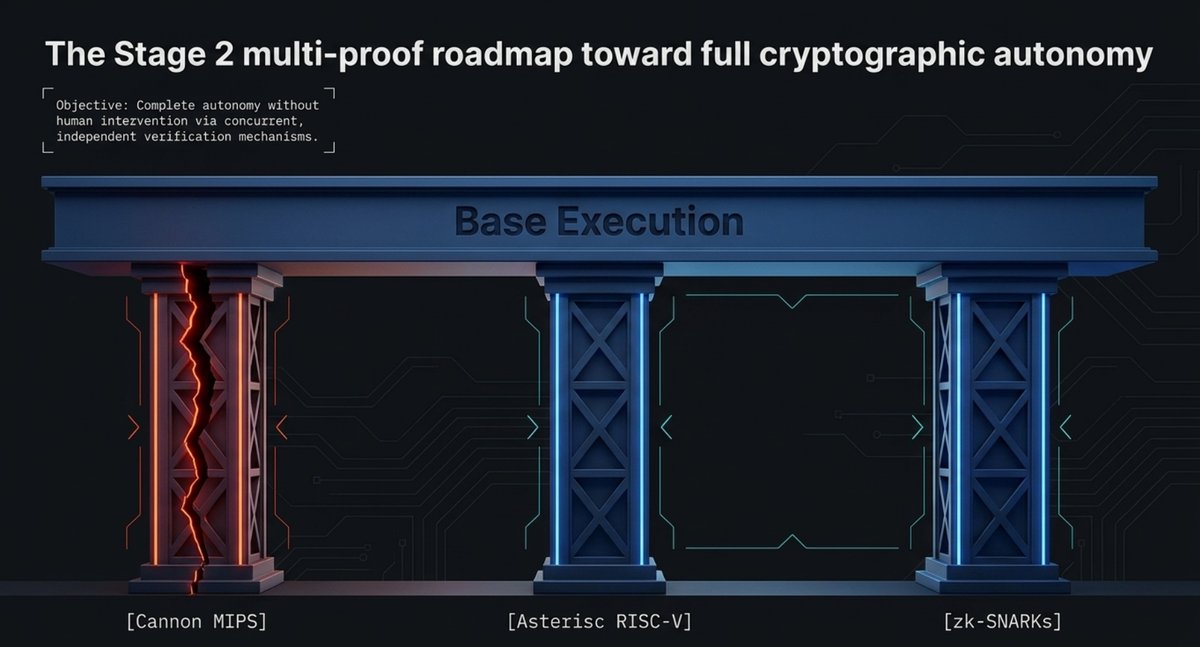
While permissionless fault proofs elevate Base to Stage 1 maturity, the ultimate objective of the OP Stack ecosystem is Stage 2 decentralization. Under Stage 2, the network removes all reliance on centralized security councils by deploying a multi-proof architecture.
In a multi-proof design, transaction validity is verified concurrently by multiple independent mechanisms, such as Cannon MIPS proofs, Asterisc RISC-V proofs, and zero-knowledge validity proofs (zk-SNARKs). If a software flaw affects one proof system, the alternative cryptographic proving systems prevent catastrophic state failure automatically, ensuring complete cryptographic autonomy without human intervention. This multi-layered defense guarantees that Base remains resilient against unforeseen bugs while maintaining high-speed throughput.