
 Base
Base Unichain
 Robinhood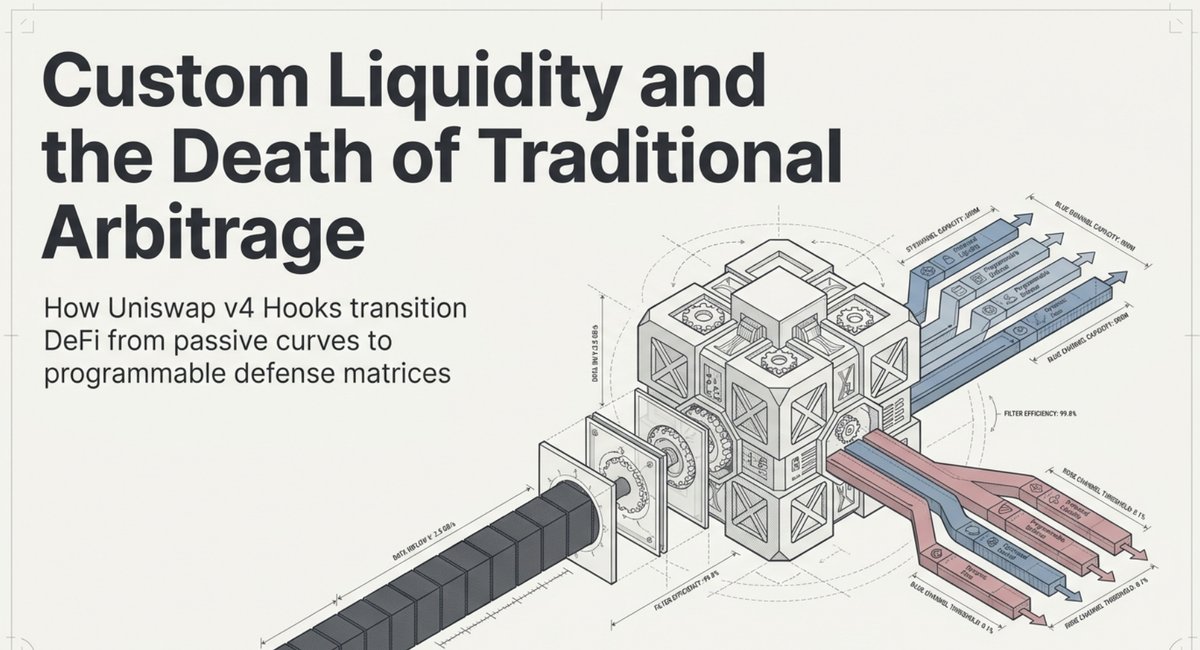
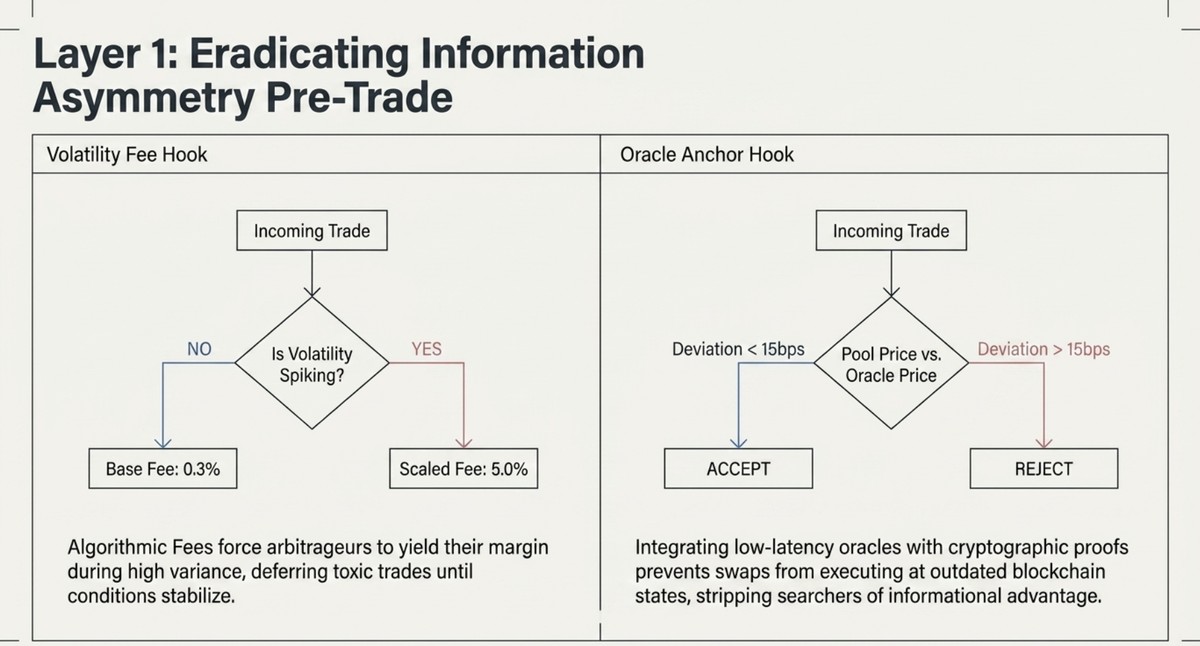
The release of Uniswap v4 marks a structural transition from passive automated market maker curves to dynamically programmable liquidity pools. The key technological breakthrough of the protocol is hooks - custom smart contracts integrated into the lifecycle of trading pools. This article examines five advanced hook designs engineered to neutralize traditional arbitrage driven by latency and information asymmetry.
By systematically reducing Loss-Versus-Rebalancing (LVR) for liquidity providers through algorithmic fees, oracle integrations, and built-in MEV auctions, these hooks will fundamentally reshape the DeFi economic model and restore profitability to liquidity providers.
The Passive Liquidity Dilemma: Why Classic AMMs Fall Short
Since the inception of decentralized finance (DeFi), the core vulnerability of automated market makers (AMMs) has been their passive nature. Classic Uniswap v2 and v3 pools operate within deterministic mathematical curves, entirely unaware of external market dynamics. Because price discovery primarily occurs on highly liquid centralized exchanges (CEXs) like Binance or Coinbase, decentralized pools inevitably lag during rapid market moves.
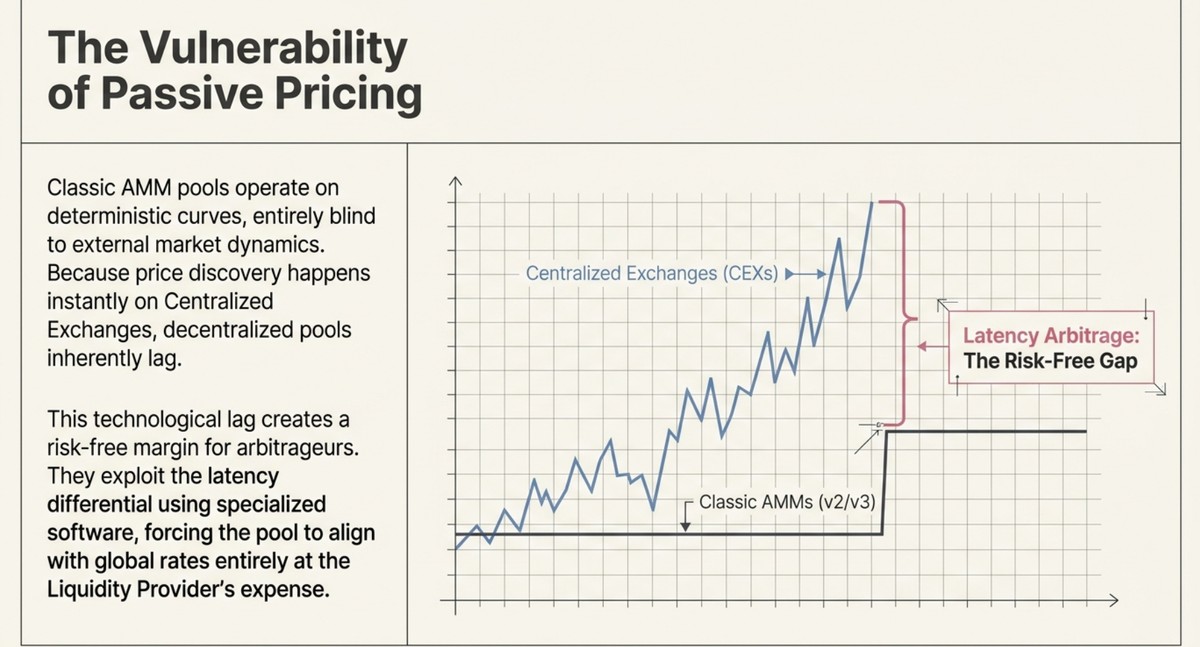
They lack the native ability to update their pricing without external transactions initiating the swap. This technological lag creates a risk-free profit opportunity for toxic arbitrage. Arbitrageurs, utilizing specialized software and direct co-location with validators, are the first to identify price discrepancies between CEXs and DEXs.
They execute swaps in the lagging pool, forcing the price to align with the global market rate. For liquidity providers (LPs), this results in permanent losses. Unlike standard impermanent loss, which can resolve if the asset price returns to its original state, Loss-Versus-Rebalancing (LVR) is path-dependent and irreversible.
LVR measures the difference between the returns of a passive LP position and the performance of an actively managed portfolio rebalanced continuously at market prices. This concept, first formalised in research from Columbia University, mathematically demonstrates that LPs are constantly selling appreciating assets too early and buying depreciating assets too late compared to a portfolio managed on an external liquid venue.
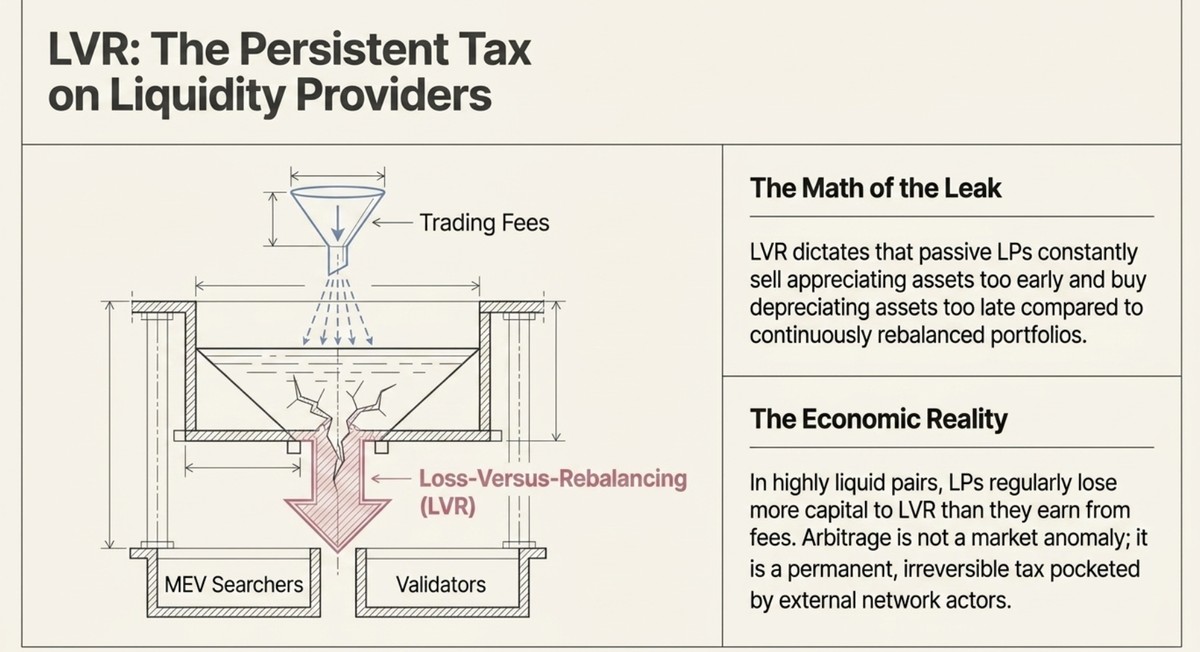
In essence, arbitrageurs execute risk-free trades against the pool, exploiting latency differentials. Empirical studies demonstrate that in highly liquid pairs, LPs regularly lose more capital to LVR than they earn from trading fees. In practice, arbitrage in DeFi has functioned as a persistent tax on liquidity, pocketed by MEV searchers and validators.
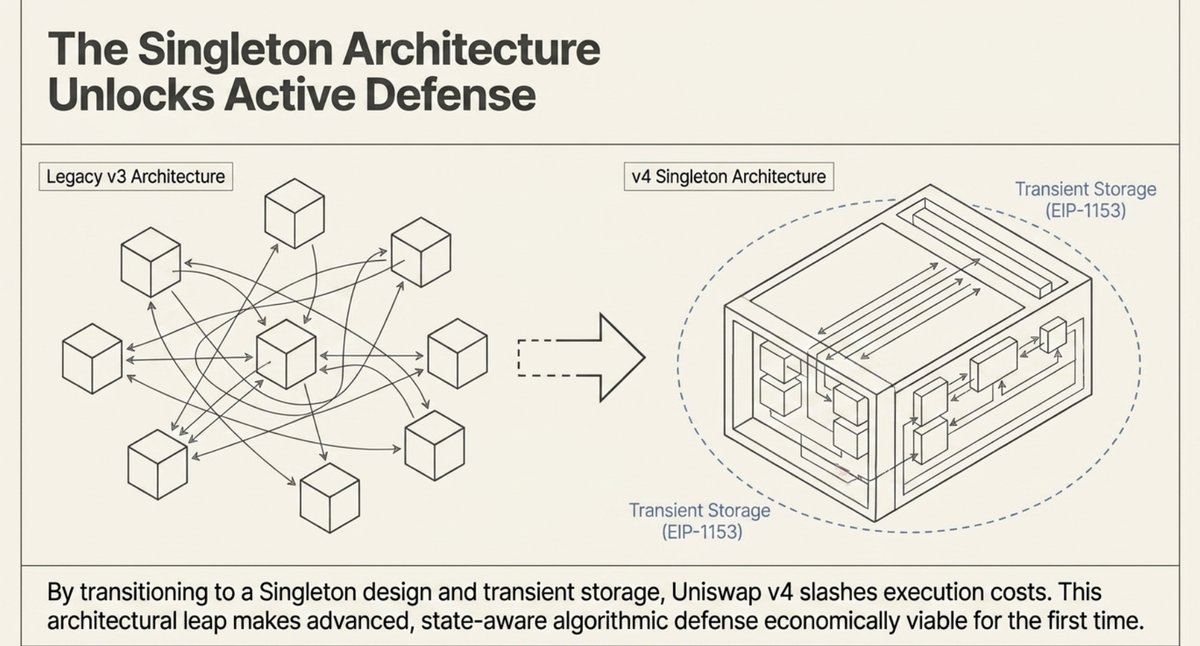
Uniswap v4 addresses this systemic inefficiency at the architectural level. By transitioning to a Singleton contract design and implementing transient storage (EIP-1153), the gas cost of executing complex logic decreases dramatically. This makes active defense mechanisms economically viable. By deploying Uniswap v4 hooks, developers can transform every pool into an autonomous, state-aware financial entity.
1. Volatility-Adjusted Algorithmic Fees (LVR Mitigation Hooks)
The traditional approach to trading fees in AMMs has always lacked flexibility. Pools with fixed fees of 0.05% or 0.3% are highly vulnerable during market turbulence. When the price of an asset on a CEX moves rapidly, the static fee fails to compensate LPs for the risk of adverse selection.
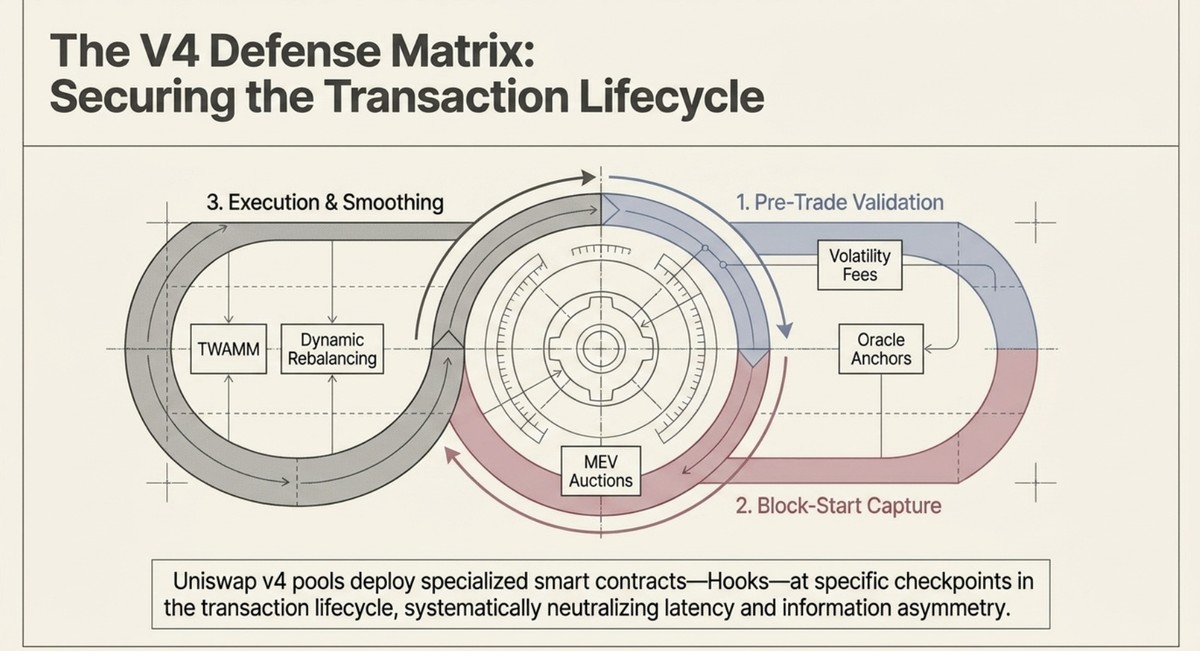
The arbitrage margin exceeds the transaction cost, allowing searchers to extract substantial value. A dynamic fee hook solves this by continuously monitoring market volatility. Using a pre-execution trigger (beforeSwap), the hook calculates current volatility based on recent price deviations or block-to-block price variance. If volatility rises above a predefined threshold, the pool fee automatically increases.
In certain configurations, fees can scale from a base rate of 0.3% to 5% or higher during periods of extreme market stress. The economics of this mechanism are straightforward: the hook increases the cost of execution when the probability of toxic order flow is highest.
Arbitrageurs are forced to yield their margin to the pool. If the fee exceeds the price difference between the CEX and DEX, the arbitrage trade becomes unprofitable and is deferred until market conditions stabilize. This retains value within the pool, improving returns for LPs.
2. Stale Price Protection via Oracle-Anchored Verification
Another effective strategy to combat toxic flow is integrating external data feeds directly into the transaction validation process. Classic pools have no awareness of the asset's price outside the blockchain, allowing arbitrageurs to exploit price discrepancies within a single block. An oracle-anchored hook (utilizing networks like Chainlink or low-latency systems like Pyth Network) executes verification logic before every swap.
When a swap request is received, the contract queries the external reference price. If the pool's current price deviates from the oracle price by more than a specified threshold (e.g., 10-15 basis points), the hook intervenes. The use of real-time oracles with cryptographic proof support allows the pool to operate in sync with the global market.
Even during network congestion on Ethereum or validator-level delays, the hook ensures that trades inside the pool are not executed at prices significantly worse than the market average. This mechanism neutralizes latency arbitrage, where bots exploit delays in blockchain state updates to execute swaps at stale prices.
By referencing real-time market data, the pool strips arbitrageurs of their informational advantage, preventing them from exploiting outdated states.
3. Internalized Block-Start MEV Auctions
In public blockchains, the first transaction of a block is highly contested. MEV searchers compete intensely to execute arbitrage trades immediately after a price-moving event on a CEX, bidding up gas fees to validators via networks like Flashbots. Consequently, millions of dollars in arbitrage revenue flow to validators and block builders, bypassing the LPs who provided the capital.
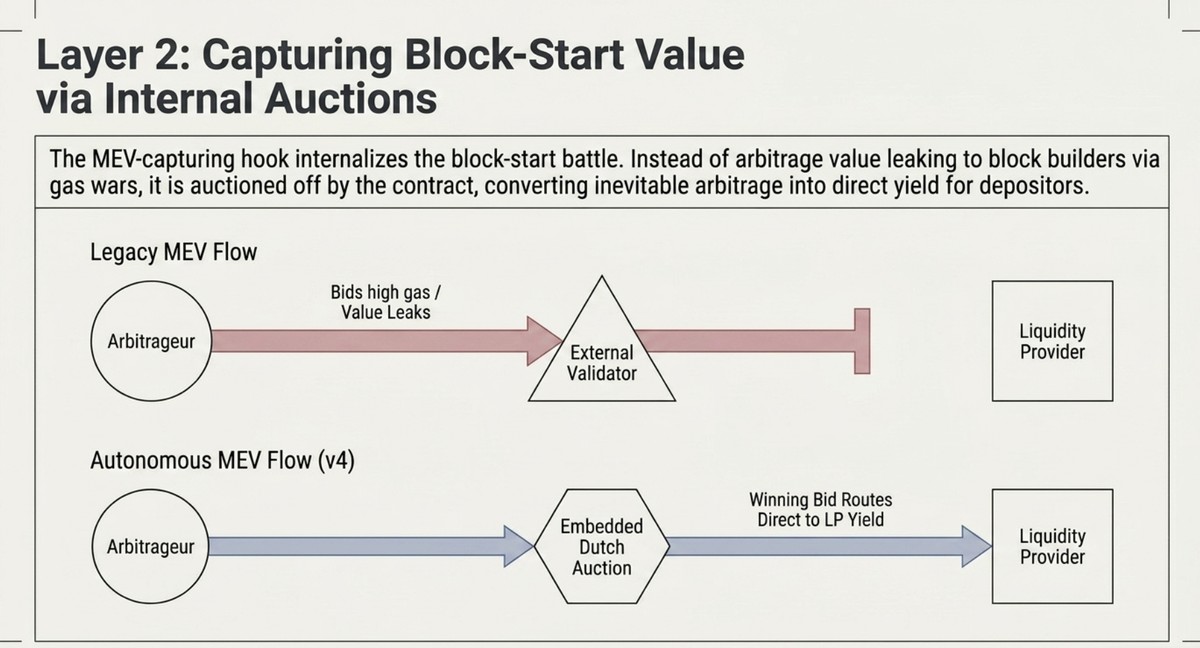
Uniswap v4 hooks allow pools to capture this value internally. An MEV-capturing hook splits each block into distinct phases, auctioning the right to execute the first transaction of the block via an embedded Dutch auction. Searchers bid for this exclusive right directly within the contract.
The winning bid is executed at the start of the block, but the bid payment is routed directly to the pool's LPs. Subsequent transactions in the block are processed under normal parameters. This setup does not eliminate arbitrage but redirects its economic value. Instead of capital leaking to external network actors, it is converted into additional yield for the pool's depositors, reducing net LVR to near-zero levels.
4. Integrated Time-Weighted Average Market Maker (TWAMM)
Large market orders on DEXs cause significant price impact, creating immediate arbitrage opportunities. Sandwich attacks - where a bot frontruns a large transaction and backruns it immediately after - harm both the executing trader and the pool's stability. Integrating a TWAMM hook solves this by smoothing the price impact of large trades.
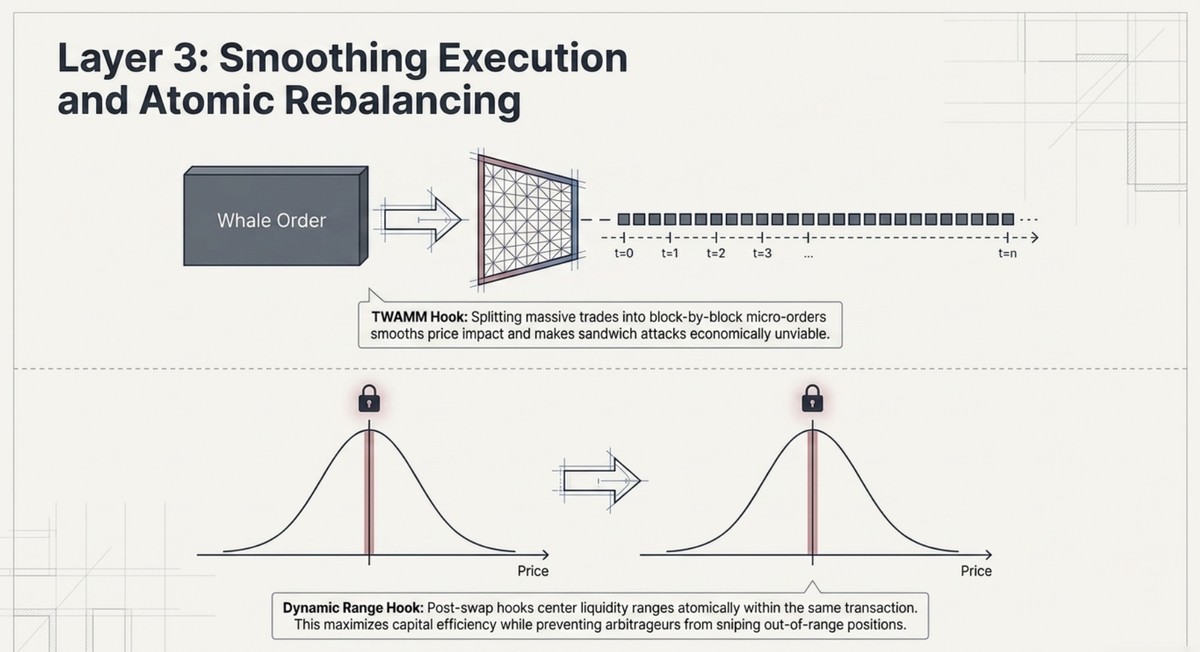
Instead of executing a massive swap in a single transaction, the hook allows users to submit long-term orders that are automatically divided into micro-orders and executed across a specified block range. The hook updates the virtual balances with every pool interaction. For arbitrageurs, this removes the large price discrepancies that make sandwich attacks profitable.
Since the trade is executed in tiny increments per block, the pool's price adjusts smoothly toward the market rate. The micro-scale of each increment makes frontrunning economically unviable, protecting traders from MEV exploitation.
5. Dynamic Range Rebalancing (Active Liquidity Management)
Concentrated liquidity in Uniswap v3 offers high capital efficiency but requires active range management. If the price moves out of range, the LP position stops earning fees. External active liquidity managers (ALMs) rely on off-chain keepers to adjust ranges, but these keeper transactions can be delayed or frontrun by arbitrageurs.
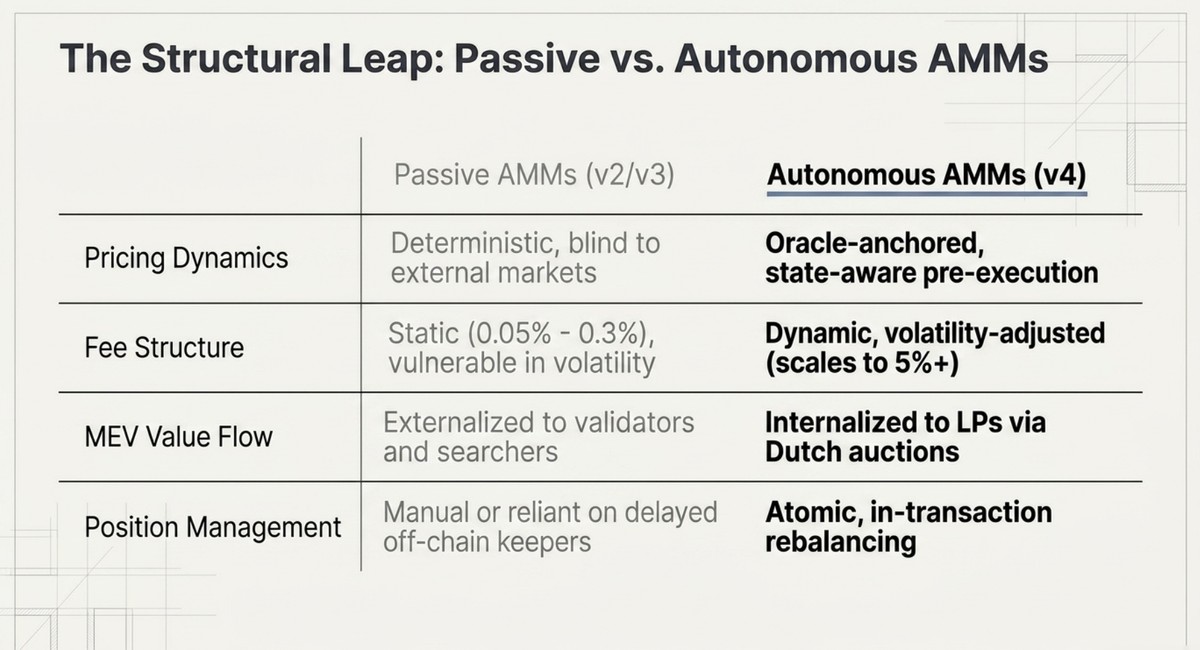
An active liquidity management hook performs rebalancing atomically within the same transaction that moves the price (afterSwap). When a swap shifts the pool price, the hook instantly relocates the LP range to center around the new price without requiring external transactions. This design eliminates the delay between price moves and liquidity adjustments.
Because the rebalancing occurs atomically within the contract execution, it prevents arbitrageurs from sniping out-of-range positions. Capital efficiency is maximized while mitigating the risk of toxic flow exploitation.
The Future of DeFi: Reshaping the Arbitrage Landscape
The introduction of Uniswap v4 hooks represents a paradigm shift in decentralized finance. Simple arbitrage bots that profit from the passivity of early AMM designs will face diminishing returns. The competitive edge is shifting toward complex financial engineering and high-fidelity data feeds. For liquidity providers, mitigating LVR creates a more predictable yield profile, comparable to traditional yield-bearing instruments.
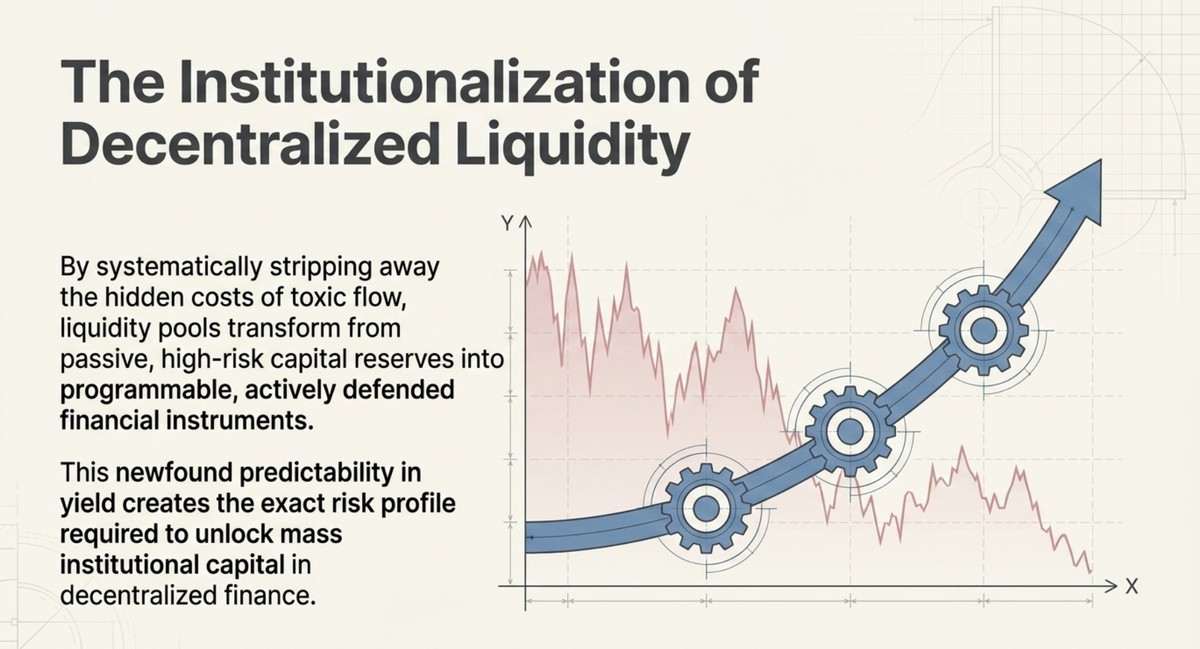
This reduction in risk is poised to attract institutional capital that previously avoided AMMs due to the hidden costs of toxic flow. Arbitrageurs will be forced to adapt, transitioning from adversarial exploiters to cooperative market makers participating in structured internal auctions. Ultimately, Uniswap v4 redefines decentralized trading.
Liquidity pools are no longer passive capital reserves; they are active, programmatically protected financial instruments capable of preserving value for their participants.

.png)