
 Base
Base Unichain
 Robinhood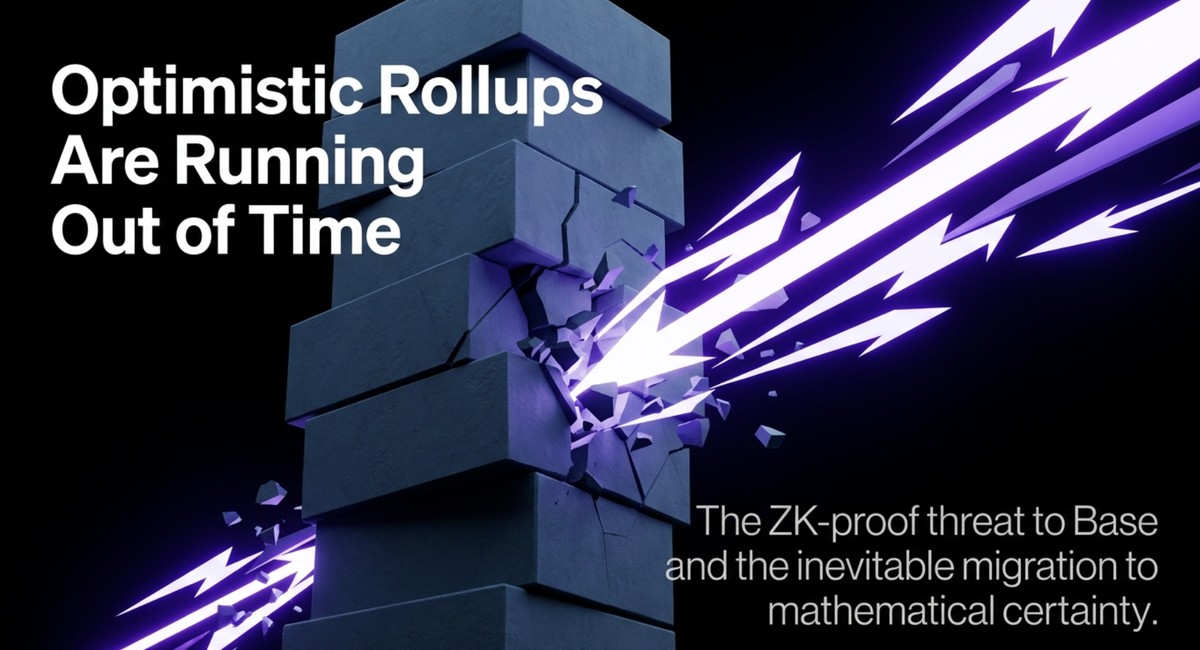
The explosive growth of Coinbase-backed L2 network Base has validated Layer-2 scaling but simultaneously exposed the hidden costs of Optimistic Rollup architecture. The seven-day challenge window hinders capital efficiency, limits institutional liquidity, and complicates integration within the Superchain ecosystem. Meanwhile, rapid progress in ZK-infrastructure - spanning general-purpose zkVMs (SP1, RISC Zero), hardware accelerators, and decentralized prover markets - makes validity proofs economically viable today.
Base faces a critical strategic challenge: transitioning to ZK-proofs is becoming a necessity to survive long-term competition. Read more about the technological shift here: ZK-proof scaling. Launched in the summer of 2023, Base has demonstrated phenomenal growth rates. As a project of Coinbase, the largest public cryptocurrency exchange in the United States, this Layer-2 (L2) blockchain quickly assumed a dominant position in the Ethereum scaling landscape.
Deep integration with Coinbase's ecosystem, user-friendly features like the Smart Wallet, low transaction fees, and robust support for consumer applications have secured billions in Total Value Locked (TVL) and established Base as the primary hub of DeFi activity. Yet, from a technical perspective, Base is built on the OP Stack, a modular software framework utilizing Optimistic Rollup architecture.
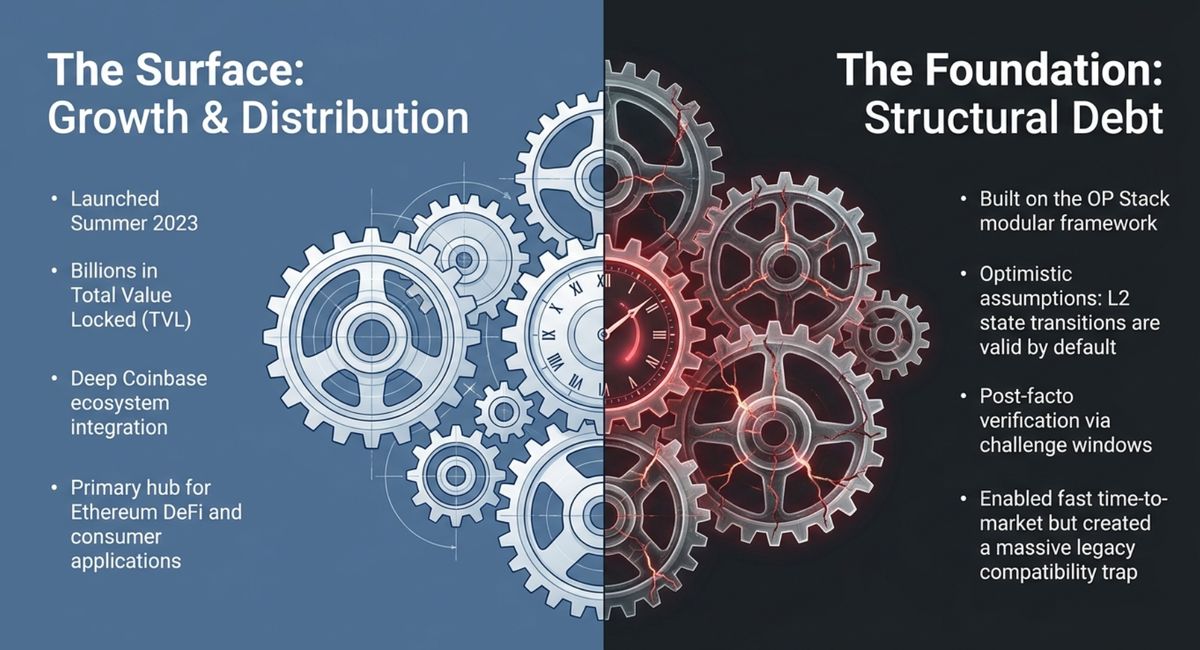
This design assumes all transactions posted by the sequencer to the Ethereum mainnet (L1) are valid by default. Verification happens post-facto, only if an independent validator detects an anomaly and submits a fault proof. While this approach enabled a fast and cost-effective market entry, it increasingly acts as a bottleneck for the ecosystem's long-term expansion.
The Economic Friction of Optimism: The Seven-Day Capital Barrier
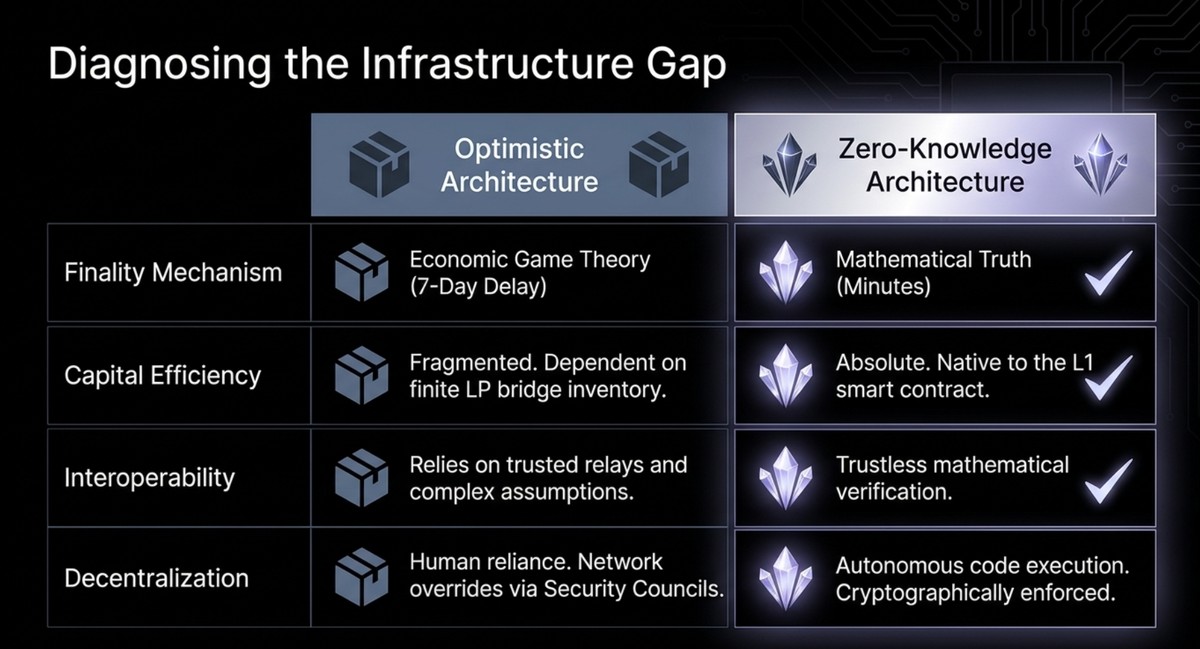
The primary vulnerability of Optimistic Rollup architecture remains the latency required to achieve finality on the base layer. To ensure security and prevent malicious state transitions, the system enforces a strict seven-day challenge window. During this period, any L2 state update can be disputed. For end-users, this translates to a hard constraint: standard withdrawals of assets from Base back to Ethereum L1 take a full week.
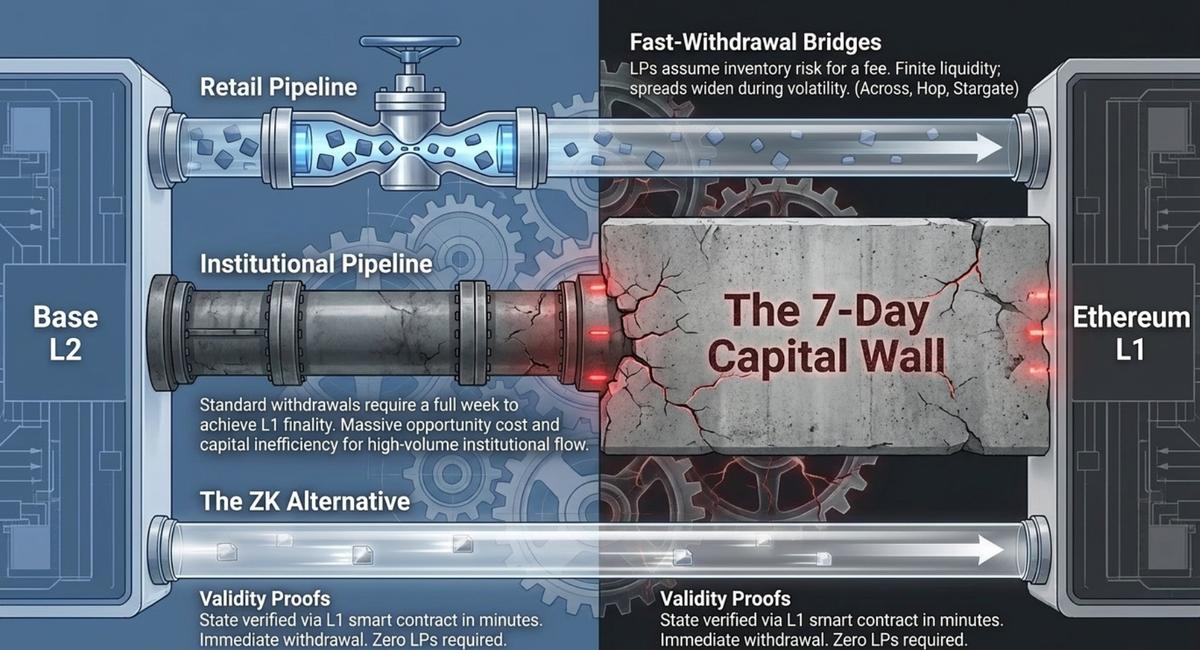
To overcome this user experience bottleneck, the industry has developed fast-withdrawal bridges such as Across, Hop Protocol, and Stargate. These protocols operate via liquidity providers (LPs) who pre-fund user withdrawals on L1 from their own pools in exchange for a fee. The LPs then assume the inventory risk and wait out the seven-day challenge window to reclaim the funds from the rollup.
While this mechanism successfully accommodates retail users moving small sums, it introduces massive capital inefficiency at the institutional level. The accumulated cost of bridge fees and the opportunity cost of locked capital create significant friction for high-volume traders. Furthermore, bridge liquidity is highly finite. During periods of market volatility or sudden spikes in withdrawal demand, LPs often widen their spreads or halt operations due to inventory depletion.
In contrast, ZK-Rollups rely on validity proofs. State transitions are verified by an L1 smart contract in minutes. Once the cryptographic proof is verified by Ethereum, the transaction is finalized, allowing immediate withdrawals without intermediaries or liquidity premiums. As institutional capital in DeFi grows, this capital efficiency gap becomes a critical competitive differentiator.
The ZK Infrastructure Revolution: Technical Parity and Falling Costs
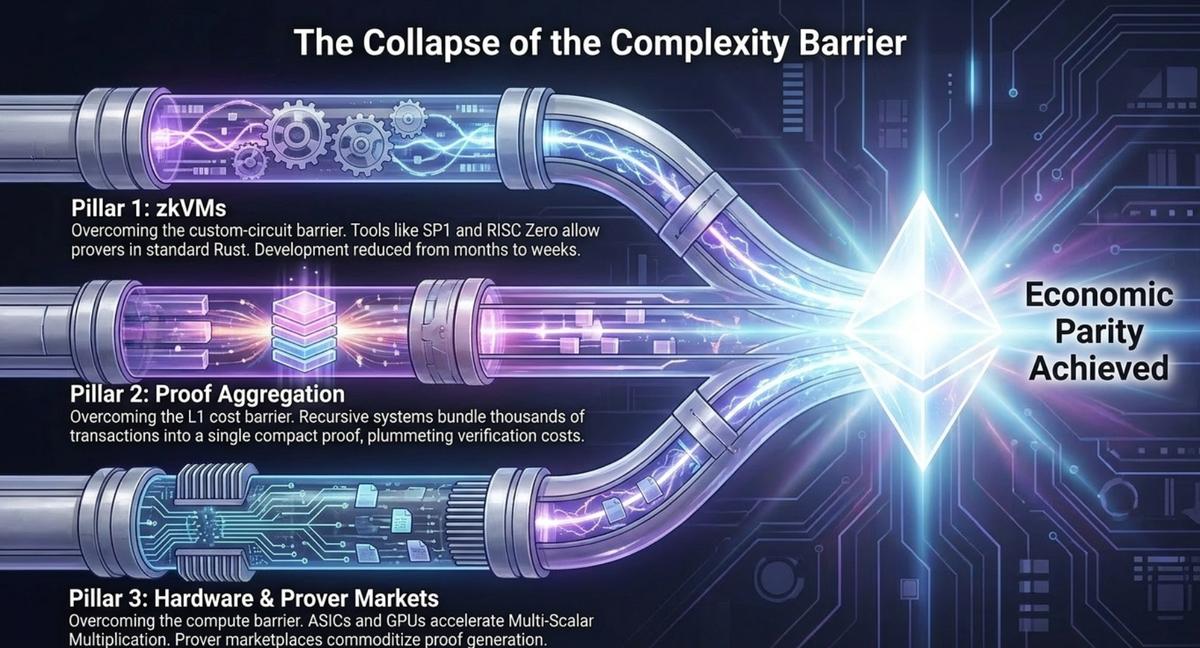
Historically, proponents of Optimistic Rollups argued that Zero-Knowledge (ZK) technology was too complex to implement and too expensive to operate. Building a zkEVM required writing custom cryptographic circuits by hand, while proof generation required hours of computation on expensive GPU clusters. Over the past two years, ZK-proof infrastructure has undergone a massive technological shift driven by three primary catalysts: First, the emergence of general-purpose Zero-Knowledge Virtual Machines (zkVMs) like Succinct's SP1 and RISC Zero has simplified development.
These tools allow developers to write prover logic in standard Rust, compiling it directly to RISC-V bytecode. This has reduced the time needed to build ZK systems from months to weeks, demystifying the development process. Second, proof aggregation and recursive proof systems have enabled the bundling of thousands of transactions into a single, compact proof.
The L1 verification cost per transaction has plummeted, eroding the primary fee advantage that optimistic networks historically enjoyed. Third, a robust hardware acceleration market has developed. Specialized Application-Specific Integrated Circuits (ASICs) and GPUs have accelerated cryptographic operations like Multi-Scalar Multiplication (MSM) by orders of magnitude.
With the rise of decentralized prover marketplaces, such as Gevulot or Succinct Network, proof generation is becoming a cheap commodity. Consequently, the cost gap between Base and ZK-rollups has narrowed to near parity.
The Battle for the Superchain: Interoperability and Shared Security
The Optimism Foundation is actively building the "Superchain" - a network of L2 chains built on the OP Stack that share security, governance, and communication standards. Base is the crown jewel of this initiative. The goal is to allow users to move seamlessly between Base, OP Mainnet, Zora, and others, creating a unified user experience.
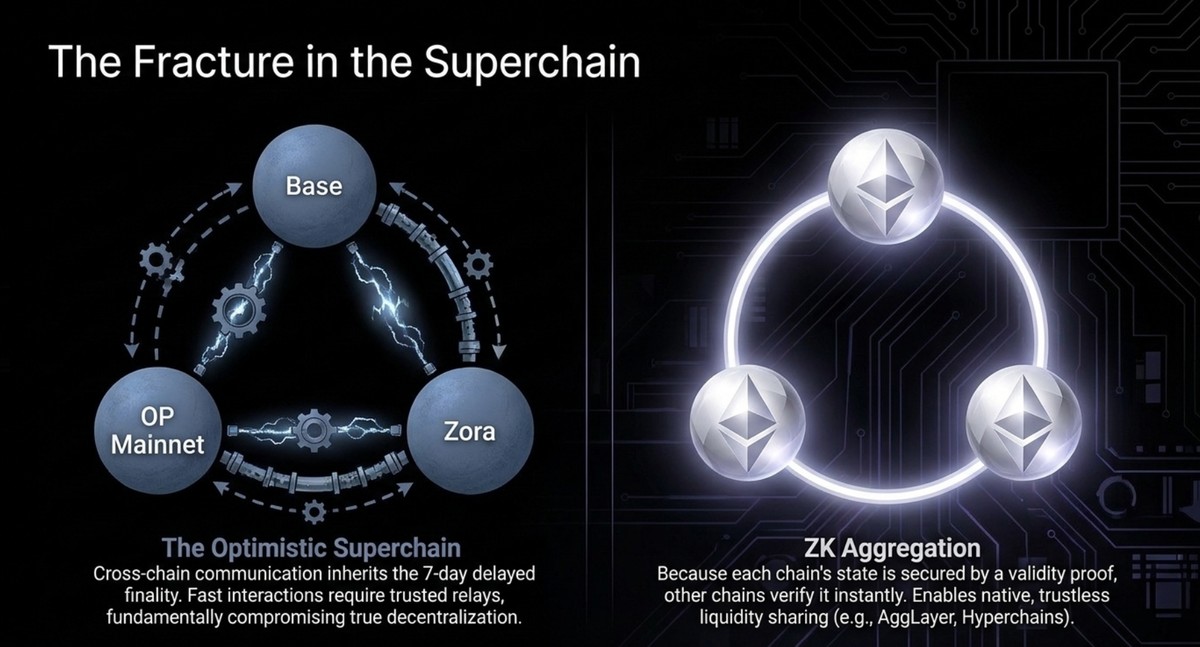
However, cross-chain communication in an optimistic framework faces the same challenge of delayed finality. Chain A cannot trust a state transition on Chain B instantly, as that transition could theoretically be reverted if a fault proof is submitted on L1 within the seven-day window. To enable fast cross-chain interactions, the Superchain must rely on trusted relays or complex optimistic assumptions, compromising decentralization.
ZK ecosystems resolve this issue mathematically. Because the state of each ZK-chain is secured by a validity proof, other chains can verify it instantly. Projects like Polygon's AggLayer and zkSync's Hyperchains demonstrate how ZK proofs enable instant liquidity sharing across multiple chains without security trade-offs.
For Base, this lag in native cross-chain interoperability could become a significant barrier as the multi-chain ecosystem matures.
Technical Debt and the Fragility of Fault Proofs
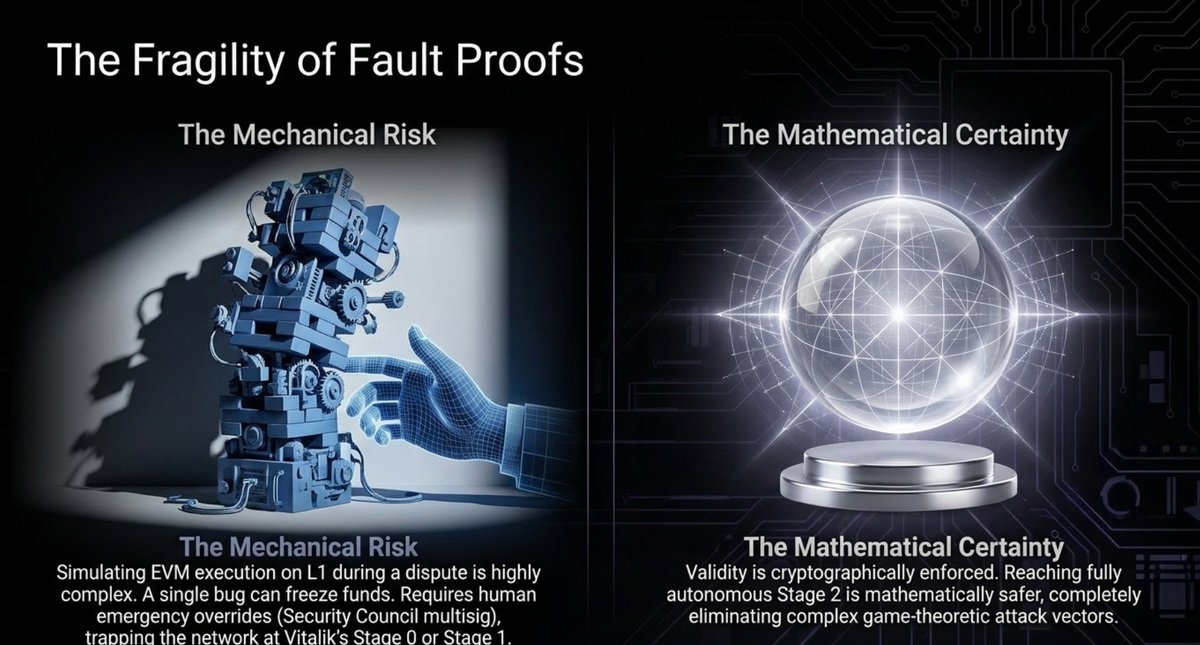
The internal mechanics of Optimistic Rollups are far more complex than originally anticipated. The system requires a fully functional fault proof mechanism to simulate EVM execution on L1 during a dispute. Developing this mechanism (such as the OP Stack's Cannon) took several years of intense engineering.
Even in production, these systems remain fragile. A single bug in the dispute game logic or the on-chain emulator could lead to catastrophic failures, including frozen funds or invalid state transitions. To mitigate these risks, optimistic networks rely on administrative overrides known as Security Councils.
These are multi-signature groups with the authority to halt the network or manually override its state in an emergency. According to Vitalik Buterin's rollup classification, this human reliance keeps Base at Stage 0 or Stage 1 of decentralization. For ZK-Rollups, achieving true decentralization is less risky.
Because validity is enforced cryptographically rather than economically, a Security Council is only needed during early testing phases. Transitioning to a fully autonomous Stage 2 rollup is mathematically safer, as the system does not have to guard against complex game-theoretic attack vectors.
Base's Strategic Dilemma: The Cost of Upgrading
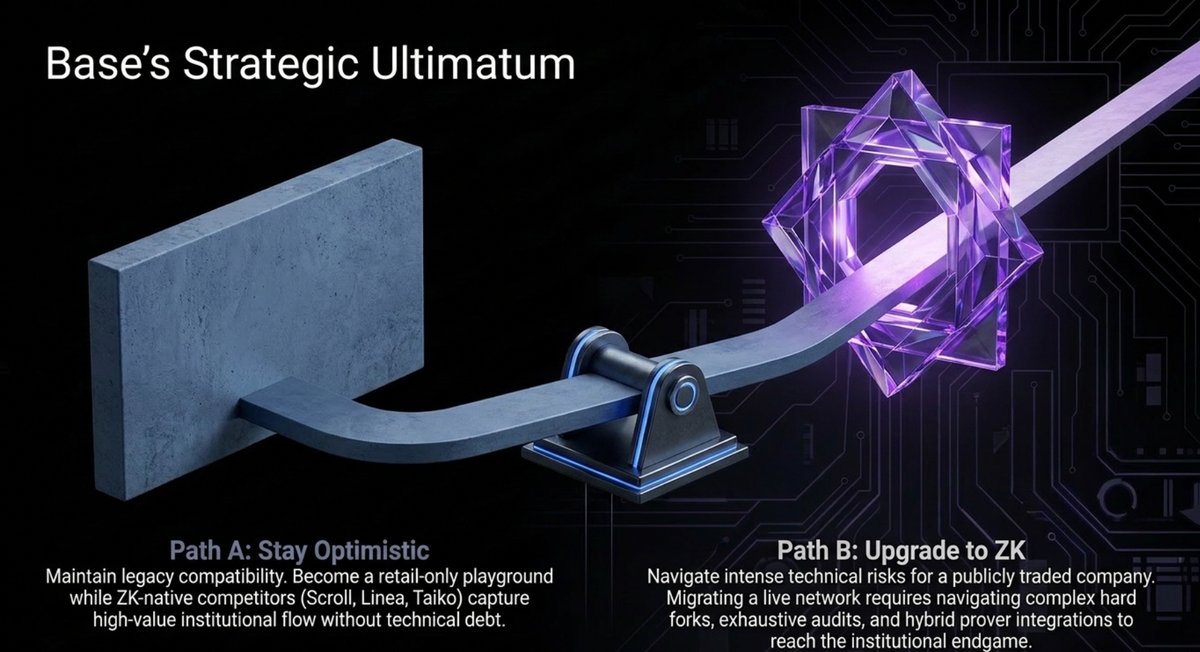
Coinbase selected the OP Stack for Base to minimize time-to-market. The strategy succeeded, allowing Base to capture market share. However, this success has created a legacy compatibility trap. ZK-native competitors like Scroll, Linea, Taiko, and Starknet are building their ecosystems from scratch without optimistic technical debt.
Although OP Labs is working to integrate ZK provers into the OP Stack (partnering with RISC Zero and Succinct to explore hybrid proving systems), implementing this transition on a live network is incredibly difficult. Upgrading a network like Base - which processes millions of transactions and secures billions in TVL - requires executing complex hard forks, performing exhaustive security audits, and risking service disruptions.
For Coinbase, a publicly traded, highly regulated company, any network instability carries severe reputational risks. Base must navigate the fine line between technological obsolescence and the risks of a major architectural overhaul.
Conclusion: The Shift in Venture and Technological Paradigms
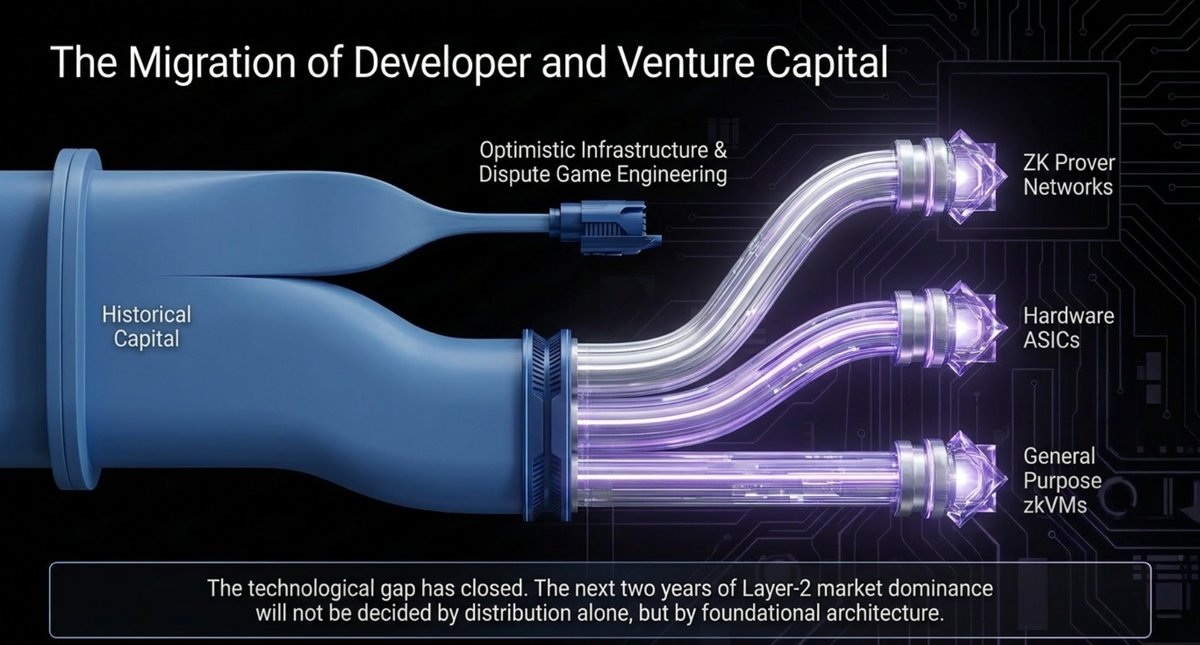
The next two years will decide the layout of the Layer-2 scaling market. While Base's dominance appears secure due to Coinbase's distribution network, the technological gap is closing. Falling ZK-proving costs and the rise of zkVMs make the optimistic rollup model increasingly obsolete. Venture capital is shifting toward ZK infrastructure, backing prover networks, hardware acceleration, and aggregation layers.
Base faces a choice: undergo a complex transition to ZK-proofs or accept a future as a retail-only playground while high-value institutional transactions migrate to ZK-validated networks. Optimistic rollups succeeded in scaling Ethereum's first wave, but the future belongs to validity-proven systems.