
 Base
Base Unichain
 Robinhood
The expansion of autonomous AI agents on the Base blockchain faces a critical hurdle: Maximal Extractable Value (MEV). Traditional transaction execution models render deterministic bots highly vulnerable to frontrunning and sandwich attacks. The solution lies in Intent-Based Arbitrage. In this architecture, AI agents do not submit transactions directly to the network.
Instead, they delegate execution to specialized solvers. This coordination is facilitated by the x402 standard - an open machine-to-machine payment protocol built around the HTTP 402 Payment Required status code. This allows AI bots to securely pay solvers in USDC stablecoins on Base, keeping transaction parameters off public mempools and neutralizing MEV threats.
The Rise of the Agentic Economy on Base and the MEV Challenge
Coinbase's Base L2 network has become the primary hub for deploying autonomous AI agents. With low fees and fast block times, Base provides an ideal environment for automated workflows. AI agents on the network have progressed from simple data aggregation to active capital management, yield optimization, and arbitrage execution.
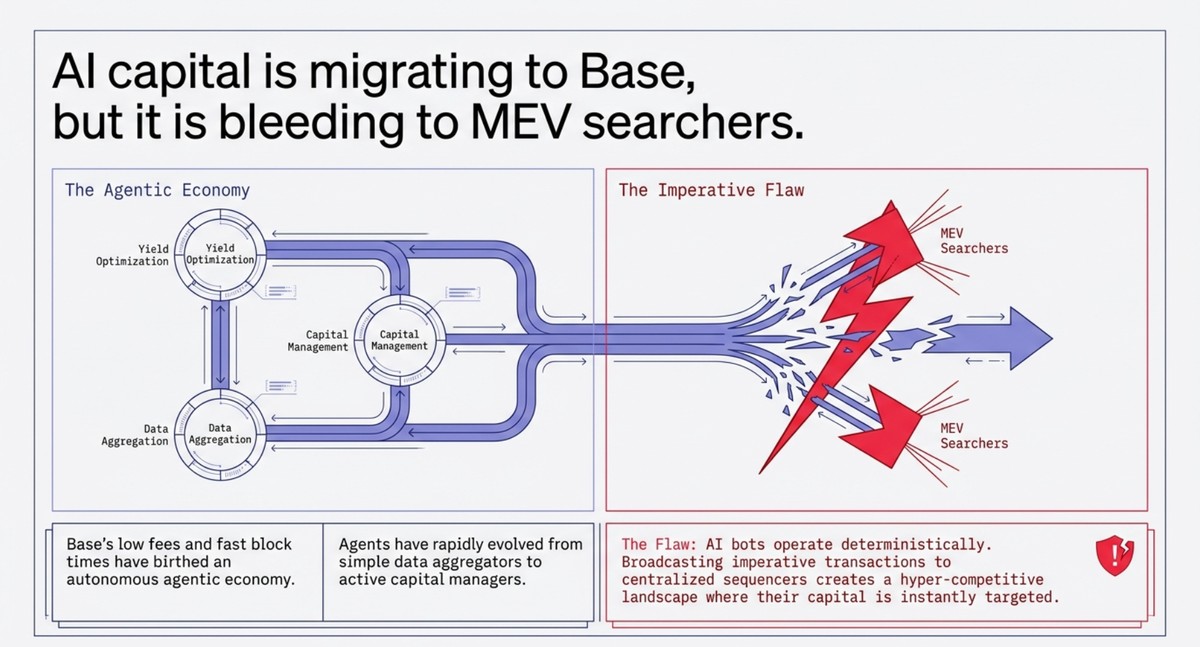
However, this massive influx of programmatic capital has attracted sophisticated Maximal Extractable Value (MEV) searchers. On Base, transactions are ordered by a centralized sequencer, creating a hyper-competitive landscape for arbitrage. Any public action taken by an AI agent can be instantly preempted by MEV searchers.
Consequently, the traditional imperative model of broadcasting transactions to public pools is becoming economically unviable for AI bots. For the machine-to-machine economy to scale, autonomous systems require a secure execution paradigm that insulates them from predatory frontrunning.
Anatomy of the Threat: Why AI Bots Are Vulnerable to Frontrunning
AI bots operate on deterministic logic that analyzes blockchain state, making their behavior highly predictable. When an AI agent detects a price discrepancy between DEX liquidity pools, it constructs and broadcasts a standard swap transaction to capture the arbitrage profit. Professional MEV searchers use simulation engines to monitor transactions, simulating outcomes and using specialized infrastructure to frontrun the agent.
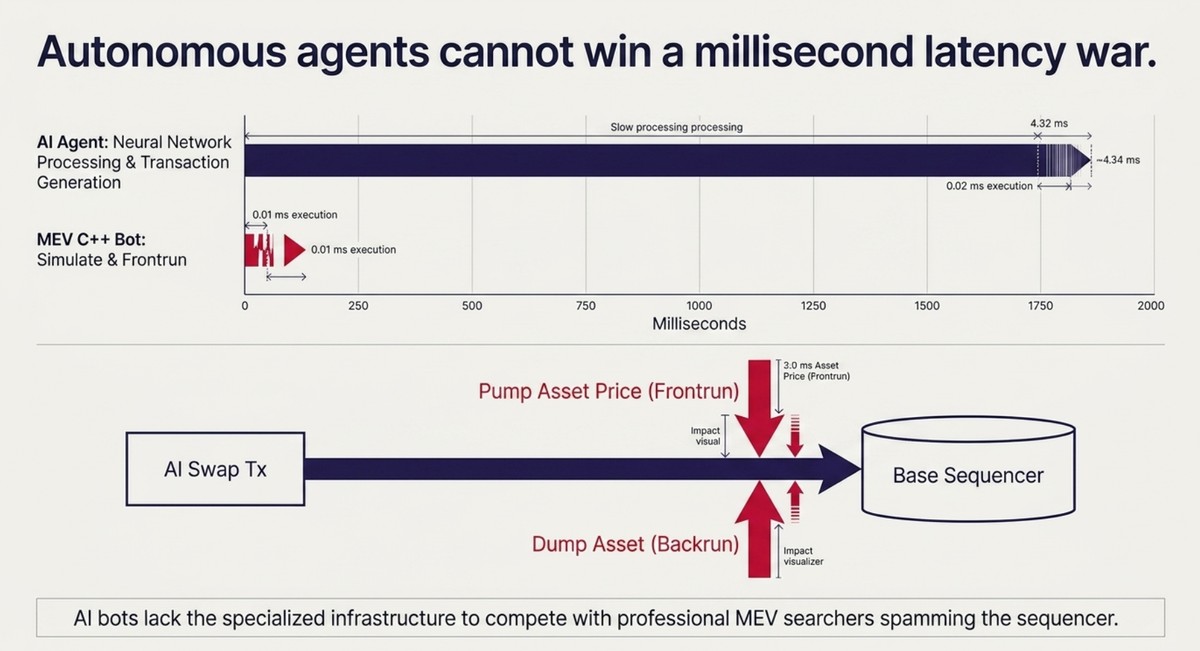
In networks with public mempools, they execute sandwich attacks, artificially manipulating the asset price before the agent's transaction is processed, extracting the profit. Even on Base, which lacks a public L1 mempool, searchers exploit latency advantages, backrunning trades and spamming the sequencer to secure block space.
Because AI agents are constrained by the processing time of neural networks, they cannot compete in millisecond-scale latency races against C++ bots running next to the sequencer. Traditional mitigation strategies, such as private RPC endpoints, require complex setup and are impractical for lightweight, distributed AI agents.
Understanding the x402 Standard: Activating HTTP 402 for Machine-to-Machine Payments
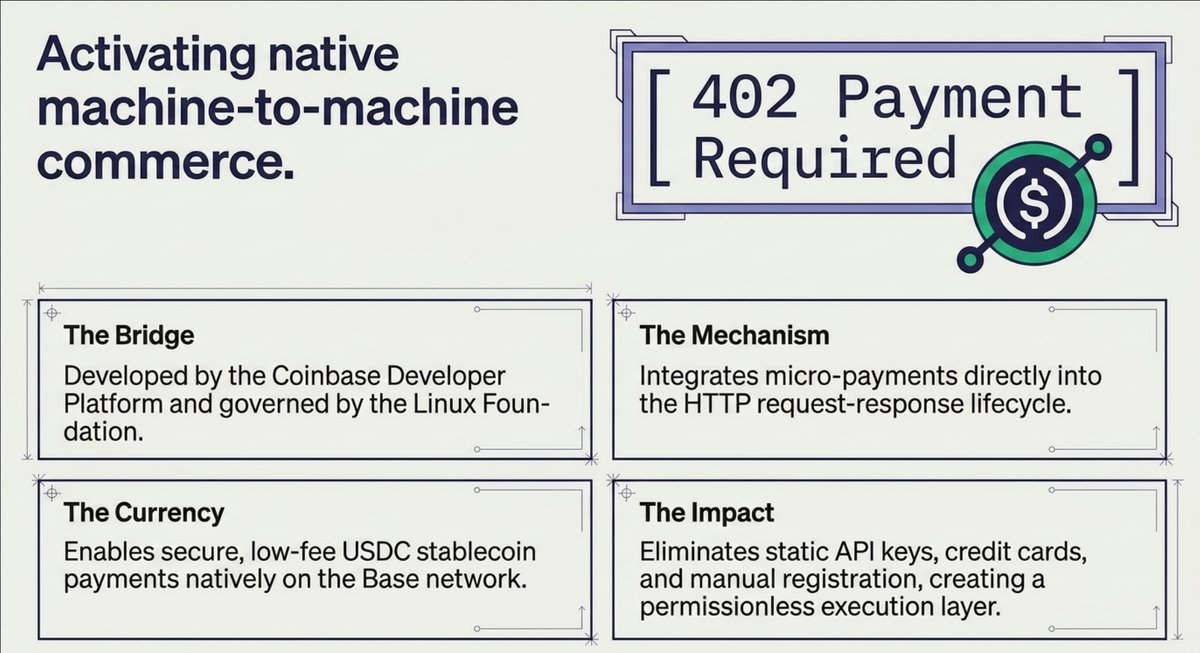
To bridge autonomous web services and blockchain transactions, developers introduced x402. Designed by the Coinbase Developer Platform and governed by the independent x402 Foundation under the Linux Foundation, this standard revives the HTTP 402 Payment Required status code. The standard integrates payments directly into the HTTP request-response lifecycle.
When an AI agent requests a restricted resource or an execution service, the server returns an HTTP 402 status code with a structured response containing payment specifications (price, recipient address, target blockchain, and token, typically USDC). The AI agent parses these parameters, signs a transaction using its wallet, and broadcasts the payment.
The agent then retries the HTTP request, appending an X-Payment header with the transaction hash. The server verifies the transaction on-chain and delivers the requested resource. This eliminates traditional payment gateways, credit cards, manual registration, and static API keys. By conducting transactions on-chain, the Base x402 standard facilitates micro-scale payments with minimal fees, creating a permissionless, programmable layer for machine-to-machine commerce.
Shifting from Imperative to Declarative: The Power of Intent-Based Architectures
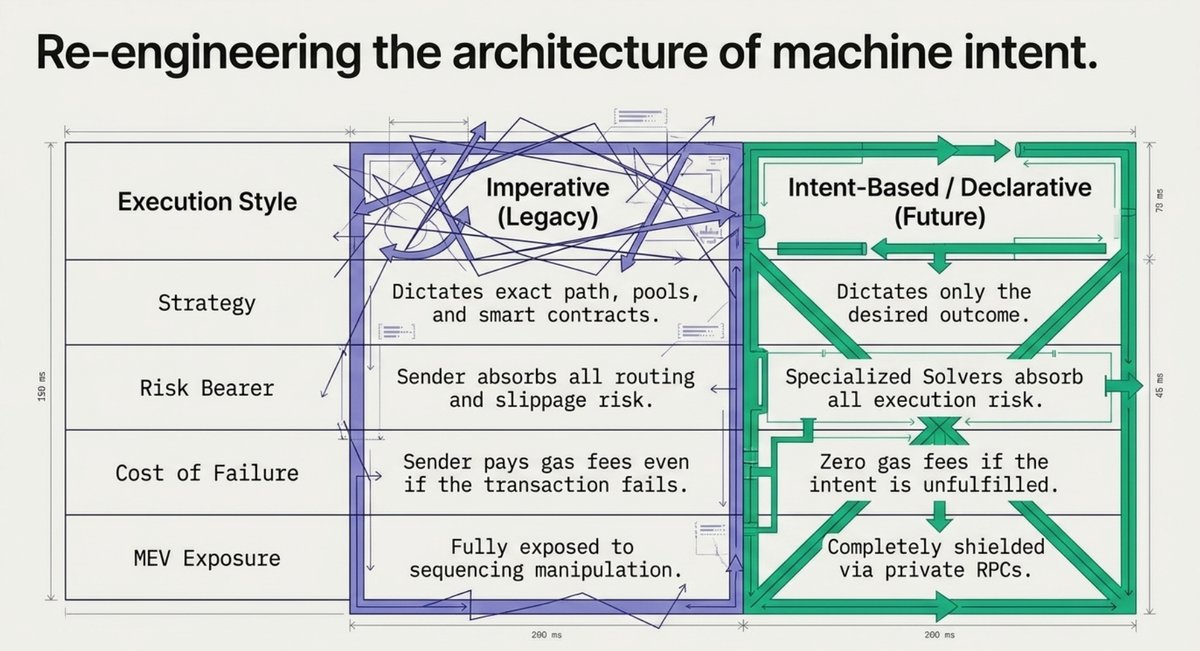
Conventional blockchain interaction is imperative: the bot specifies the exact path, pools, and contracts. Senders bear all routing, slippage, and failure risks, leaving a large exploit surface. Conversely, intent-based (declarative) architecture allows agents to specify only their desired outcome (intent) rather than the path. For example, an AI agent might sign an intent stating: "I want to exchange 5 WETH for at least 15,000 USDC." The execution mechanics are abstracted away from the agent.
The execution of these intents is delegated to a competitive network of solvers. Solvers are sophisticated market participants with proprietary liquidity and optimized routing algorithms. They compete in real-time to satisfy the agent's intent under the most favorable conditions. The winning solver bundles the trade and submits it to the blockchain.
This removes the burden of routing, monitoring slippage, or paying gas for failed transactions, shifting complexity and risk to solvers.
How the x402 and Intent-Based Synergy Neutralizes MEV
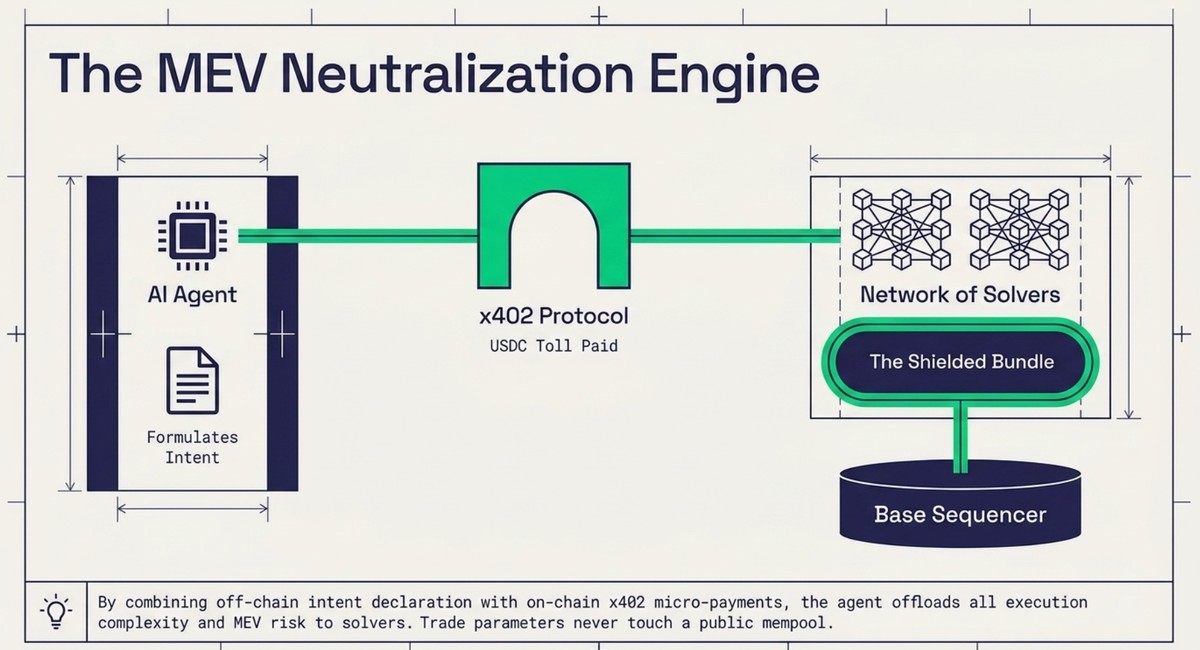
Integrating x402 and intents provides a robust MEV defense. Instead of broadcasting transactions publicly, the bot interacts with solver APIs. When the AI bot identifies an arbitrage opportunity, it generates an off-chain intent and submits it to the solver gateway via an HTTP request. The gateway returns an HTTP 402 response, requesting a micro-payment fee (e.g., 0.1 USDC).
The AI agent executes the payment on Base using the x402 protocol and submits the transaction hash in a retried HTTP request. Once validated, the gateway forwards the intent to solvers. Critically, the intent is never exposed to public mempools, as solvers use private RPCs to communicate with the sequencer.
The trade is bundled atomically with the solver's transaction, preventing external MEV detection or frontrunning. If market conditions shift and the solver cannot fulfill the intent, the transaction is aborted. In this scenario, the AI agent loses no gas fees, as solver execution fees are only captured upon successful settlement.
The entire MEV risk is absorbed by the professional solver network.
Step-by-Step Execution: From Discrepancy Detection to Secure Settlement
Let us walk through the lifecycle of an arbitrage transaction executed by an AI bot: 1. Market Scanning: An autonomous AI agent monitors price feeds across DEXs on Base. It identifies a 0.5% price discrepancy for WETH/USDC between Uniswap V3 and Aerodrome. 2. Intent Formulation: Rather than constructing a swap transaction, the agent signs a declarative intent specifying that it will provide 10 WETH in exchange for at least 30,150 USDC, ensuring a net profit.
- API Submission: The AI agent sends a POST request containing the signed intent to the secure execution gateway. 4. Payment Request (HTTP 402): The gateway receives the intent, estimates the gas costs, and returns an HTTP 402 Payment Required response instructing the agent to pay a routing fee of 0.15 USDC to the gateway's address on Base.
- Micro-payment: The agent parses the response, signs a 0.15 USDC transfer on Base, and broadcasts it for instant processing. 6. Proof Submission: The agent resubmits the POST request, attaching the transaction hash to the X-Payment-Hash header. 7. Verification and Routing: The gateway verifies the payment, registers the intent, and submits it to the solver auction.
- Execution Bundling: Solvers compete to route the trade. The winning solver bundles the swap on Uniswap and the swap on Aerodrome into a single atomic transaction. The solver submits the bundle directly to the Base sequencer via a private RPC. 9. Atomic Settlement: The bundle is mined on Base.
The agent receives 30150 USDC, the solver claims the remaining spread, and the trade settles without exposing parameters.
Future Outlook and Challenges: Solver Decentralization and Scaling
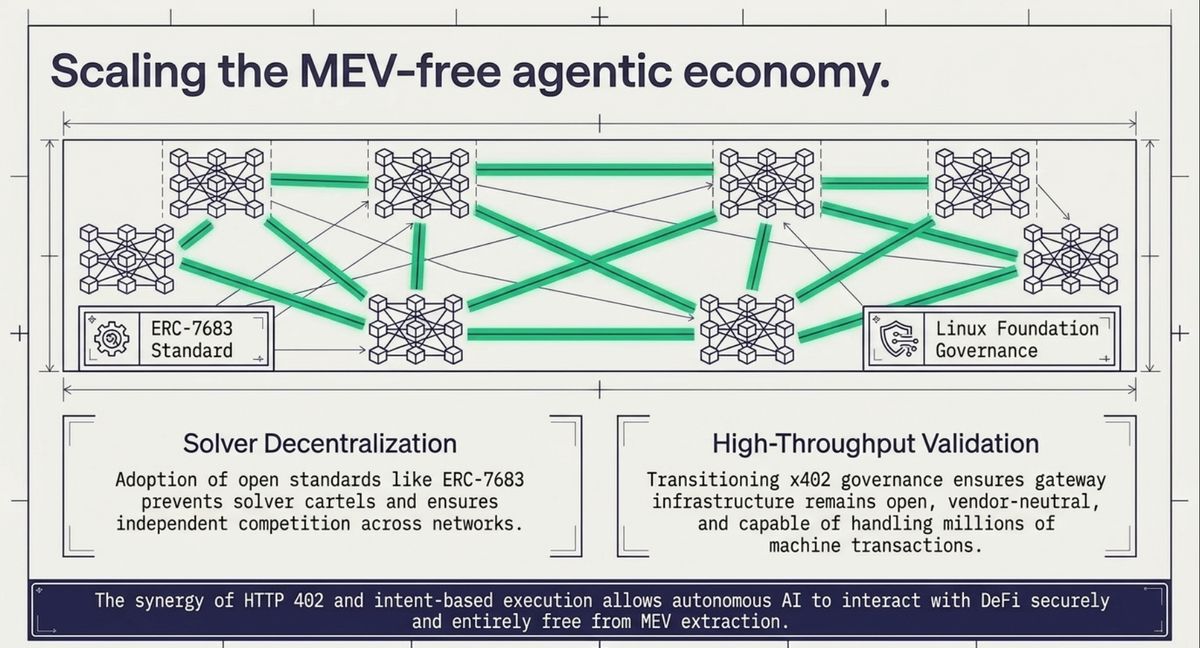
While x402 and intent-based execution offer clear advantages, solver centralization remains a challenge. A dominant solver cartel could inflate HTTP 402 fees or extract solver MEV. To counter this, the industry is adopting open standards like ERC-7683. Developed by Uniswap Labs and Across Protocol, ERC-7683 provides a standardized framework for cross-chain intents, ensuring that any independent solver can compete on terms.
Scaling x402 is also critical. As machine transactions grow, gateways must handle high-throughput validation. Transitioning x402 to the Linux Foundation keeps it open and vendor-neutral. In the long term, the synergy between the HTTP 402 standard and intent-based execution will form the foundational infrastructure for the agentic economy.
It will allow millions of autonomous AI agents to interact with DeFi protocols securely, efficiently, and free from the threat of MEV exploitation.