
 Base
Base Unichain
 Robinhood
- Centralized AI APIs present a severe censorship and operational bottleneck for autonomous on-chain agents.
- AI inference differs fundamentally from model training: it is stateless, highly parallelizable, and can run on distributed consumer GPUs.
- Decentralized networks like Bittensor, Akash, and Render aggregate global computing power and use cryptographic verification to ensure accurate model outputs.
- Autonomous Web3 applications gain censorship-resistant, permissionless machine intelligence without relying on corporate cloud monopolies.
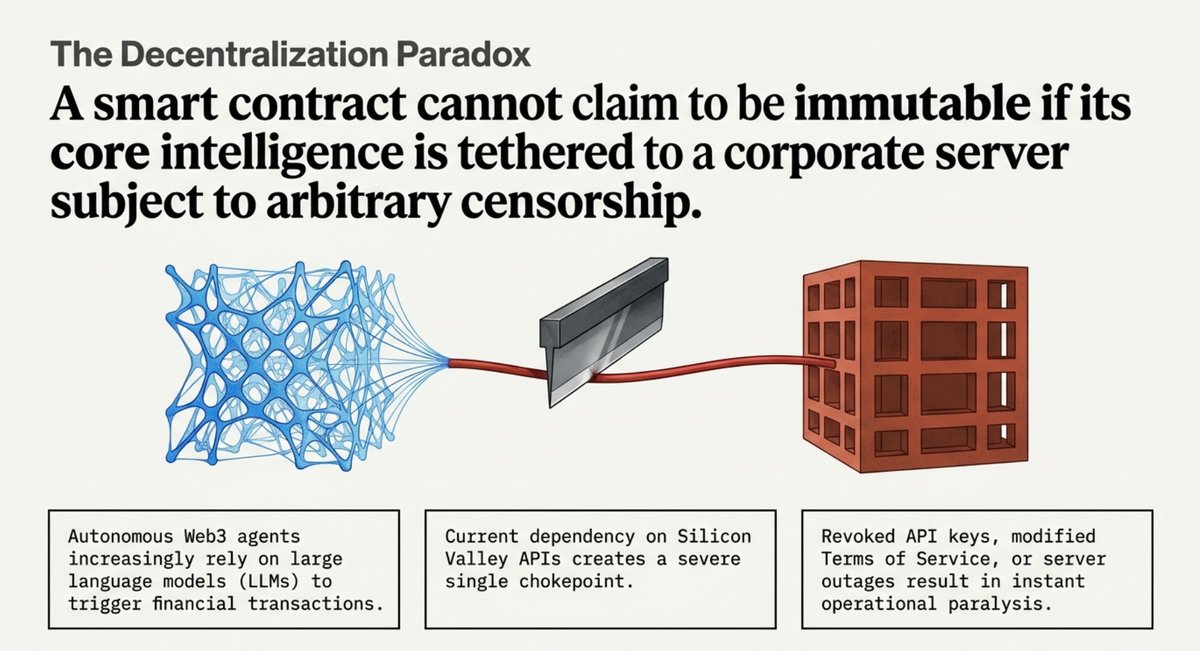
The explosion of artificial intelligence has created an uncomfortable paradox for the decentralized economy. Autonomous Web3 agents, algorithmic trading protocols, and decentralized social networks increasingly rely on large language models (LLMs) to analyze data, parse sentiment, and trigger financial transactions. Yet, virtually all of these applications depend on centralized Application Programming Interfaces (APIs) controlled by a handful of Silicon Valley cloud monopolies, such as OpenAI, Microsoft Azure, and Amazon Web Services.
If a centralized provider revokes an API key, modifies its terms of service, or experiences a data center outage, the decentralized agent dependent on that endpoint is instantly paralyzed. A smart contract cannot truly claim to be decentralized or immutable if its core intelligence is tethered to a corporate server subject to arbitrary censorship. Decentralized AI inference represents the technological solution, utilizing blockchain coordination to aggregate global graphics processing units (GPUs) into an open, verifiable machine intelligence network.
The Architectural Divide: Training Versus Inference
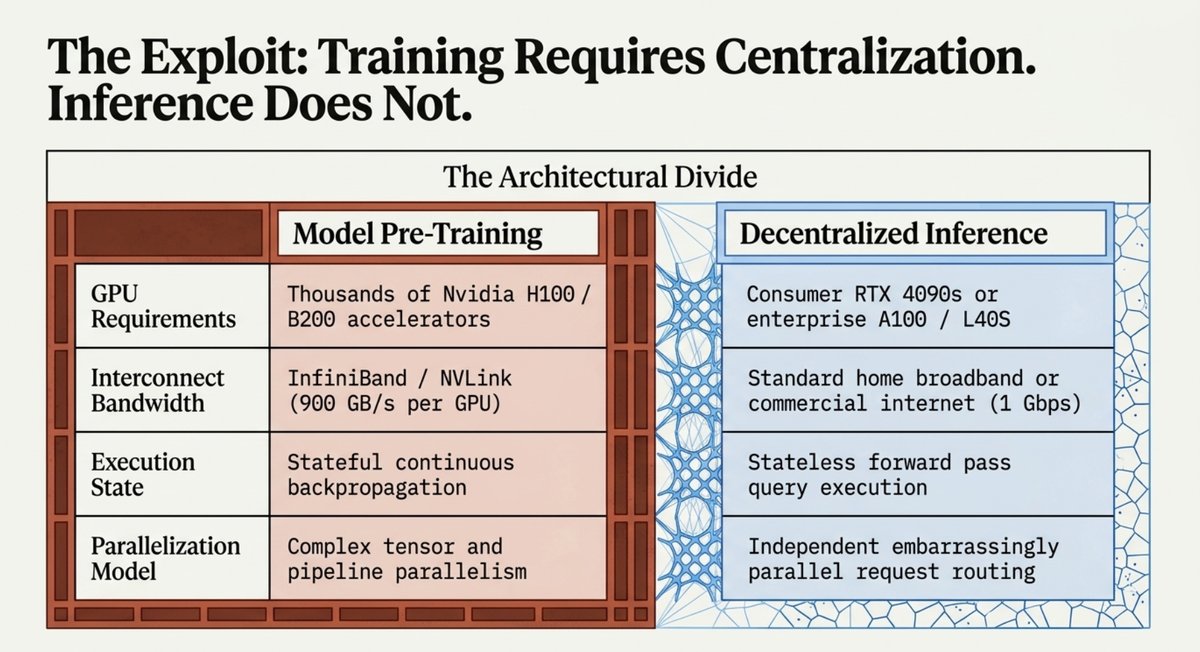
To understand how decentralized AI functions, one must first distinguish between the two primary stages of machine learning: training and inference.
- Model Training: This is the process of creating an AI model from scratch. Training massive frontier models requires thousands of specialized GPUs (such as Nvidia H100s) tightly interconnected via ultra-low-latency physical networking like NVLink. Because every processor must synchronize billions of mathematical weights continuously, training cannot easily be distributed across consumer computers scattered around the world.
- Model Inference: Once a model is trained, using it to answer a query or process an image is called inference. Inference is stateless, lightweight, and embarrassingly parallel. A single high-end consumer GPU (such as an Nvidia RTX 4090) or an enterprise workstation can easily host an open-weight model (such as Llama or Mistral) and process thousands of prompt requests independently.
AI Workflow Comparison:
1. Training (Monolithic): 10,000 H100 GPUs in 1 Data Center connected via NVLink
2. Inference (Decentralized): Thousands of independent GPUs across the globe answering prompts
Because inference does not require microsecond-level synchronization between nodes, it can be distributed across a permissionless, decentralized network of independent computer operators.
The Verification Dilemma: Proving Honest Computation
In a decentralized network where anonymous operators are paid in tokens to run AI prompts, a fundamental security challenge arises: how does the network verify that a node actually ran the requested neural network instead of returning a cheap, pre-computed answer or using a smaller, inferior model to pocket the difference?
Decentralized compute networks employ three distinct architectural models to solve this verification dilemma, as documented across protocols like Bittensor and Akash:
- Consensus and Redundant Sampling: The network routes the identical prompt to three random, independent nodes. If all three nodes return outputs that match within a statistical threshold, the result is accepted, and the nodes are rewarded. A node returning malicious or degraded outputs is mathematically detected and financially penalized.
- Zero-Knowledge Machine Learning (zkML): Specialized cryptography compiles neural network execution into a succinct zero-knowledge proof. The node executes the prompt and generates a mathematical proof demonstrating that the output was derived by running the exact verified weights of the model. While mathematically perfect, zkML currently carries high computational overhead for multi-billion-parameter LLMs.
- Optimistic Fraud Proofs: Similar to Layer-2 rollups, the network assumes node outputs are honest by default. Challengers can audit historical inferences; if an invalid execution is detected, the challenger initiates a dispute, and the fraudulent node's staked collateral is slashed.
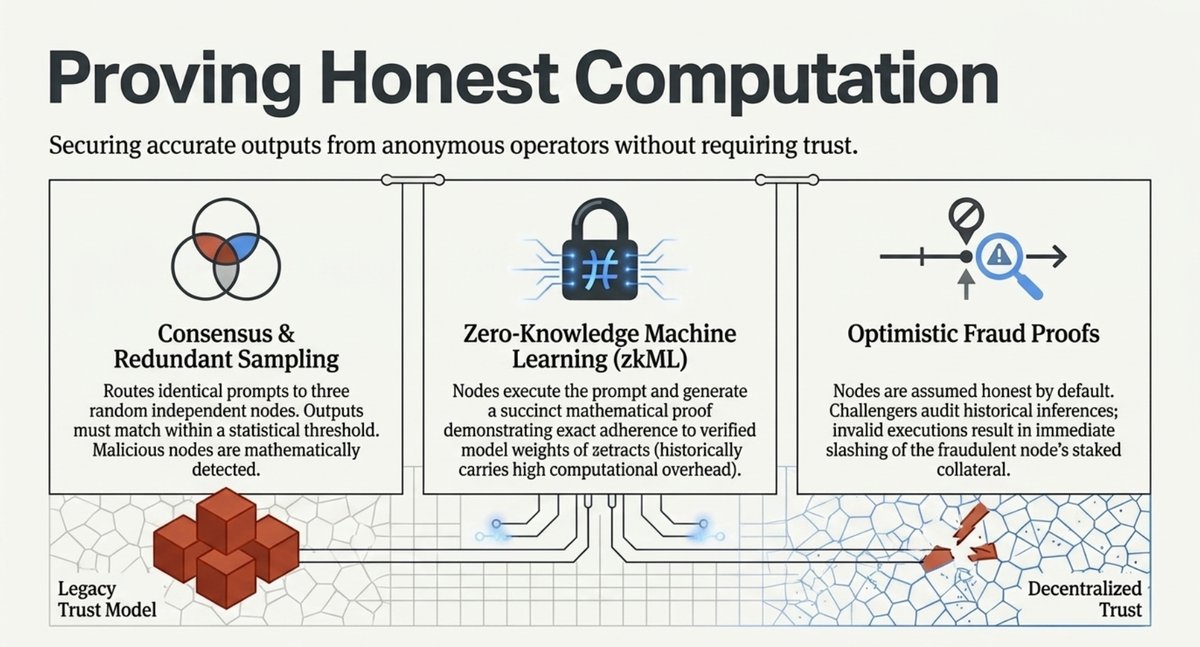
Verification ensures that decentralized AI networks deliver authentic machine intelligence without requiring users to trust the integrity of anonymous node operators.
Practical Advantages for the Web3 Economy
Decentralized AI inference provides tangible structural benefits over traditional corporate APIs:
- Immunity from Platform De-platforming: Smart contracts and autonomous on-chain agents can purchase inference using stablecoins or native crypto assets directly on-chain, eliminating the risk of sudden credit card declines or account bans.
- Censorship-Resistant Intelligence: Corporate AI APIs enforce strict centralized filtering guardrails that frequently interfere with financial analysis, competitive intelligence, or privacy-preserving research. Decentralized networks execute open-weight models without corporate editorial bias.
- Global Hardware Monetization: Compute networks aggregate idle consumer GPUs, university clusters, and independent data centers into a single liquidity pool, driving the cost of raw AI inference down through open market competition.
The Future of Autonomous Economic Agents
As artificial intelligence and blockchain technology converge, the necessity for decentralized inference will become paramount. Future on-chain applications will not be operated by humans clicking buttons in graphical user interfaces. They will be directed by autonomous AI agents managing multi-million-dollar investment portfolios, negotiating cross-chain trades, and allocating capital in real time.
For these agents to operate as sovereign economic entities, their cognitive substrate must be as immutable and decentralized as the underlying financial ledger. By liberating machine intelligence from centralized server farms and anchoring it in open cryptographic networks, decentralized inference ensures that the intelligence layer of the internet remains open, neutral, and accessible to everyone.