
 Base
Base Unichain
 Robinhood
The first year of a single European regime for crypto assets is best judged not by loud headlines but by what actually changed in the daily work of venues and in the position of their clients. The unified rules were meant to replace a patchwork of national approaches with a predictable set of requirements, and it is predictability, rather than strictness on its own, that turned out to be the main result. For the client this means fewer surprises when moving between jurisdictions and more clarity about who is responsible for what.
What the regime requires of a venue
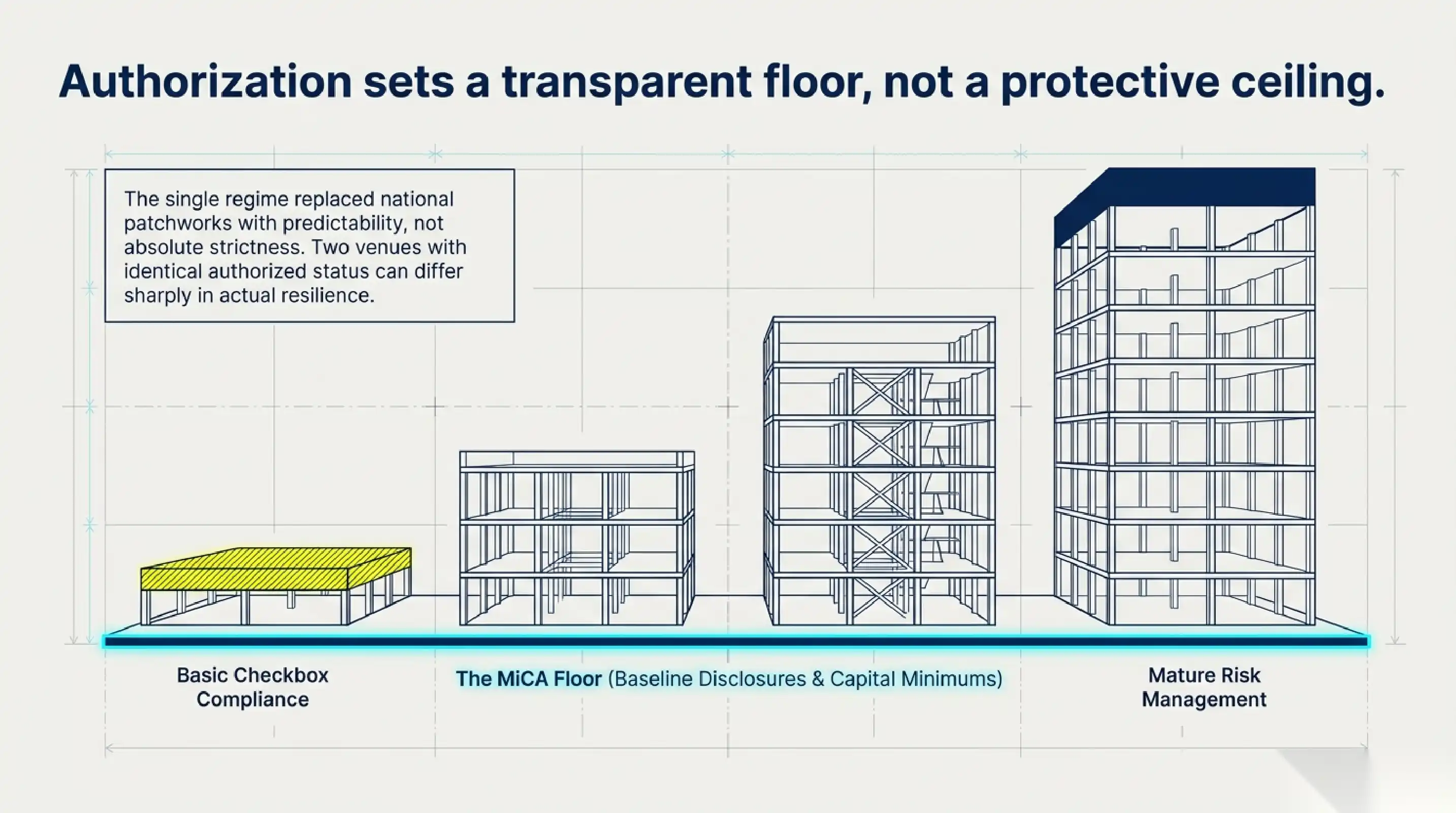
The single regime requires a venue to obtain the status of an authorized service provider and to disclose basic facts about itself, its risks and how it holds client funds. This is not abstract paperwork but a set of obligations that can be checked: segregation of assets, disclosure practices, capital requirements and procedures for failures. The client gains the right to expect certain behavior rather than to rely on the reputation of a brand.
It is important to understand that authorization describes a minimum standard, not a guarantee of quality. Two venues with the same status can differ sharply in resilience and in the quality of their risk management. The regime sets a floor below which no one may fall, but it does not make all participants equally reliable. So the status is best read together with how a company discloses details and how it behaves in disputed situations.
What changed for stablecoins

A separate part of the regime is devoted to stablecoins, and this is where the changes proved most visible. Issuers must hold reserves in liquid form and disclose their composition, while large projects fall under additional limits. For the client this lowers the risk that a coin they hold as a cash equivalent suddenly turns out to be unbacked.
The flip side is that some popular coins stopped being freely offered in the region or received volume limits. A client used to a specific instrument may have found that a venue removed or restricted it. This is an inconvenience, but it reflects the basic logic of the regime: an instrument that behaves like money should be regulated closer to money rather than as an ordinary speculative asset.
Passporting and the single market
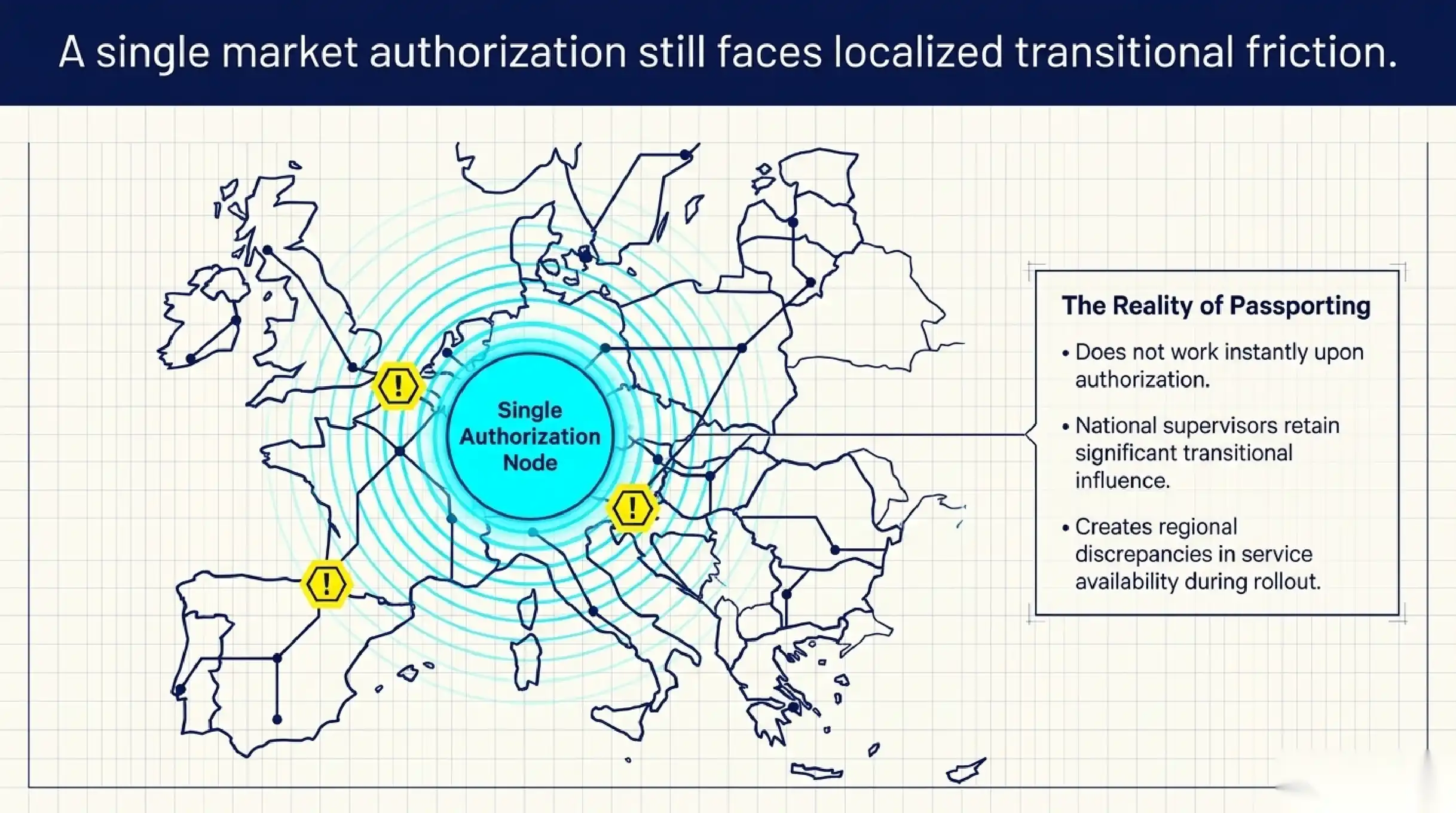
One of the main promises of the regime is the ability to operate across the whole region on the basis of a single authorization instead of a dozen separate licenses. For a venue this lowers the cost of entering new countries, and for the client it means that a service available in one country is more likely to be available in a neighboring one on the same terms. The single market stops being a slogan and becomes a practical possibility.
In practice passporting does not work instantly or without friction. National supervisors keep their influence, and transitional provisions are stretched over time. So it helps the client to understand that the availability of a service in a specific country may depend not only on the general regime but also on whether the venue completed the formalities with the local supervisor.
Custody and segregation of assets
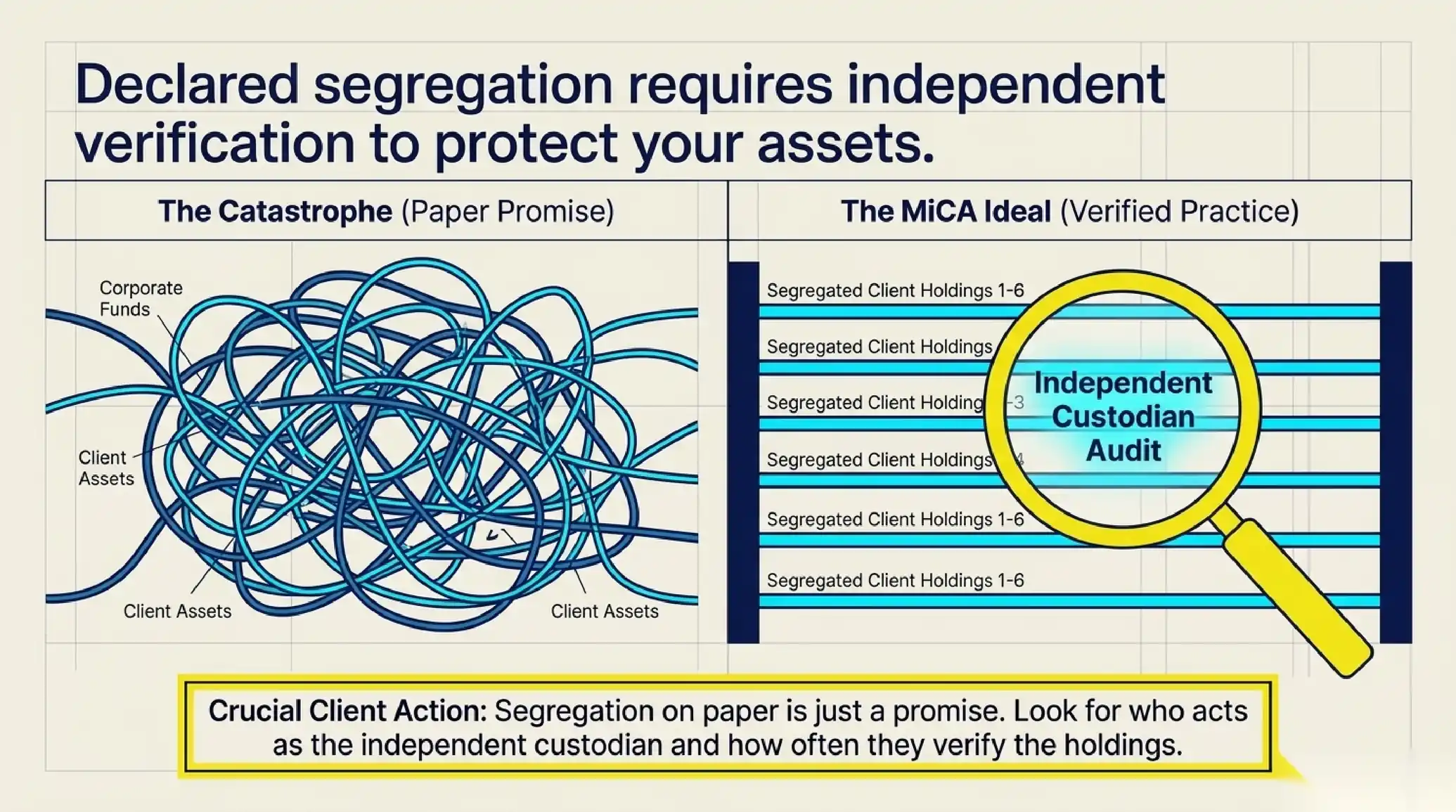
The regime pays notable attention to how a venue holds client funds and separates them from its own. This is a key question, because it was precisely the mixing of client and corporate money that turned past collapses into catastrophes for users. Segregation of assets means that if the venue itself runs into trouble, client funds are more likely to be recoverable.
However, segregation on paper and segregation in practice are not the same thing. It helps the client to understand where the assets are actually held, who acts as custodian and how often this is checked. A statement about segregation without independent verification remains a promise rather than protection. The sensible approach is to look at how a company confirms segregation, not only at the fact that it declares it.
Disclosure and white papers
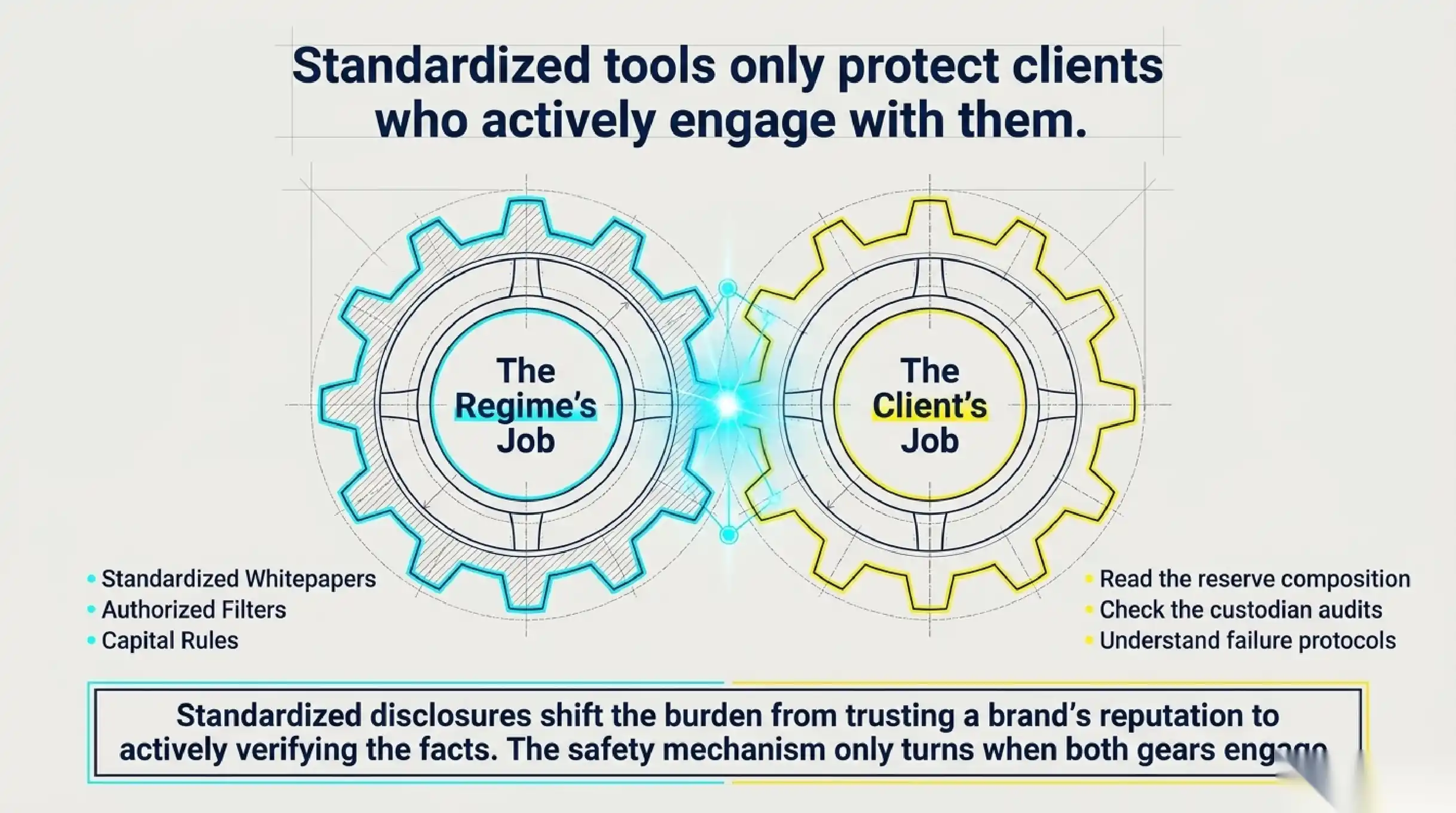
The regime requires issuers and venues to disclose key information in a standardized form resembling a prospectus. The idea is that a client can compare products by the same parameters rather than decoding a new marketing language every time. Standardized disclosure is a quiet but important change, because it shifts the burden from trust in a brand toward verification of facts.
The problem is that disclosure is useful only when it is read. A standard form lowers the barrier but does not remove the need to study the details: the composition of reserves, redemption rights, the order of actions in a failure. A client who flips through disclosure without looking loses the main advantage of the regime. The value of the rules appears only in combination with careful reading.
What the regime still does not cover
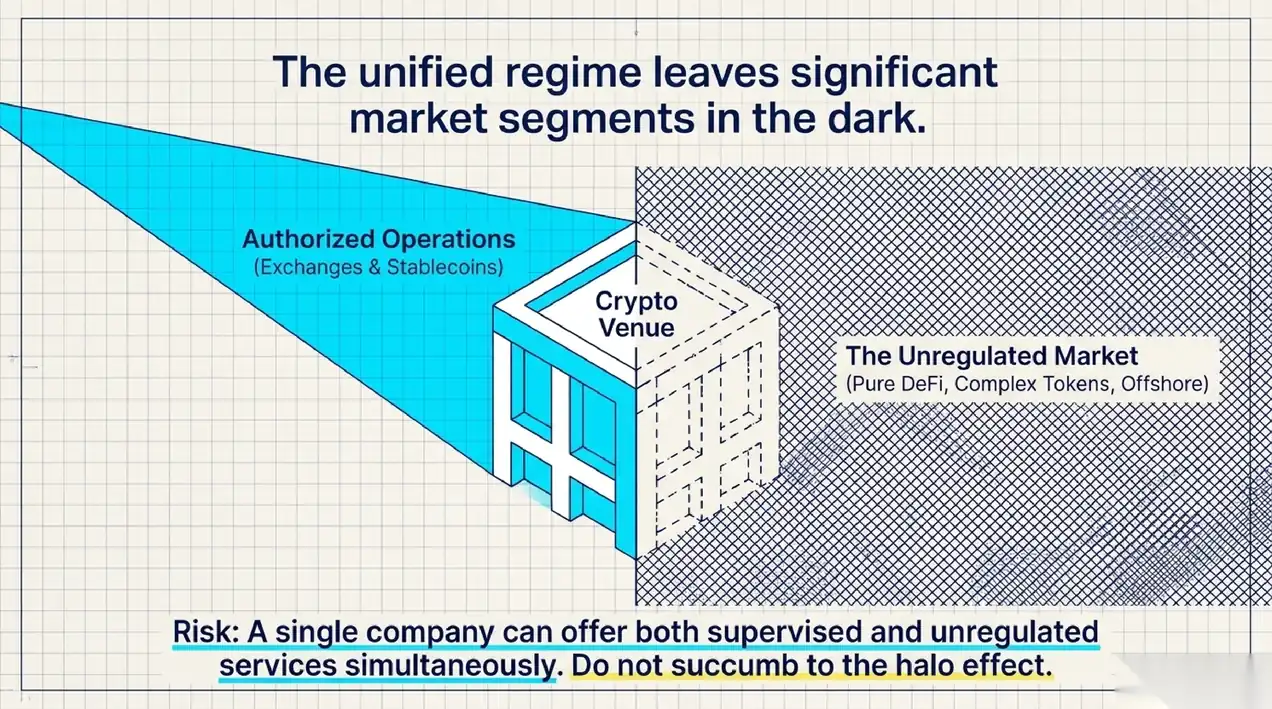
It is important to understand the limits of the regime, because a notable part of the market remains outside it. Purely decentralized protocols, some kinds of tokens and activity outside the region are not fully covered or not covered at all. A client who believes the single regime protects any operation with crypto assets overestimates their protection.
So it helps to separate what happens under the supervision of an authorized venue from what happens in the unregulated part of the market. The same company may offer both, and client protection differs sharply between these segments. Understanding the boundary, rather than a general feeling of being regulated, defines the real level of risk.
How the regime affected fees and costs
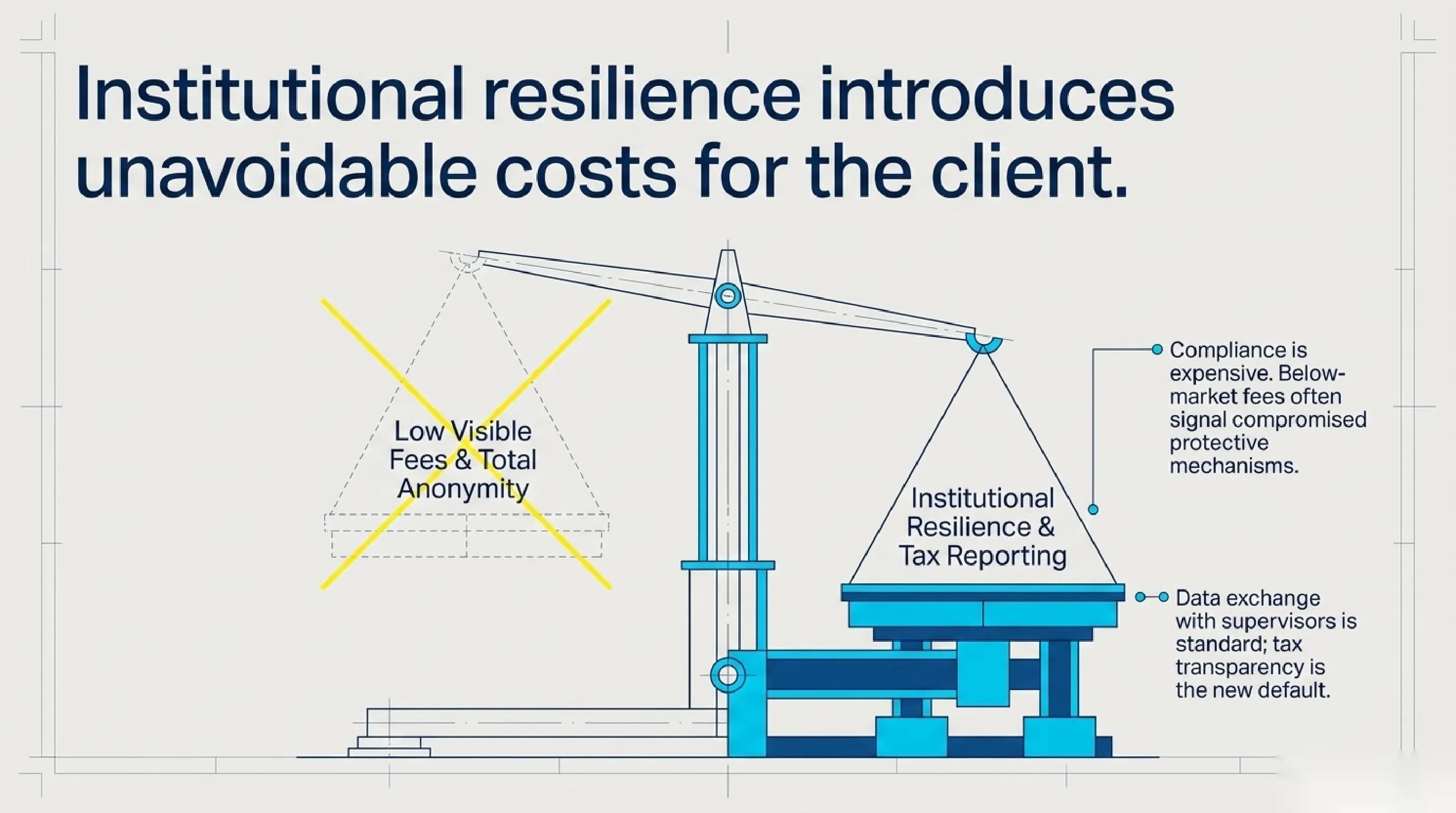
Compliance with the single rules costs money, and these costs sooner or later reach the client. Authorization, reserve audits and constant reporting require resources, and some smaller players either left the market or merged with larger ones. For the client this has a double effect: less choice at the edge of the market, but on average more resilient counterparties.
It helps to understand that a low fee does not always mean a good deal. If a venue charges noticeably less than the market, it is worth asking how it covers the cost of compliance. Sometimes the answer is harmless, and sometimes it means the company is saving precisely on protective mechanisms. A sensible client looks at the full cost of the service, not only at the visible tariff.
Reporting and tax transparency
The single regime strengthened data exchange between venues and supervisors, and indirectly this touches tax transparency. Client operations are more often recorded in a form that can be passed to tax authorities, and this changes the expectations of those who used to treat crypto operations as invisible.
For the client this means reporting stops being voluntary and becomes part of normal work with a legal venue. This is inconvenient for those who valued anonymity, but it lowers the risk of late claims and penalties. It helps to understand in advance what information the venue passes on and how it relates to the client’s own obligations.
Marketing and yield promises under the new rules
The regime limits how a venue can advertise its products, especially when it comes to yield. Promises of guaranteed returns without a clear disclosure of risks are now harder to pass off as a safe product. For the client this is protection from the most aggressive advertising that used to mask risk as stable earnings.
However, limits on advertising do not abolish the creativity of marketers. Promises may become softer in form but not disappear in substance. So it helps the client to read not only the bright part of the message but also the caveats, where the real risk is most often hidden. The regime made the language more honest but did not remove the need to think.
How to tell formal compliance from mature compliance
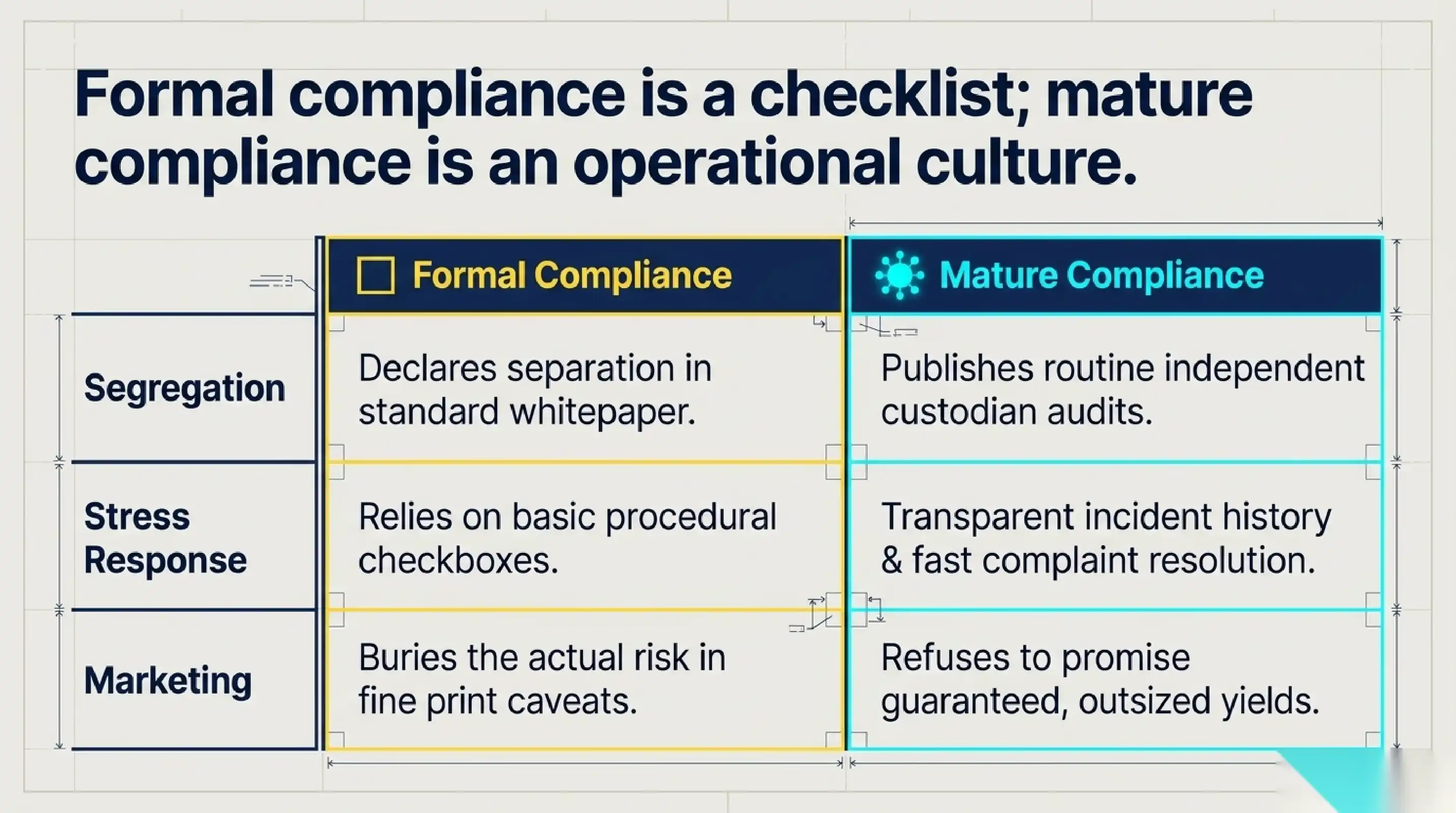
A venue can formally satisfy every point and still treat them as a formality. The difference between a checkbox in a form and a mature risk culture is visible not in documents but in behavior: how quickly a company answers complaints, how it behaves under stress and how it discloses problems.
It helps the client to look at indirect signs of maturity: a transparent history of incidents, clear answers to uncomfortable questions and a willingness to admit limitations. Formal compliance is easy to buy, maturity accumulates over years. It is this difference, rather than the fact of authorization itself, that most often defines how comfortable and safe the client will be over the long run.
What it means for the client in practice
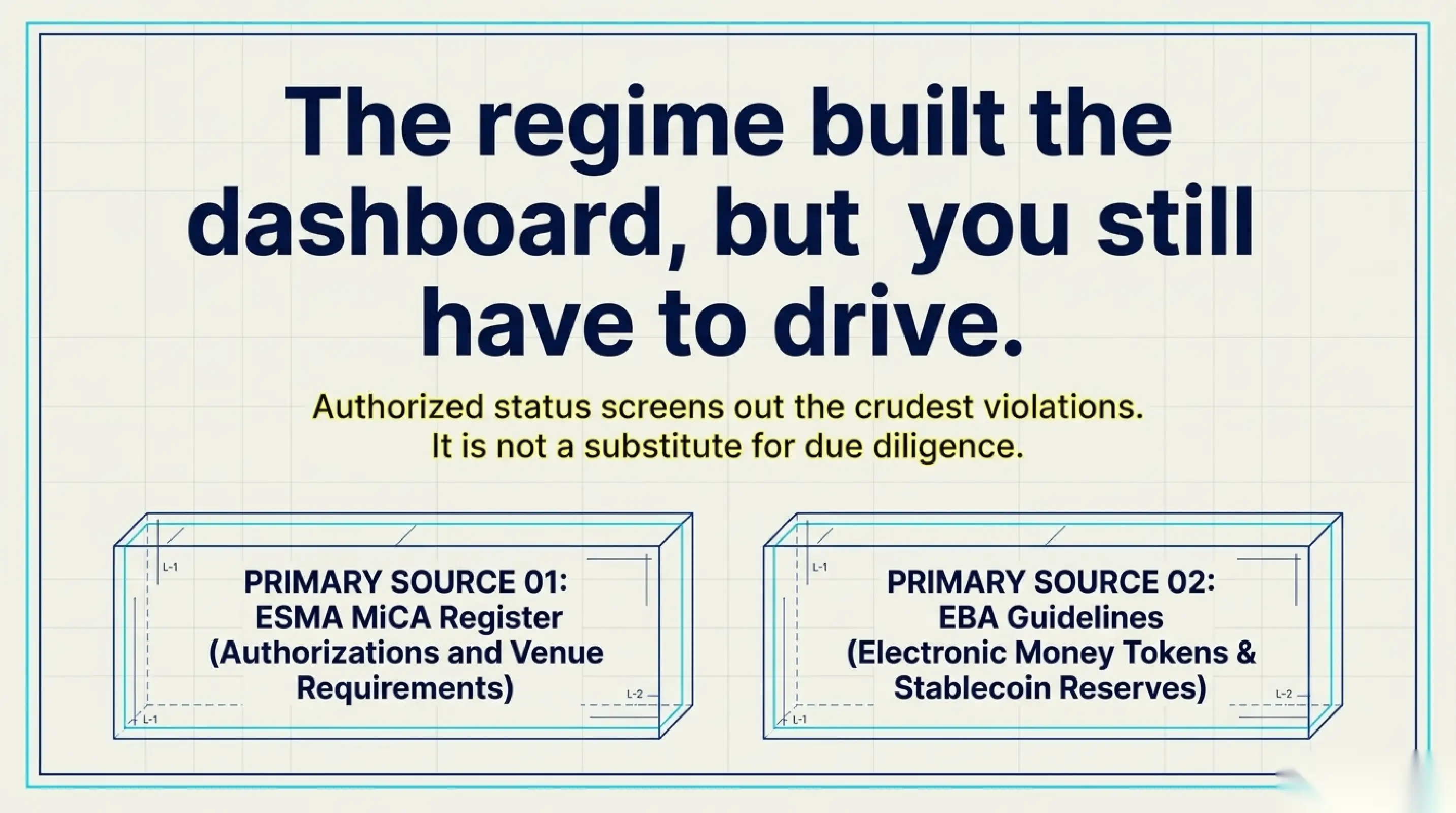
A year later the main practical conclusion is that the regime made the market more predictable but did not relieve the client of the duty to look closely. Authorized status is best treated as a filter that screens out the crudest violations, not as a mark of quality that removes the need for checks. The difference between venues within the regime is still large.
The sensible strategy is to use disclosure and status as a starting point and then to verify specific things: how funds are segregated, which coins are supported and on what terms, what happens in a failure or a withdrawal of authorization. The regime gave the client tools, but using them is still up to the client.
Examples and sources
The primary source on the regime is the MiCA page at ESMA, which gathers the requirements for venues and the register of authorizations. Questions on stablecoins and reserves are covered further by the EBA, which is responsible for part of the rules on electronic money tokens.