 Base
Base Unichain
 Robinhood
- Smart contracts on Ethereum cannot efficiently access historical blockchain data or run heavy mathematical calculations due to extreme gas costs.
- ZK coprocessors move heavy data queries off-chain, compute the results, and generate a succinct cryptographic zero-knowledge proof.
- The smart contract verifies this tiny proof on-chain for a fraction of a cent, trusting the result with mathematical certainty.
- Projects like Axiom and Brevis enable dynamic DeFi interest rates, trustless loyalty programs, and complex on-chain identity systems.
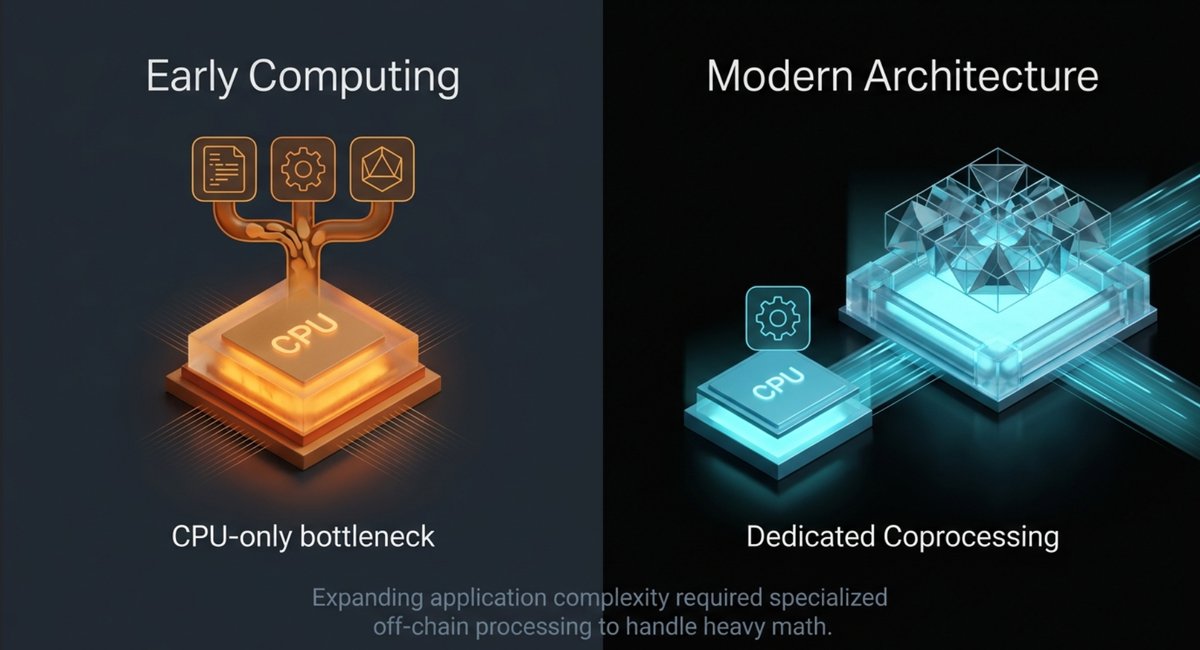
In the early days of personal computing, the central processing unit (CPU) handled every single calculation, from basic text processing to rendering graphical lines on a display. As applications grew more sophisticated, computers began struggling with heavy workloads like 3D gaming and video encoding. The industry solved this problem by introducing dedicated coprocessors: Graphics Processing Units (GPUs) that offloaded heavy graphical math from the CPU, allowing each processor to excel at its specialized task.
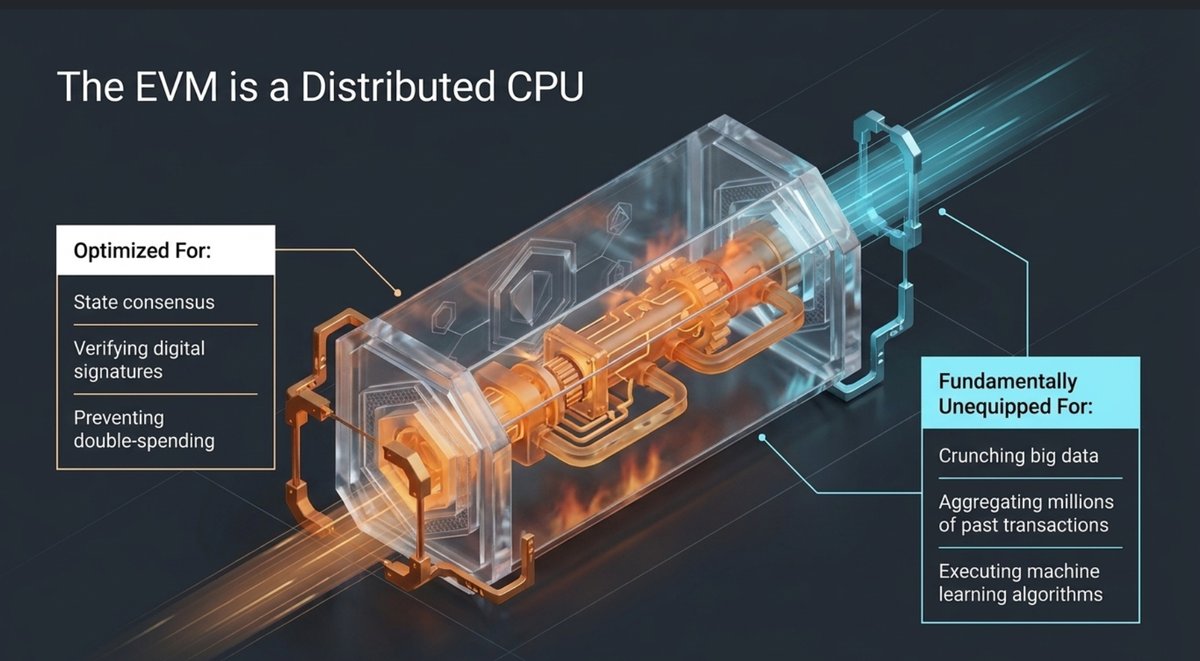
Decentralized applications are currently reaching an identical architectural turning point. The Ethereum Virtual Machine is effectively a global distributed CPU. It was designed to maintain real-time state consensus, verify digital signatures, and prevent double-spending. It was never engineered to crunch big data, aggregate millions of past transactions, or execute machine learning algorithms. ZK coprocessors represent the GPU moment for Web3, providing smart contracts with a trustless, scalable mechanism to query historical data and perform heavy computations without gas exhaustion.
The Blind Spot of On-Chain Smart Contracts
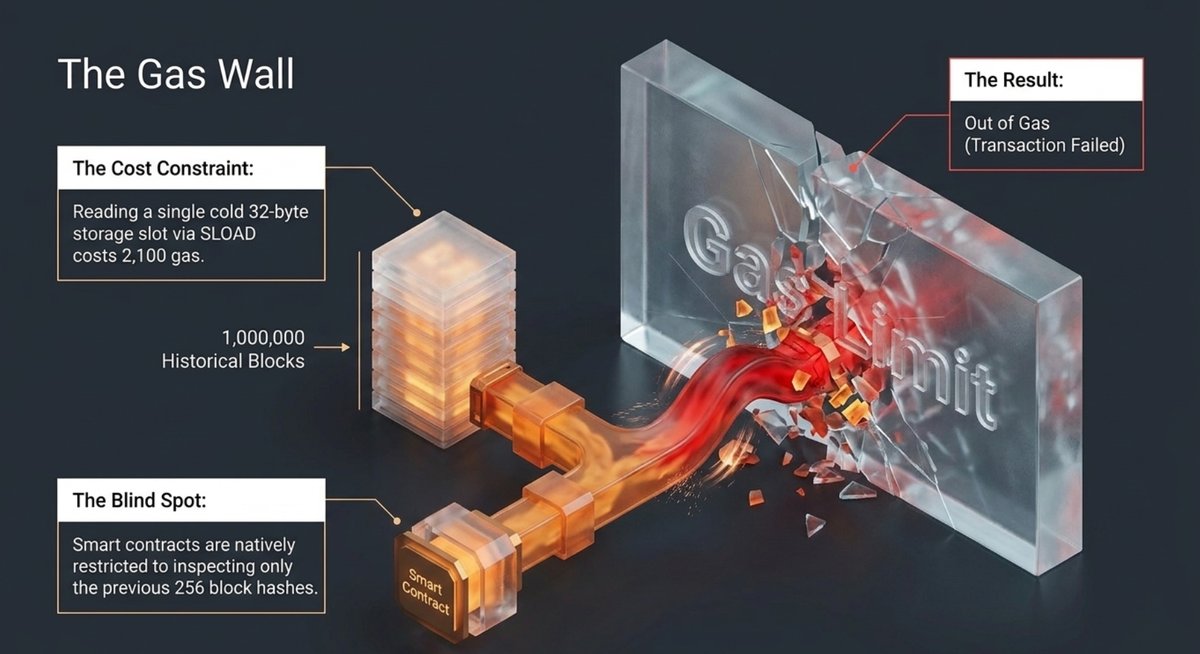
To understand why ZK coprocessors are essential, one must look at the strict constraints imposed by on-chain execution environments. In Solidity, reading a single 32-byte storage slot using the SLOAD opcode costs 2,100 gas if the data is cold. If a developer wants to write a DeFi lending protocol that calculates a user's borrowing interest rate based on their average wallet balance over the past twelve months, the contract would need to query hundreds of thousands of historical blocks.
On-Chain Attempt (Impractical):
Smart Contract ---> Loop through 1,000,000 blocks ---> Hits Gas Limit (Out of Gas)

With ZK Coprocessor (Scalable):
Smart Contract ---> Requests Historical Query ---> ZK Coprocessor (Off-Chain Engine)
                                                         |
Smart Contract <--- Verifies Proof (< 100k Gas) <--------+ Computes Math + Generates ZK Proof
Executing such a loop on-chain would cost tens of thousands of dollars in transaction fees, quickly exceeding the Ethereum block gas limit and causing the transaction to fail. Furthermore, the EVM does not even retain historical storage states within its readily accessible execution environment; nodes maintain archival state, but smart contracts can only natively inspect the block hash of the previous 256 blocks.
Consequently, smart contract developers have historically been blind to the past. They could only build applications that react to the immediate present: current balances, current prices, and single isolated events.
How a ZK Coprocessor Works: Compute Off-Chain, Verify On-Chain
A ZK coprocessor breaks this bottleneck by shifting the heavy computational burden off-chain while using zero-knowledge cryptography to retain complete decentralization and trustlessness. The workflow operates in four coordinated phases, as documented by protocols like Axiom and Brevis:
- Data Access and Extraction: The coprocessor ingests historical blockchain data directly from archive nodes, including past transaction receipts, event logs, and account storage roots.
- Off-Chain Computation: The coprocessor runs the required calculations off-chain in a specialized computing environment. This could involve averaging a trader's volume across two years, verifying that a user held an NFT during a specific snapshot, or calculating an on-chain credit score.
- ZK Proof Generation: The engine generates a zero-knowledge proof (typically a SNARK or STARK). This cryptographic proof mathematically demonstrates that the calculation was executed faithfully against authentic, historical block headers signed by Ethereum consensus.
- On-Chain Verification: The proof and the final computational output are submitted back to the user's smart contract on Ethereum or an L2. The smart contract runs a lightweight verification contract, consuming less than 100,000 gas, and accepts the result as absolute truth.
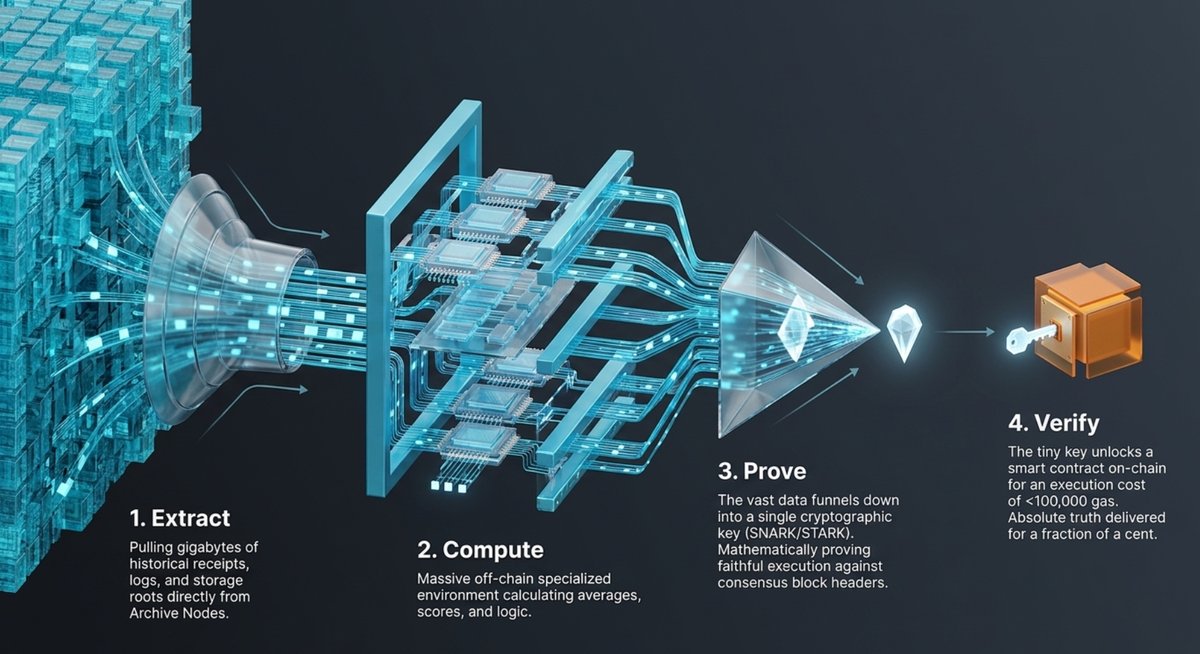
ZK coprocessors allow smart contracts to compute over gigabytes of historical data without paying the EVM a single cent for redundant execution.
Trustless Verification Versus Centralized Oracles
Before the emergence of ZK coprocessors, developers wanting to leverage historical data relied on centralized off-chain servers or traditional oracle networks. A centralized server would watch the blockchain, calculate the user's statistics in a private database, and sign an authorization message.
While functional, this approach completely undermines the trustless premise of Web3. If the server is hacked, misconfigured, or coerced, it can sign false data, allowing bad actors to drain protocol funds. Traditional multisig oracles mitigate this slightly by introducing committee voting, but they still rely on human and economic trust assumptions.
In stark contrast, a ZK coprocessor relies strictly on mathematics. The validity of a SNARK proof does not depend on who generated it. Even if the operator of the ZK coprocessor is malicious, it is cryptographically impossible for them to produce a valid proof for an incorrect mathematical result. The smart contract verifies the proof against Ethereum's own historical block roots, achieving absolute data integrity without trusted third parties.
Concrete Implementation Patterns in Modern Protocols
To grasp how developers interact with ZK coprocessors in production, consider a real-world example using the Axiom SDK. In a traditional smart contract, calculating a user's trading volume requires either emitting thousands of event logs that the contract can never read back, or writing custom storage logic that updates a persistent storage variable on every single swap, multiplying gas costs for end users.
With a ZK coprocessor architecture, the on-chain swap contract remains lightweight: it simply executes the swap without maintaining historical counters. When the protocol hosts an annual reward distribution, a script queries the ZK coprocessor off-chain with a simple declarative query:
// Conceptual off-chain query definition
const query = new AxiomQuery();
query.setHistoricalContract(UNISWAP_POOL_ADDRESS);
query.filterEvent("Swap", { recipient: userAddress });
query.aggregateSum("amountUSD", { fromBlock: 18000000, toBlock: 20000000 });
const { result, zkProof } = await query.computeAndProve();
The coprocessor processes millions of blocks off-chain, generates a succinct SNARK proof, and returns both the calculated sum and the proof. The user presents this bundle to the protocol's claim contract on-chain. The claim contract verifies the proof against Ethereum's historical block header roots in a single execution step, confirming the user's exact eligibility in milliseconds.
Comparing ZK Coprocessors to Web3 Indexers
It is critical to distinguish ZK coprocessors from popular indexing services like The Graph. Traditional indexers ingest blockchain logs, parse them into relational SQL databases, and serve them to web frontends via GraphQL APIs. While indexers are indispensable for displaying user interfaces, their data cannot be trusted directly by smart contracts because standard indexer databases lack cryptographic validity proofs.
ZK coprocessors bridge this gap between database analytics and smart contract execution. By producing cryptographic proofs of every relational query, coprocessors allow on-chain smart contracts to consume indexed data with the exact same trust guarantees as on-chain consensus.
Unlocking New Possibilities in Decentralized Applications
By giving smart contracts access to rich historical data, ZK coprocessors transform what developers can build:
- Dynamic DeFi Parameters: Lending protocols can offer personalized interest rates or lower collateral requirements to borrowers who have maintained healthy loan-to-value ratios across multiple market cycles.
- Gasless Loyalty and Rewards: dApps can reward their most committed users based on comprehensive historical interaction volume without forcing users to stake tokens or lock assets in advance.
- Trustless On-Chain Governance: DAOs can allocate voting power weighted by a member's continuous, multi-year participation across governance forums and liquidity pools, eliminating sudden flash-loan governance attacks.
- Verifiable Autonomous Accounting: Corporate treasuries can generate cryptographic audit reports proving solvency and historical tax compliance without publishing their entire transaction history to competitors.
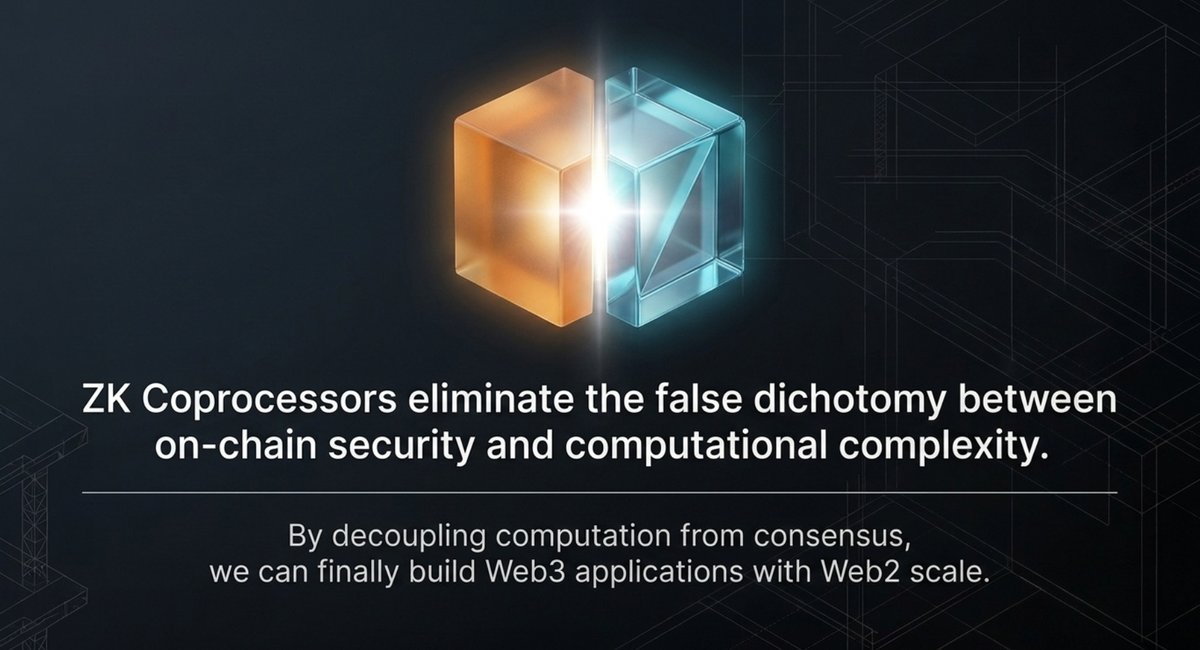
ZK coprocessors eliminate the false dichotomy between on-chain security and computational complexity. By serving as high-performance cryptographic auxiliary processors, they empower developers to build sophisticated, data-driven applications that retain the uncompromising security guarantees of decentralized networks.